Jewish art at The Metropolitan Museum of Art can be found across thousands of years of history, from ancient objects decorated with menorahs and shofars to elaborate Torah ornaments, Passover Judaica and works inspired by the Hebrew Bible.
Visitors sometimes expect to find a single gallery labeled “Jewish Art.” In reality, Jewish objects at The Met are distributed across several curatorial departments because they belong simultaneously to the histories of religion, archaeology, decorative arts, medieval culture, European art and the Islamic world.
This makes exploring Jewish art at The Met especially interesting.
Rather than representing Jewish culture as an isolated artistic tradition, the museum’s collection demonstrates how Jewish communities lived and created art within many different civilizations.
Does The Metropolitan Museum of Art Have a Jewish Art Collection?
The Met owns important examples of Judaica and Jewish art, but they are not organized into one independent Jewish-art department.
Jewish objects appear in different parts of the museum depending on where and when they were created.
For example, Jewish works can be associated with departments devoted to:
- European Sculpture and Decorative Arts
- Medieval Art
- Islamic Art
- Ancient art
- Works on paper and manuscripts
This arrangement reflects an important reality of Jewish art history.
Jewish communities lived throughout Europe, the Middle East, North Africa and other regions, often adapting local materials and artistic styles while creating objects for Jewish religious and cultural purposes.
What Kind of Jewish Art Can You Find at The Met?
The Metropolitan Museum of Art’s collection includes Jewish ceremonial objects, archaeological material and works connected with biblical subjects.
Examples include:
- Torah crowns
- Torah finials
- Torah pointers
- Passover Seder plates
- Ketubot
- Spice containers
- Ancient Jewish glass
- Objects decorated with menorahs and shofars
- Jewish manuscripts and book decoration
- Objects connected with Jerusalem and the Temple
Together, these objects show that Jewish visual culture extends far beyond painting.
What Is Judaica?
Judaica generally refers to objects connected with Jewish religion, tradition and culture.
Some Judaica objects are used directly in religious practice.
Others are decorative objects inspired by Jewish symbols and history.
Common forms of ceremonial Judaica include Torah ornaments, menorahs, Kiddush cups, mezuzah cases, spice boxes, Shabbat candlesticks, Seder plates and ketubot.
You can learn more in our guide to Judaica art, symbols and Jewish traditions.




Ancient Jewish Art at The Met
Some of the most fascinating Jewish objects at The Met date from antiquity and the early Byzantine period.
These works are important because they challenge the common assumption that ancient Jewish visual culture contained few images.
Archaeological objects reveal menorahs, Torah arks, shofars, lulavs and other Jewish symbols appearing on glass, lamps, plaques, seals and other materials.
Ancient Jewish Glass
The Met owns examples of ancient glass associated with Jewish communities.
One particularly important group includes vessels decorated with familiar Jewish symbols.
These objects demonstrate how recognizable Jewish imagery was incorporated into everyday and ceremonial material culture centuries ago.
The museum’s collection includes Jewish glass vessels dating to the sixth and seventh centuries CE.
The Menorah in Ancient Jewish Art
The menorah became one of the most recognizable Jewish symbols of antiquity.
It appears on archaeological objects from Jewish communities throughout the Roman and Byzantine worlds.
Ancient artists represented the menorah alongside other religious symbols, including the shofar, lulav and Torah ark.
These surviving images are especially valuable because they show how Jewish communities represented their identity visually.
Ancient Jewish Symbols at The Met
An object at The Met may appear simple until its decoration is examined closely.
A glass vessel, lamp or fragment may contain symbols such as:
- Menorah
- Shofar
- Lulav
- Etrog
- Torah ark
- Temple-related imagery
To a modern viewer, these same symbols are still immediately recognizable as Jewish.
That continuity makes ancient Judaica especially compelling.
Jewish Art and the Jerusalem Temple
The Jerusalem Temple has been represented in Jewish and non-Jewish visual culture for centuries.
The Met even owns an elaborate 19th-century architectural model representing the Temple of King Solomon in Jerusalem.
Created in London in 1883, the model reflects how later generations attempted to visualize the biblical Temple through historical research and artistic imagination.
Like modern Temple paintings, such reconstructions should not be interpreted as exact archaeological records.
They reveal how artists and scholars in their own periods imagined one of the most important structures in biblical history.
Explore Alex Levin’s Jerusalem Temple paintings.
Torah Art at The Metropolitan Museum
Some of The Met’s most impressive Jewish ceremonial objects were created to honor and protect the Torah scroll.
Jewish communities developed elaborate artistic traditions surrounding Torah decoration.
These objects could be made from silver, textiles, wood and other precious materials.
They demonstrate the Jewish concept of enhancing a mitzvah through beauty.
Torah Crowns
A Torah crown, or keter Torah, is placed above a Torah scroll as a symbol of the Torah’s spiritual royalty.
The Met owns elaborate silver examples created by European Jewish communities.
These crowns can contain architectural forms, floral decoration, Hebrew inscriptions and imagery connected with Jewish religious tradition.
The combination of religious meaning and sophisticated metalwork makes Torah crowns important examples of Jewish decorative art.
Torah Finials – Rimonim
Rimonim are ornamental finials placed over the wooden rollers of a Torah scroll.
The Hebrew word rimon means pomegranate.
Depending on community and period, Torah finials can vary dramatically in appearance.
The Met’s collection includes silver examples influenced by the local artistic traditions of the places where Jewish communities lived.
This illustrates an important characteristic of Judaica: Jewish purpose and local artistic style frequently exist within the same object.
The Yad – Torah Pointer
A yad is a pointer used while reading from a Torah scroll.
The Hebrew word yad means “hand,” and many Torah pointers end in a miniature sculpted hand with an extended finger.
The object allows the reader to follow the text without unnecessarily touching the parchment.
Even this practical object became an opportunity for Jewish artistic craftsmanship.
The Met continues to acquire examples of Judaica, including a silver Torah pointer attributed to Iran or North Africa and dated from the late 19th to mid-20th century. :chatgpt-content-reference{index=”1″}
Jewish Art From Italy
Italy produced an extraordinary tradition of Jewish ceremonial art.
Jewish communities in Venice, Rome, Turin and other cities commissioned Torah ornaments, marriage contracts and ritual objects from highly skilled craftsmen.
These works often combined specifically Jewish symbols and Hebrew inscriptions with decorative styles fashionable in Italian art at the time.
The result is art that is simultaneously Jewish and unmistakably connected with the broader history of Italian design.
Italian Torah Silver at The Met
The Met owns significant examples of Italian Torah ornaments.
Silver Torah crowns and finials could include decorative elements derived from contemporary European styles alongside menorahs, Tablets of the Law and other Jewish imagery.
Such objects demonstrate how Jewish patrons participated in the artistic culture surrounding them while commissioning objects specifically for synagogue use.
A Passover Seder Plate at The Met
Passover Judaica provides another excellent example of Jewish ceremonial art.
The Met owns a silver Passover Seder plate created by Jewish silversmith Israel Lattes in Turin in 1824.
The object combines the practical requirements of the Passover Seder with the decorative metalwork traditions of early 19th-century Italy.
The museum currently identifies this Seder plate as being on display at The Met Fifth Avenue, although gallery installations can change and visitors should verify current availability before visiting. :chatgpt-content-reference{index=”2″}
Learn more about Passover imagery in our guide to Passover art and paintings.
Jewish Spice Containers – Besamim
The Havdalah ceremony at the conclusion of Shabbat includes fragrant spices.
Beautiful containers known as besamim boxes developed to hold these spices.
The forms can be surprisingly imaginative.
The Met owns an Austrian silver spice container from 1813 shaped like a fish. Its hinged head opens to reveal the interior, while Hebrew elements connect the decorative object with Jewish ritual.
The museum currently lists this object as on view at The Met Fifth Avenue. :chatgpt-content-reference{index=”3″}
Jewish Marriage Art – The Ketubah
A ketubah is a Jewish marriage contract.
Although the text has a legal and religious function, ketubot have also developed into one of the richest traditions of Jewish decorative art.
Artists have surrounded the text with architectural borders, flowers, biblical imagery, Jerusalem scenes and intricate calligraphy.
The Met’s Judaica holdings include ketubot originating in Jewish communities from different geographic regions.
This tradition continues today, with many contemporary couples commissioning highly artistic ketubah designs for their weddings.
Jewish Wedding Art and Judaica
The ketubah demonstrates something important about Jewish art.
Beauty is often integrated into ordinary Jewish life rather than separated into an art object viewed only in a museum.
A document required for marriage can also become an artwork displayed in the home for decades.
The same principle applies to menorahs, Seder plates, Torah ornaments and other ceremonial Judaica.
Read more about Jewish wedding traditions and art.
Jewish Art From the Islamic World
Jewish communities lived for centuries throughout the Middle East and North Africa.
Their artwork frequently reflects the artistic environments of those regions.
The Met’s departmental organization makes this history particularly visible.
Some Jewish objects belong to the museum’s Islamic Art department because they were created within societies whose dominant artistic culture was Islamic.
They remain Jewish objects while also belonging to the larger material history of those regions.
What Jewish Art Tells Us About the Diaspora
Jewish art is rarely isolated from its surroundings.
A Torah ornament from Italy may incorporate Italian decorative forms.
A Jewish object from North Africa may reflect local metalworking traditions.
An Eastern European Judaica object may resemble the architecture or ornament of that region.
These differences tell the story of the Jewish diaspora visually.
The religious purpose may remain recognizable while materials, decoration and craftsmanship change from country to country.
Jewish Art and the Hebrew Language
Hebrew text frequently becomes part of the artwork itself.
Torah ornaments, ketubot and ceremonial objects may include blessings, biblical quotations, dedications or the names of donors.
Hebrew therefore functions simultaneously as language and visual design.
This relationship remains important in modern Jewish art, where artists often incorporate Hebrew letters into paintings and abstract compositions.
Learn more about Hebrew art, letters and Jewish visual culture.
Biblical Art at The Met
The Met also contains an enormous number of artworks depicting stories from the Hebrew Bible.
These should not automatically be classified as Jewish art.
Many were created by Christian artists for Christian audiences.
Nevertheless, they provide an important record of how stories involving Moses, David, Solomon, Abraham and other biblical figures were interpreted visually across different cultures.
This distinction matters.
A painting depicting Moses is biblical art, but whether it should also be described as Jewish art depends on its creator, context, purpose and interpretation.
Moses in Western Art
Moses became one of the most frequently represented figures from the Hebrew Bible in European art.
Artists portrayed the burning bush, confrontation with Pharaoh, crossing of the Red Sea, receiving the commandments at Sinai and other moments from his life.
These works demonstrate how Jewish scripture influenced the entire history of Western art.
For a specifically Jewish perspective on the subject, read our guide to Moses in art and paintings of the Exodus.
King David in Art
King David also became an enormously important subject for artists.
He appears as shepherd, musician, warrior and king.
His association with Jerusalem and the Psalms gave artists many different ways to interpret the same biblical personality.
Ancient, medieval and Renaissance artists approached David very differently, demonstrating how biblical figures can continually be reinterpreted.
Jerusalem in The Met’s Collection
Jerusalem appears throughout The Met’s collection in maps, models, archaeological objects, photographs, biblical scenes and works connected with religious history.
The city has been imagined by artists who visited it and by artists who never saw it personally.
Historical representations often reveal as much about the artists’ own cultures as they do about Jerusalem itself.
Explore our guide to ancient Jerusalem art and historical paintings.
The Jerusalem Temple in Art
The Temple provides a particularly interesting case because artists must reconstruct a building that no longer survives intact.
Biblical descriptions, historical sources, archaeology and imagination have all influenced artistic representations.
The Met’s 1883 model of Solomon’s Temple demonstrates the continuing fascination with reconstructing sacred architecture. :chatgpt-content-reference{index=”4″}
Modern Israeli artists continue this tradition while incorporating current archaeological and architectural research.
Jewish Art Is More Than Religious Art
Jewish art should not be limited to ritual objects.
Modern Jewish artists have addressed migration, family, identity, antisemitism, Israel, the Holocaust, memory and contemporary life.
Some works contain obvious Jewish symbols.
Others have no menorah, Torah or Hebrew lettering at all.
The connection to Jewish experience may emerge through the artist’s biography, historical context or subject.
Read our broader guide to Jewish art through history.
Modern Jewish Artists
The history of Jewish art extends far beyond Judaica.
Jewish artists became major participants in modern painting, sculpture, abstraction and contemporary art.
Artists including Marc Chagall, Amedeo Modigliani, Chaim Soutine, Mark Rothko, Louise Nevelson, Lee Krasner, Eva Hesse and Judy Chicago worked in very different visual languages.
Their careers demonstrate why Jewish art cannot be reduced to a single style.
Read our guide to famous Jewish artists and painters.
How Is Museum Judaica Different From Contemporary Jewish Art?
Historical Judaica was often created for a specific ritual purpose.
A Torah pointer helped someone read from the scroll. A Seder plate held symbolic foods. A ketubah served as a marriage document.
Contemporary Jewish artwork may have no ceremonial function at all.
A modern painting of Jerusalem, Shabbat or the Torah can exist primarily as fine art while still carrying Jewish cultural or spiritual meaning.
That distinction allows Jewish visual culture to include both ritual craftsmanship and contemporary art.
Contemporary Jewish Art Today
Today’s Jewish artists continue to reinterpret subjects that appear throughout museum collections.
Jerusalem, Torah, Hebrew letters, Jewish holidays and biblical narratives remain active artistic subjects.
The difference is often the visual language.
Traditional silverwork may become acrylic or mixed media. Hebrew letters may become abstraction. Jerusalem may be represented through fragmented geometry rather than realistic architecture.
Explore Alex Levin’s Contemporary Jewish Art collection.
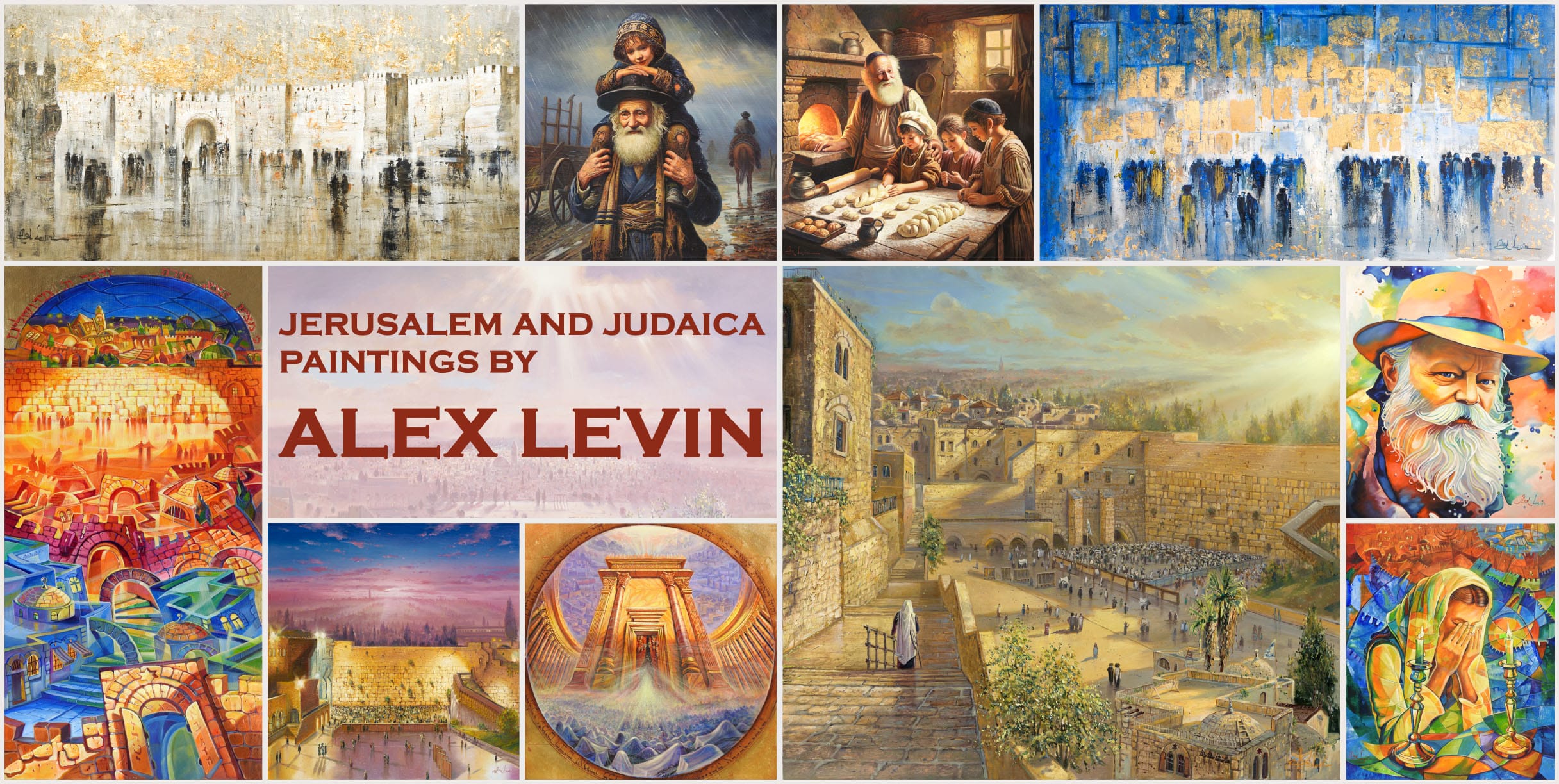
Jewish Art by Alex Levin
Israeli artist Alex Levin works within the continuing tradition of Jewish visual art while primarily using painting rather than ceremonial objects.
His subjects include Jerusalem, Jewish life, Torah study, Shabbat, the Jerusalem Temple, Jewish holidays, biblical figures and contemporary Jewish symbolism.
Some works are realistic and historical.
Others combine Hebrew letters, abstract forms, symbolic light and Jerusalem architecture.
This combination demonstrates how subjects visible in museums can continue to evolve within living Jewish art.
From Museum Judaica to Jewish Art in the Home
Museum collections preserve exceptional examples of Jewish material culture, but Jewish art was never intended to exist only behind glass.
Many historical Judaica objects were created for synagogues and homes.
They were used during Torah reading, Shabbat, Passover, weddings and other parts of Jewish life.
Contemporary Jewish paintings can continue that relationship between art and everyday Jewish identity.
Explore Judaica and Jewish Art by Alex Levin
Planning a Visit to See Jewish Art at The Met
If Jewish art is a major reason for your visit, research individual objects on The Met’s website before arriving.
The museum’s collection is enormous, and not every object is displayed at the same time.
Gallery installations also change.
Searching The Met’s online collection for terms such as Judaica, Torah, Jewish, menorah, Seder plate, ketubah and Hebrew can help identify works currently relevant to your interests.
Don’t Look for Only One Jewish Gallery
The most important advice is not to expect all Jewish objects to appear together.
A Torah ornament may be located within European decorative arts.
An ancient Jewish glass vessel may appear within medieval or Byzantine galleries.
A Jewish object from the Middle East may belong to Islamic Art.
This distribution may initially seem inconvenient, but it actually illustrates the geographic diversity of Jewish history.
Why Jewish Art at The Met Matters
Jewish art at The Metropolitan Museum of Art demonstrates that Jewish visual culture has always existed in conversation with the wider world.
Jewish communities adopted local materials and artistic techniques while maintaining recognizable traditions, Hebrew language and religious practices.
A Torah crown, Seder plate or spice container can therefore tell several stories simultaneously.
It can tell the story of Jewish religion, the history of a particular community, the artistic traditions of a country and the individual craftsmanship of its maker.
That layered history is what makes Judaica such an important part of the broader story of art.
Frequently Asked Questions About Jewish Art at The Metropolitan Museum of Art
Does The Met have Jewish art?
Yes. The Metropolitan Museum of Art owns Judaica, ancient Jewish objects, Torah ornaments, Jewish ceremonial art and many artworks connected with biblical and Jewish history.
Is there a Jewish art gallery at The Met?
Jewish objects are distributed among several museum departments rather than being limited to one permanent Jewish-art department. Visitors should check The Met’s current online collection and gallery information before visiting.
What Judaica can you see at The Met?
The museum owns objects including Torah crowns and finials, Torah pointers, Seder plates, ketubot, spice containers, ancient Jewish glass and other ceremonial and archaeological material.
Does The Met have Torah art?
Yes. The Met owns Torah ornaments including crowns, finials and pointers created for Jewish communities in different parts of the world.
Does The Met have Passover Judaica?
Yes. The museum owns Passover objects including historical Seder plates. Its collection also contains biblical artwork related to the Exodus.
Does The Met have ancient Jewish artifacts?
Yes. The Met owns ancient and Byzantine-period objects associated with Jewish communities, including glass and other material decorated with symbols such as menorahs and Torah arks.
Does The Met have a model of Solomon’s Temple?
Yes. The Met owns an elaborate architectural model of Solomon’s Temple created in London in 1883. It is a later artistic reconstruction rather than an archaeological model of a surviving building.
Where is Jewish art located inside The Met?
Jewish objects may appear in several galleries and departments depending on their date and geographic origin. Because displays change, visitors should check individual object pages on The Met’s official website before their visit.
What is the difference between Judaica and Jewish art?
Judaica usually refers to objects specifically associated with Jewish religion, ritual and culture. Jewish art is a broader category that can also include painting, sculpture, photography and contemporary works dealing with Jewish identity, history or experience.
Where can I see contemporary Jewish art online?
ArtLevin.com features traditional and contemporary Jewish paintings by Israeli artist Alex Levin, including Jerusalem, Torah, Jewish Life and modern Judaica subjects.