Passover art and paintings bring one of the most important stories in Jewish history into visual form – slavery in Egypt, the Exodus, Moses, the crossing of the Red Sea, matzah, the Passover Seder and the continuing Jewish celebration of freedom.
For centuries, Jewish artists have illustrated the Passover story through illuminated Haggadot, manuscripts, prints, paintings and contemporary Judaica.
Israeli artist Alex Levin approaches Passover through both biblical history and Jewish family tradition. His works include dramatic scenes of Moses leading the Israelites from Egypt, the crossing of the Red Sea and the traditional preparation of matzah.
These subjects connect an ancient story with a holiday still observed in Jewish homes throughout the world.
What Is Passover?
Passover, or Pesach in Hebrew, is the Jewish holiday commemorating the Exodus of the Israelites from slavery in Egypt.
The story appears primarily in the Book of Exodus.
According to the biblical narrative, the Israelites had been enslaved in Egypt when Moses was called to confront Pharaoh and demand their freedom.
After a series of plagues, Pharaoh finally allowed the Israelites to leave. Their departure from Egypt and journey toward freedom became one of the defining narratives of Jewish history.
Passover is celebrated for seven days in Israel and traditionally eight days in many Jewish communities outside Israel.



Why Is Passover Important in Jewish Art?
Passover offers artists an extraordinary variety of subjects.
The holiday contains dramatic biblical events as well as intimate family traditions.
An artist might portray:
- Moses before Pharaoh
- The Ten Plagues
- The Israelites leaving Egypt
- The crossing of the Red Sea
- Moses leading the Jewish people
- Making matzah
- A traditional Passover Seder
- The Seder plate
- The Four Questions
- Reading the Haggadah
- Families celebrating together
- Jerusalem and the hope of return
This allows Passover paintings to range from monumental historical scenes to quiet images of Jewish family life.
The Exodus in Jewish Art
The Exodus from Egypt is the central historical narrative behind Passover.
It is also one of the most visually dramatic stories in the Torah.
The story contains oppression, confrontation, plagues, hurried departure, pursuit, the sea, rescue and the beginning of a journey toward a new future.
Artists have interpreted these events literally, symbolically and through contemporary visual language.
A traditional painting may attempt to reconstruct ancient Egypt and the Israelites’ departure. A modern artist may emphasize light, movement and symbolic forms to express the broader idea of liberation.
Moses in Passover Art
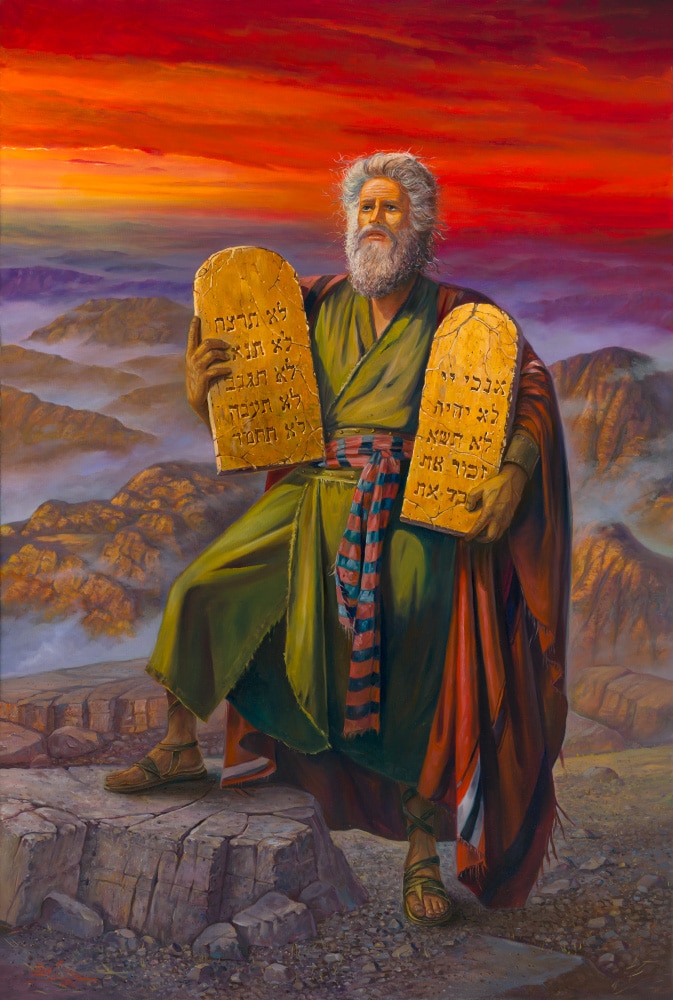
Moses is naturally one of the most recognizable figures in artistic depictions of the Exodus.
Artists have portrayed him confronting Pharaoh, leading the Israelites, raising his staff beside the sea and guiding the people through the wilderness.
In art, Moses can represent leadership, faith, responsibility, freedom and the transition from slavery toward nationhood.
Passover imagery often places him at the center of the visual narrative even though the traditional Haggadah emphasizes that redemption ultimately comes from God rather than presenting Moses simply as a conventional heroic figure.
Explore Alex Levin’s Moses paintings.
You can also read our guide to Moses in art and famous paintings of the Exodus.
Moses Before Pharaoh
The confrontation between Moses and Pharaoh provides artists with a dramatic contrast.
Pharaoh represents imperial power and the determination to maintain control over an enslaved population.
Moses appears before him carrying a very different kind of authority.
In painting, this scene can be portrayed through architecture, clothing, posture and scale.
The grandeur of Pharaoh’s court can make Moses appear physically small while emphasizing the strength of the message he carries.

The Ten Plagues in Passover Art
The Ten Plagues are another important part of the Exodus story.
Blood, frogs, lice, wild animals, livestock disease, boils, hail, locusts, darkness and the death of the firstborn create powerful visual imagery.
Artists may portray individual plagues or combine several into one composition.
The plague of darkness is particularly interesting for painters because it allows dramatic contrasts between light and shadow.
Modern artists may interpret the plagues less literally, using color, fragmented imagery or symbolic forms to suggest chaos and judgment.
The Israelites Leaving Egypt
The moment of departure from Egypt combines relief with uncertainty.
The Israelites have been freed, but their journey has only begun.
Families carry possessions. Children travel beside parents. People leave behind the only environment many of them have ever known.
For an artist, the scene allows a large composition filled with figures moving in the same direction.
The image becomes not simply a departure but a visual representation of an entire people moving from slavery toward freedom.
Crossing the Red Sea in Art
The crossing of the Red Sea is one of the most dramatic scenes in biblical art.
The Israelites find themselves trapped between the pursuing Egyptian army and the sea.
The biblical narrative describes the waters dividing, allowing the Israelites to cross on dry ground.
The Egyptians follow, and the waters eventually return.
This moment provides artists with enormous possibilities – walls of water, frightened families, Egyptian soldiers, dramatic skies and Moses standing at the center of the action.
View Alex Levin’s Moses Crossing the Sea.
Exodus – Moses Crossing the Red Sea
Alex Levin also explores this moment in Exodus – Moses Crossing the Red Sea.
The crossing of the sea represents more than physical escape.
It marks a transition between slavery and a new existence.
This is one reason the scene has remained so powerful in Jewish art. The sea becomes both an obstacle and the path through which freedom becomes possible.
Freedom as the Central Theme of Passover
Passover is fundamentally concerned with freedom.
But the Jewish understanding of freedom is deeper than simply escaping physical slavery.
The Exodus begins a journey toward Sinai, Torah and the formation of a people with responsibilities and obligations.
For artists, this allows the Exodus to become a broader symbol of transformation.
Passover art can therefore speak not only about an ancient historical narrative but also about hope, dignity, perseverance and the possibility of change.
What Is Matzah?
Matzah is unleavened bread eaten during Passover.
The Torah connects matzah with the Israelites’ hurried departure from Egypt. Their dough did not have time to rise before they left.
Matzah is therefore both a food and a symbol.
It recalls slavery and hardship, but also the speed with which freedom finally arrived.
At the Passover Seder, matzah occupies a central position on the table and within the Haggadah ritual.
Making Matzah in Jewish Art
The preparation of matzah has itself become a subject of Jewish art.
Unlike monumental Exodus scenes, a matzah bakery allows an artist to portray Jewish communal life.
People work together preparing dough, rolling it, perforating it and baking it quickly.
The scene can contain movement, concentration and a sense of shared purpose.
Alex Levin captures this traditional atmosphere in Making Matzah.
Making Matzah by Alex Levin
In Alex Levin’s Making Matzah, the focus shifts from ancient Egypt to a Jewish community preserving Passover traditions generations later.
The painting portrays the communal preparation of matzah rather than simply showing the finished food on a Seder table.
This approach connects the ancient Exodus with the everyday work required to preserve Jewish tradition.
The people in the painting are participating in something that generations before them also practiced.
That continuity is one of the recurring themes throughout Levin’s Jewish Life paintings.
What Is the Passover Seder?
The Passover Seder is the ceremonial meal held at the beginning of Passover.
The Hebrew word seder means “order.”
The meal follows an established sequence that includes blessings, symbolic foods, questions, storytelling, drinking wine, eating matzah and retelling the Exodus.
Children have an especially important role because one of the central purposes of the Seder is transmitting the story to the next generation.
This makes the Seder a natural subject for Jewish family art.
The Passover Seder in Jewish Paintings
A Passover Seder painting can bring many visual elements into one composition.
The artist may include:
- The Seder plate
- Matzah
- Wine cups
- Haggadot
- Candles
- Parents and grandparents
- Children asking questions
- Traditional Jewish clothing
- A festive table
The resulting scene is about more than food.
It portrays the transmission of memory from one generation to another.
The Passover Haggadah
The Haggadah is the text used to guide the Passover Seder.
It includes biblical passages, rabbinic interpretation, blessings, songs, questions and the story of the Exodus.
Because the Haggadah is used in the home and often shared by an entire family, it became one of the most artistically decorated forms of Jewish manuscript.
Over many centuries, artists illustrated Haggadot with scenes from Genesis, Exodus, Jewish ritual and contemporary family life.
Famous Passover Art and Illuminated Haggadot
Some of the most famous historical examples of Passover art are not paintings on canvas but richly illuminated Haggadah manuscripts.
These books demonstrate that Jewish artists and patrons were combining religious text with sophisticated visual art centuries ago.
Among the best-known examples are the Golden Haggadah and the Sarajevo Haggadah.
The Golden Haggadah
The Golden Haggadah is one of the great surviving medieval Hebrew manuscripts.
Created in Spain in the early 14th century, it received its modern name from the extensive gold backgrounds used in its illuminated scenes.
Its illustrations include biblical narratives presented in richly decorated panels.
The manuscript demonstrates the artistic sophistication of medieval Jewish book production and the important role visual storytelling could play in the Passover experience.
The Sarajevo Haggadah
The Sarajevo Haggadah is another celebrated illuminated Passover manuscript.
It originated in northern Spain during the second half of the 14th century and contains a remarkable sequence of biblical illustrations.
The manuscript later traveled through Europe and eventually reached Sarajevo, where it became part of the collection of the National Museum of Bosnia and Herzegovina.
Its survival through centuries of upheaval has made the Haggadah itself a powerful symbol of Jewish cultural endurance.
Why Haggadah Art Is So Important
The Passover Haggadah is unusually suited to visual interpretation because the Seder is built around storytelling.
The Torah instructs parents to explain the meaning of the Exodus to their children.
Images can help transform a distant historical narrative into something immediate and memorable.
Medieval artists used manuscript illumination. Later generations used printed illustrations, lithographs and modern graphic design.
Today, artists continue creating Haggadot using photography, abstract art, contemporary illustration and digital media.
The Seder Plate in Passover Art
The Seder plate provides one of the most recognizable still-life subjects associated with Passover.
It holds symbolic foods used during the Seder.
Customs and arrangements can vary, but familiar elements include maror, charoset, karpas, a roasted bone or other commemorative item and an egg.
Each element contributes to the retelling of the Exodus.
For an artist, the Seder plate combines shape, color, food, ritual objects and symbolism within a single composition.
Maror – The Bitter Herbs
Maror, or bitter herbs, represents the bitterness of slavery in Egypt.
It provides an example of how the Seder turns an abstract historical idea into a physical experience.
The participant does not simply hear about bitterness but actually tastes something bitter.
This sensory dimension can be powerful in art as well, where familiar foods represent much larger historical themes.
Charoset
Charoset is a sweet mixture whose ingredients vary among Jewish communities.
Its appearance traditionally recalls the mortar associated with the Israelites’ forced labor in Egypt.
The contrast is striking: a sweet food represents a painful memory.
This type of layered symbolism is one reason the Passover table offers artists so much visual material.
The Four Cups of Wine
Four cups of wine are traditionally associated with the Passover Seder.
They structure different stages of the evening and are often connected with biblical expressions of redemption.
Wine glasses also add strong color and reflected light to Passover paintings.
A painter can use the deep red of wine, white matzah, candlelight and ceremonial silver to create a visually rich Seder scene.
The Four Questions
Children traditionally ask the Four Questions during the Seder, beginning with Mah Nishtanah – “Why is this night different from all other nights?”
The questions encourage the telling of the Exodus story.
Artistically, this provides a beautiful family subject: a child reading or asking questions while parents and grandparents listen.
The scene expresses one of Passover’s central ideas – Jewish memory continues because each generation teaches the next.
Passover and Jewish Children
Children occupy an unusually important place in the Seder.
The Haggadah is structured to encourage questions, curiosity and participation.
Customs such as hiding or searching for the afikoman help keep children engaged.
In Jewish art, children allow a Passover scene to become a story about continuity rather than simply a historical reenactment.
The viewer sees that the Exodus is being remembered thousands of years later within a living family.
Passover in the Shtetl
Passover was celebrated for generations in Jewish communities throughout Eastern Europe.
Preparing a home for Pesach, baking matzah, attending synagogue and gathering for the Seder were part of the annual rhythm of shtetl life.
Paintings of these traditions now carry an additional historical meaning because so many of those communities were destroyed during the Holocaust.
Art can preserve details of communal life that might otherwise survive only in photographs, written memories and family stories.
Explore Alex Levin’s Shtetl paintings.
Passover and Jerusalem
Jerusalem has a deep historical connection with Passover.
In ancient times, Passover was one of the pilgrimage festivals associated with journeys to Jerusalem and the Temple.
After the destruction of the Second Temple, Jewish communities continued to maintain Jerusalem within Passover memory and prayer.
The familiar concluding hope “Next year in Jerusalem” expresses the enduring connection between the Seder and the Holy City.
This gives Jerusalem a natural place in Passover art even when a painting does not directly portray the Exodus.
Explore Alex Levin’s Jerusalem paintings.
Passover and the Jerusalem Temple
During the periods when the Jerusalem Temple stood, Passover was connected with pilgrimage and sacrificial worship in Jerusalem.
This historical relationship adds another dimension to Temple paintings.
An artist portraying the Second Temple during a pilgrimage festival can imagine enormous numbers of people approaching Jerusalem, carrying offerings and filling the streets surrounding the Temple Mount.
Explore Alex Levin’s Jerusalem Temple paintings.
“Next Year in Jerusalem” in Jewish Art
The phrase L’Shanah Haba’ah B’Yerushalayim – “Next year in Jerusalem” – is traditionally recited near the conclusion of the Passover Seder.
For Jewish communities living far from the Land of Israel, the words preserved Jerusalem as both a real city and a spiritual aspiration.
Artists can express that connection by combining Seder imagery with Jerusalem walls, the Kotel or imagined views of the Holy City.
This brings together two forms of Jewish memory: the Exodus from Egypt and the continuing relationship with Jerusalem.
Traditional Passover Paintings
Traditional Passover art tends to emphasize recognizable narrative and family subjects.
These may include Moses, the Red Sea, Jewish families gathered around the Seder table, rabbis reading the Haggadah, matzah baking or historical shtetl scenes.
Detailed figurative paintings allow viewers to enter the scene and imagine themselves witnessing the event.
They can also preserve clothing, architecture and ritual customs from particular Jewish communities.
Modern Passover Art
Contemporary Jewish artists can approach Passover very differently.
The Exodus may be expressed through abstract movement from darkness toward light.
The Red Sea may become bands of color rather than realistic water.
Hebrew words from the Haggadah can become visual elements. Matzah, wine cups or the Seder plate may be simplified into geometric symbols.
These approaches allow Passover’s themes of freedom, memory and identity to speak through modern visual language.
Passover Art and the Idea of Freedom
The continuing power of Passover comes partly from the fact that its central idea is universally understandable.
A people moves from slavery toward freedom.
But Jewish tradition does not treat that story simply as an event belonging to distant ancestors.
The Haggadah asks participants in every generation to understand the Exodus personally.
Art can help create that experience by making the ancient story visually immediate.
From Slavery to Freedom in Art
An artist can represent the movement from slavery to freedom through more than literal storytelling.
Dark colors can give way to light.
Confined architectural spaces can open into broad landscapes.
Figures may move from crowded compositions toward open horizons.
The Red Sea can function as the dividing line between two different states of existence.
These visual choices allow Passover paintings to communicate emotional meaning even to viewers who do not know every detail of the biblical narrative.
Passover Paintings by Alex Levin
Israeli artist Alex Levin has created a dedicated collection of Passover paintings inspired by the Exodus, Moses, the Red Sea and traditional Jewish life.
His Passover works range from monumental biblical scenes to intimate depictions of Jewish communities preparing for Pesach.
The collection currently includes paintings such as Moses Crossing the Sea, Exodus – Moses Crossing the Red Sea, Making Matzah and other works connected with the journey from Egypt.
Explore Passover Paintings by Alex Levin
Making Matzah as Jewish Life Art
Among Levin’s Passover works, Making Matzah is especially useful for understanding the difference between biblical and Jewish Life painting.
Rather than showing Moses or ancient Egypt, the painting portrays Jews preparing for Passover generations later.
The subject demonstrates how an ancient event becomes part of ordinary community life through repeated traditions.
This makes the painting simultaneously about Passover, Jewish history and cultural continuity.
Moses Crossing the Sea as Passover Art
Moses Crossing the Sea approaches Passover from the opposite direction.
Instead of portraying later Jewish tradition, it places the viewer directly inside the Exodus narrative.
The monumental natural setting reinforces the scale of the event while Moses and the Israelites create the human story within it.
For collectors interested in biblical Jewish art, the crossing of the sea is one of the most recognizable subjects connected with Passover.
Choosing Passover Artwork for a Jewish Home
Different Passover subjects create different moods in a home.
- Exodus paintings emphasize freedom, biblical history and dramatic storytelling.
- Moses paintings emphasize leadership, Torah and Jewish history.
- Making Matzah scenes emphasize tradition and community.
- Seder paintings emphasize family and continuity.
- Jerusalem art connects Passover with “Next year in Jerusalem.”
- Contemporary Passover art can express the holiday through modern symbolism and abstraction.
The artwork does not need to be displayed only during Pesach. Many Passover subjects express broader Jewish ideas that remain meaningful throughout the year.
Passover Art as a Jewish Gift
Passover artwork can also make a meaningful Jewish gift.
A painting of Moses or the Exodus can be appropriate for someone interested in Torah and biblical history.
A matzah-making scene may appeal to a family with strong memories of traditional Jewish community life.
Passover paintings can also be appropriate for a Jewish home, synagogue, school or family celebrating an important milestone.
Frequently Asked Questions About Passover Art
What is Passover art?
Passover art is artwork inspired by Pesach and the Exodus from Egypt. Common subjects include Moses, Pharaoh, the Ten Plagues, crossing the Red Sea, matzah, the Passover Seder, Haggadah, Seder plate and Jewish family traditions.
What are common subjects in Passover paintings?
Common Passover painting subjects include Moses leading the Israelites, crossing the Red Sea, the Exodus from Egypt, matzah making, families celebrating the Seder and symbolic Passover foods.
What are some famous examples of historical Passover art?
Famous historical Passover artworks include illuminated Haggadah manuscripts such as the Golden Haggadah and Sarajevo Haggadah. These manuscripts combine the traditional Passover text with elaborate biblical illustrations and decorative art.
What is the Golden Haggadah?
The Golden Haggadah is a richly illuminated Passover manuscript created in medieval Spain in the early 14th century. It is named for the extensive gold backgrounds used in many of its illustrations.
What is the Sarajevo Haggadah?
The Sarajevo Haggadah is a famous illuminated Hebrew manuscript created in northern Spain during the 14th century. It contains extensive biblical imagery and is today preserved by the National Museum of Bosnia and Herzegovina.
Why is matzah important during Passover?
Matzah recalls the Israelites’ hurried departure from Egypt, when their dough did not have time to rise. It also carries broader associations with hardship, freedom and the Exodus story.
What is a Passover Seder?
The Passover Seder is the ceremonial meal held at the beginning of Passover. Families use the Haggadah to retell the Exodus through questions, blessings, symbolic foods, matzah, wine and songs.
Why is Moses common in Passover art?
Moses is the central human leader in the biblical Exodus narrative. Artists frequently portray him confronting Pharaoh, leading the Israelites and standing beside the divided sea.
Why is Jerusalem connected with Passover?
Passover historically had a strong connection with pilgrimage to the Jerusalem Temple. The traditional conclusion “Next year in Jerusalem” continues to connect the Passover Seder with the Holy City.
Where can I find Passover paintings?
ArtLevin.com features a dedicated collection of Passover paintings by Israeli artist Alex Levin, including the Exodus, Moses crossing the Red Sea and traditional matzah-making scenes.
View the Passover Paintings Collection