
Jewish artists have played an important role in modern and contemporary art, influencing movements ranging from Impressionism and Expressionism to Abstract Expressionism, sculpture, feminist art, and contemporary painting.
Some Jewish artists explored their heritage directly through biblical imagery, Jewish communities, history, spirituality, and memories of Eastern Europe. Others became internationally recognized for artistic styles and subjects that extended far beyond specifically Jewish themes.
From Marc Chagall and Camille Pissarro to contemporary Israeli artist Alex Levin, these painters and artists have helped shape the history of art while bringing distinctive personal and cultural perspectives to their work.
Here are ten famous Jewish artists and painters whose work continues to be admired around the world.
1. Marc Chagall (1887-1985)
Marc Chagall is one of the most famous Jewish artists of the 20th century. Born in Vitebsk, in what is now Belarus, Chagall grew up in a Jewish community whose traditions, people, and stories remained a major source of inspiration throughout his life.
His paintings are instantly recognizable for their dreamlike imagery, floating figures, musicians, animals, biblical scenes, villages, and vivid colors. Jewish folklore and memories of shtetl life frequently appeared in his work.
Chagall developed a highly personal visual language that incorporated elements of Cubism, Expressionism, Symbolism, and modern European art without completely belonging to any single movement.
His works can be found in major museums throughout the world, and his biblical paintings and stained-glass windows remain among the most recognizable examples of modern Jewish art.
2. Camille Pissarro (1830-1903)
Camille Pissarro was one of the founding figures of Impressionism and an important influence on many of the artists who would transform European painting in the late 19th century.
He was born on the island of St. Thomas in the Danish West Indies to a Sephardic Jewish family. After moving to France, Pissarro became closely associated with artists such as Claude Monet, Paul Cézanne, Edgar Degas, and Pierre-Auguste Renoir.
Pissarro is particularly known for landscapes, village scenes, city views, and depictions of rural life. His loose brushwork and attention to changing light helped define the Impressionist approach.
He was also the only artist to exhibit in all eight of the Impressionist exhibitions held in Paris between 1874 and 1886.
3. Amedeo Modigliani (1884-1920)
Amedeo Modigliani was an Italian Jewish painter and sculptor best known for his elegant portraits featuring elongated faces, graceful necks, almond-shaped eyes, and simplified forms.
Born into a Sephardic Jewish family in Livorno, Italy, Modigliani later moved to Paris, where he became part of the vibrant artistic community of Montparnasse.
Although his career was relatively short, Modigliani developed one of the most recognizable styles in modern art. His portraits often convey a remarkable sense of personality despite their highly stylized appearance.
Today, Modigliani’s paintings are among the most celebrated works of early 20th-century modernism.
4. Chaim Soutine (1893-1943)
Chaim Soutine was a Jewish painter associated with Expressionism and the School of Paris. Born into a Jewish family in what is now Belarus, he eventually moved to Paris and became part of a generation of immigrant artists who transformed European modern art.
Soutine’s paintings are known for intense colors, energetic brushwork, distorted forms, and powerful emotional expression.
He painted portraits, landscapes, still lifes, and dramatic studies of food and animals. His expressive approach influenced later artists, including members of the Abstract Expressionist movement.
Soutine’s life and work reflect the experience of a Jewish artist moving from the traditional communities of Eastern Europe into the center of the modern European art world.
5. Mark Rothko (1903-1970)
Mark Rothko became one of the most important figures in American Abstract Expressionism.
Born Marcus Rothkowitz into a Jewish family in Dvinsk, in the Russian Empire – now Daugavpils, Latvia – Rothko immigrated to the United States with his family as a child.
He became famous for large canvases composed of luminous rectangular fields of color. Although seemingly simple, Rothko intended his paintings to create profound emotional and contemplative experiences.
His mature works do not usually depict specifically Jewish subjects, yet his immigrant background, interest in spirituality, and search for universal human emotion were important elements of his artistic development.
Rothko’s paintings are now among the most recognizable works of postwar American art.
6. Lee Krasner (1908-1984)
Lee Krasner was an American Jewish painter and a major figure in Abstract Expressionism.
Born in Brooklyn to Jewish immigrant parents from Eastern Europe, Krasner studied art in New York and became deeply involved in the developing American modern-art movement.
She worked in a variety of styles throughout her career, creating paintings, drawings, collages, and large abstract compositions.
Krasner was married to artist Jackson Pollock, and for many years her artistic achievements were overshadowed by his fame. Over time, however, museums and art historians increasingly recognized Krasner as an important artist in her own right.
Her energetic compositions and constant experimentation made her one of the significant painters of 20th-century American abstraction.
7. Judy Chicago (b. 1939)
Judy Chicago is one of the most influential feminist artists of the contemporary era.
Born Judith Sylvia Cohen into a Jewish family in Chicago, she became known for challenging traditional assumptions about women, art, history, and artistic education.
Her best-known work, The Dinner Party, is a monumental installation honoring women from history and mythology. The work has become an important landmark of feminist art and is permanently housed at the Brooklyn Museum.
Chicago’s career has included painting, installation, sculpture, textile work, performance, and large collaborative projects.
Her work demonstrates how contemporary artists can use personal identity, cultural history, and social experience as important sources of artistic expression.
8. Eva Hesse (1936-1970)
Eva Hesse was a German-born Jewish American artist who became one of the most important figures associated with post-minimalism.
Born into a Jewish family in Hamburg, Germany, Hesse escaped Nazi persecution as a child and eventually settled in the United States.
Her sculptures challenged conventional ideas about materials and form. She experimented with latex, fiberglass, rope, wire, and other industrial materials to create works that felt organic, fragile, irregular, and deeply human.
Although Hesse died at only 34 years old, her work had an enormous influence on contemporary sculpture and helped expand the possibilities of what sculpture could be.
9. Louise Nevelson (1899-1988)
Louise Nevelson was a Jewish American sculptor who became famous for monumental assemblages created from pieces of wood, furniture fragments, architectural elements, and found objects.
Born Leah Berliawsky in what is now Ukraine, Nevelson immigrated to the United States with her family while still a child.
She became especially known for large sculptural installations in which many individual objects were assembled into unified architectural compositions. These works were frequently painted entirely black, white, or gold.
Nevelson transformed discarded materials into dramatic environments filled with shadow, rhythm, texture, and mystery.
Her distinctive work established her as one of the most important American sculptors of the 20th century.
10. Alex Levin (b. 1975)
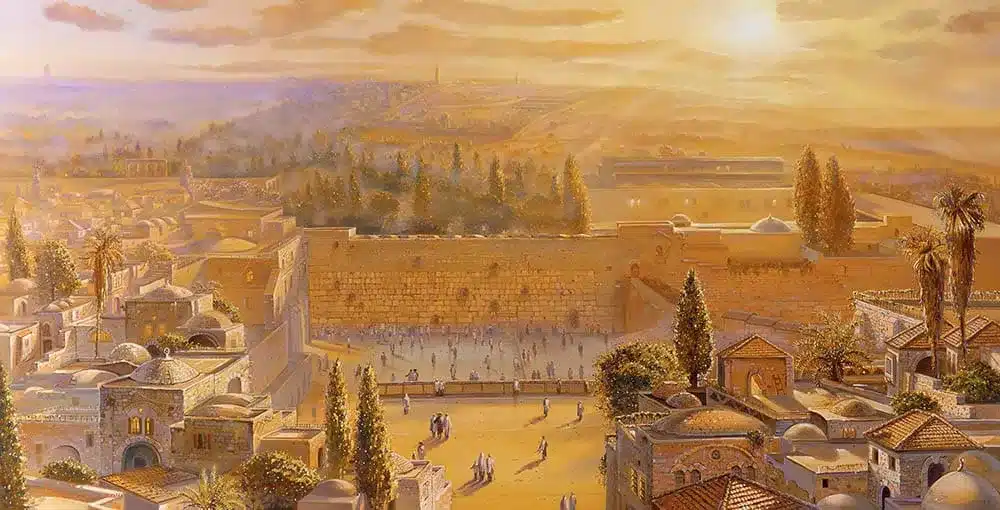
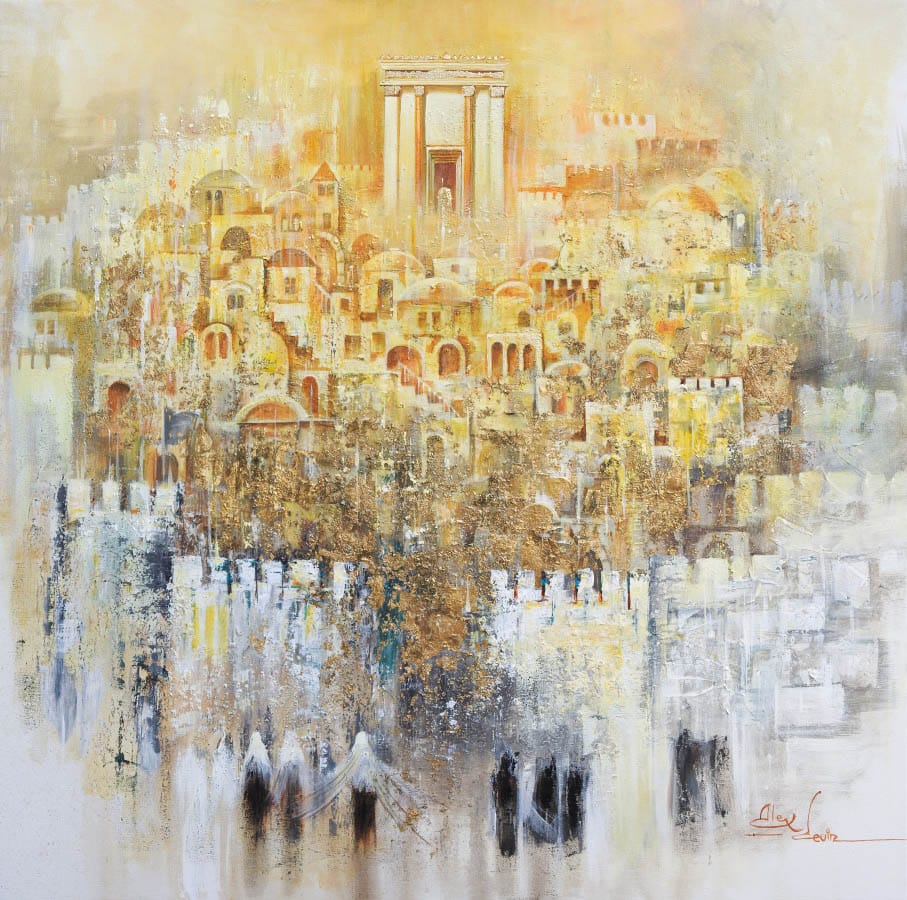
Alex Levin is a contemporary Israeli Jewish artist known for paintings of Jerusalem, Jewish life, the Kotel, the Jerusalem Temple, Torah study, Jewish traditions, and the landscapes of Israel.
Born in Kyiv in 1975, Levin immigrated to Israel in 1990. He later served in the Israel Defense Forces and developed his artistic career in Israel.
Levin’s paintings combine detailed architectural imagery, traditional painting techniques, dramatic light, and themes rooted in Jewish history, faith, memory, and the Land of Israel.
Jerusalem is one of the most important subjects in his work. His paintings portray the Kotel, the Old City, Jerusalem streets and gates, the Beis Hamikdash, and both traditional and contemporary visions of the Holy City.
Jewish life is another major theme. Levin depicts Torah study, Shabbat, Jewish holidays, rabbis, shtetl communities, Jewish families, prayer, and traditions passed from one generation to another.
While many of the famous Jewish artists on this list belong to earlier generations, Levin continues that artistic tradition through contemporary interpretations of Judaism, Jerusalem, Jewish history, and Israel.
Collectors can explore his Jewish paintings, Jerusalem paintings, and contemporary Jewish art.


Jewish Artists and the Evolution of Jewish Art
There is no single style that defines Jewish art.
The artists on this list worked in remarkably different ways. Chagall drew heavily on Jewish folklore and memories of Eastern European Jewish life. Pissarro helped establish Impressionism. Modigliani developed an unmistakable portrait style. Rothko explored abstraction and emotion, while Nevelson transformed sculpture through monumental assemblage.
Contemporary Jewish artists continue to broaden the definition of Jewish art by exploring identity, spirituality, history, Israel, Jerusalem, tradition, and modern Jewish experience.
What connects these artists is not necessarily a shared style, but the distinctive experiences and perspectives each brought to the art world.
Explore Jewish Art by Alex Levin
The tradition of Jewish art continues today through artists who explore Jewish identity, faith, history, memory, and Israel through contemporary painting.
Alex Levin’s collections include traditional Jewish scenes as well as modern and abstract interpretations of Jerusalem and Jewish life.
Explore Jewish Life Paintings – paintings of Torah study, Shabbat, Jewish holidays, shtetl life, rabbis, families, prayer, and Jewish traditions.
Explore Jerusalem Paintings – paintings of the Kotel, Old City, Jerusalem streets, gates, sacred landmarks, and panoramic views of the Holy City.
Explore Contemporary Jewish Art – modern and abstract interpretations of Judaism, Jerusalem, Jewish heritage, spirituality, and identity.
Frequently Asked Questions About Jewish Artists
Who is the most famous Jewish artist?
Marc Chagall is often considered one of the most famous Jewish artists in modern art. His paintings frequently incorporated Jewish life, biblical imagery, folklore, spirituality, and memories of the Jewish communities of Eastern Europe.
Who are some famous Jewish painters?
Famous Jewish painters include Marc Chagall, Camille Pissarro, Amedeo Modigliani, Chaim Soutine, Mark Rothko, and Lee Krasner. Jewish artists have contributed to many important movements, including Impressionism, Expressionism, modernism, and Abstract Expressionism.
Who are some famous Jewish women artists?
Important Jewish women artists include Lee Krasner, Judy Chicago, Eva Hesse, and Louise Nevelson. Their work helped shape modern painting, sculpture, feminist art, and contemporary artistic practice.
Are there contemporary Jewish artists today?
Yes. Contemporary Jewish artists continue to explore Jewish identity, spirituality, history, Israel, Jerusalem, and modern Jewish life through painting, sculpture, photography, and other media. Israeli artist Alex Levin is particularly known for paintings of Jerusalem and Jewish traditions.
What subjects are common in Jewish art?
Jewish art can include biblical stories, Jerusalem, the Torah, Jewish holidays, prayer, shtetl life, rabbis, Jewish families, Israel, Jewish history, and contemporary Jewish identity. Other Jewish artists create work that is not explicitly religious or Jewish in subject while still reflecting their individual cultural backgrounds and experiences.
