Ancient Jerusalem art offers a remarkable visual journey through one of the world’s oldest and most frequently imagined cities.
For centuries, Jerusalem has been represented in mosaics, maps, manuscripts, engravings, drawings, paintings, photographs and contemporary art. Some artists worked from direct observation. Others reconstructed ancient Jerusalem from biblical texts, historical sources, archaeology and imagination.
The result is an extraordinary artistic record in which the real Jerusalem and the Jerusalem of memory, faith and history constantly overlap.
From early representations of the Holy City to detailed 19th-century views and contemporary paintings of the Old City, Jerusalem has remained one of the most enduring subjects in religious and historical art.
What Is Ancient Jerusalem Art?
The phrase ancient Jerusalem art can mean several different things.
It may refer to art and artifacts actually created in ancient Jerusalem, such as architectural decoration, coins, seals, pottery, mosaics and objects discovered through archaeology.
It can also describe later artwork attempting to reconstruct or imagine Jerusalem as it appeared during biblical, First Temple, Second Temple or Roman times.
These are important distinctions.
A modern painting of King Solomon’s Jerusalem may depict an ancient subject, but it is not itself ancient art. It is a contemporary artistic interpretation based on historical and biblical sources.
Why Has Jerusalem Inspired Artists for Centuries?
Few cities combine as many layers of history, religion and architecture within such a small area.
Jerusalem is central to Jewish history and prayer and is also sacred to Christianity and Islam.
Artists have been drawn to its walls, gates, ancient stones, hills, religious landmarks and distinctive light.
But Jerusalem is more than an architectural subject.
For many artists and viewers, it represents ideas such as:
- Faith
- Exile and return
- Memory
- Prayer
- Conflict and peace
- Destruction and rebuilding
- Biblical history
- Hope and redemption
This helps explain why Jerusalem can appear completely different in the work of different artists even when they depict the same location.
The Earliest Visual Representations of Jerusalem
Jerusalem appears in visual culture going back to antiquity, although complete realistic city views from the earliest periods have not survived.
Archaeological discoveries provide evidence through architecture, coins, seals, inscriptions, pottery and decorative objects rather than through conventional landscape painting.
Later artists attempted to reconstruct the ancient city using biblical descriptions, historical writings and eventually archaeology.
One of the most important early surviving visual representations of Jerusalem appears not in Jerusalem itself but in a mosaic in present-day Jordan.
The Madaba Mosaic Map of Jerusalem
The famous Madaba Map dates from the Byzantine period, in the sixth century CE.
Created as part of a large mosaic map of the Holy Land, it includes a remarkably detailed representation of Jerusalem.
The walled city is shown from a bird’s-eye perspective with streets, gates and prominent buildings.
The Church of the Holy Sepulchre is prominently represented, reflecting the Christian context in which the mosaic was created.
Although it should not be treated as a modern street map, the Madaba representation is enormously important to historians because it preserves an early visual conception of Jerusalem’s urban form.
It demonstrates something that would continue for centuries: artists and mapmakers did not merely record Jerusalem. They emphasized the parts of the city most significant to the communities for whom the images were created.
Jerusalem in Medieval Art
During the Middle Ages, many European artists who represented Jerusalem had never personally visited the city.
Jerusalem might therefore appear as an imagined medieval city filled with architecture familiar to European viewers.
Artists were usually more concerned with communicating biblical and religious meaning than producing an archaeologically accurate reconstruction.
Jerusalem served as the setting for scenes connected with the Hebrew Bible, the Temple, and Christian scripture.
As a result, historical Jerusalem in medieval art often combines geography, theology and imagination.
Jerusalem Maps as Works of Art
Historic maps of Jerusalem frequently functioned as artworks as much as geographic documents.
They could contain decorative architecture, biblical scenes, city walls, temples, churches, mountains, inscriptions and imagined reconstructions of ancient sites.
Some maps attempted to show contemporary Jerusalem. Others reconstructed biblical Jerusalem or combined different historical periods in a single composition.
The Israel Museum’s collection of early Holy Land maps demonstrates how mapmakers repeatedly balanced geographic information with religious interpretation.
For people who could never travel to Jerusalem, such images offered a way to imagine the Holy City from thousands of miles away.
The 1486 Breydenbach View of Jerusalem
One particularly influential early printed representation was published in 1486 in an account of a pilgrimage by Bernhard von Breydenbach.
Its panoramic view presented Jerusalem and surrounding sacred locations in unusual detail for European audiences of the period.
The image became influential enough that later mapmakers copied elements from it for generations.
Like many historical Jerusalem views, it mixed observation with the religious priorities of its intended audience.
Biblical Jerusalem in Art
Artists have repeatedly attempted to imagine Jerusalem during the periods of King David, King Solomon and the ancient Temples.
These reconstructions present a special artistic challenge.
No photograph or complete architectural plan exists for ancient Jerusalem.
An artist must combine archaeological evidence, ancient writings, biblical descriptions, architectural research and informed imagination.
The resulting work can therefore be historically inspired without pretending to be an exact photographic reconstruction.
King David’s Jerusalem
King David occupies a central place in Jerusalem’s history and artistic imagination.
According to the biblical narrative, David established Jerusalem as his capital and brought the Ark of the Covenant to the city.
Artists portraying Jerusalem in the time of David may emphasize the fortified ancient settlement, surrounding hills and the landscape south of the later Temple Mount.
Modern archaeological research into the City of David continues to influence contemporary attempts to visualize this period.
Alex Levin frequently connects Jerusalem’s contemporary landscape with its biblical past in his paintings.
King Solomon and the First Temple in Jerusalem Art
The reign of King Solomon provides artists with one of the most monumental subjects in biblical Jerusalem: the construction of the First Temple.
The biblical books provide descriptions of the Temple and its furnishings, but considerable uncertainty remains about its exact architectural appearance.
Artists therefore interpret Solomon’s Temple through combinations of biblical description, archaeology, comparative ancient architecture and imagination.
These works should be understood as artistic reconstructions rather than surviving visual records of the First Temple.
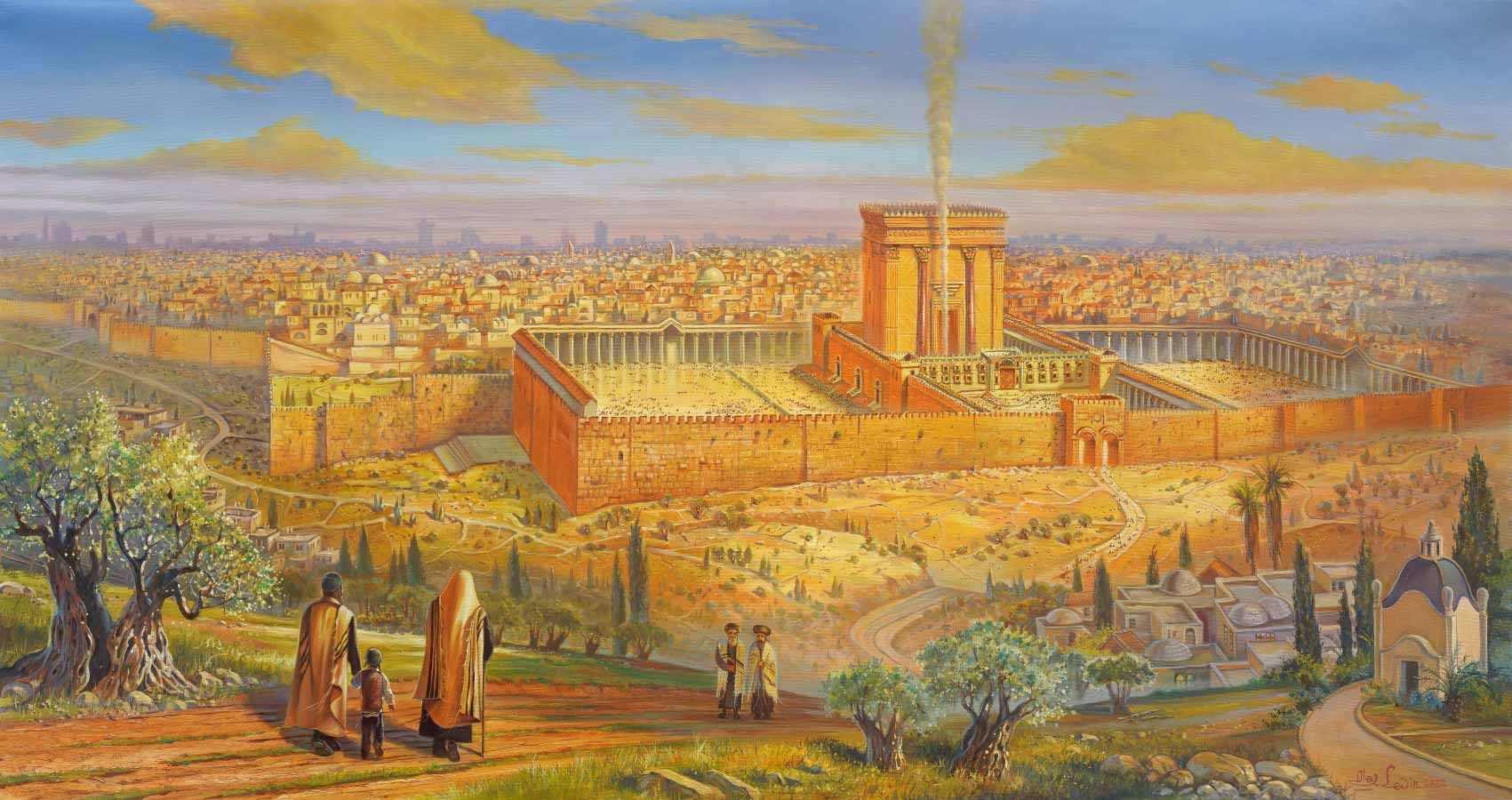
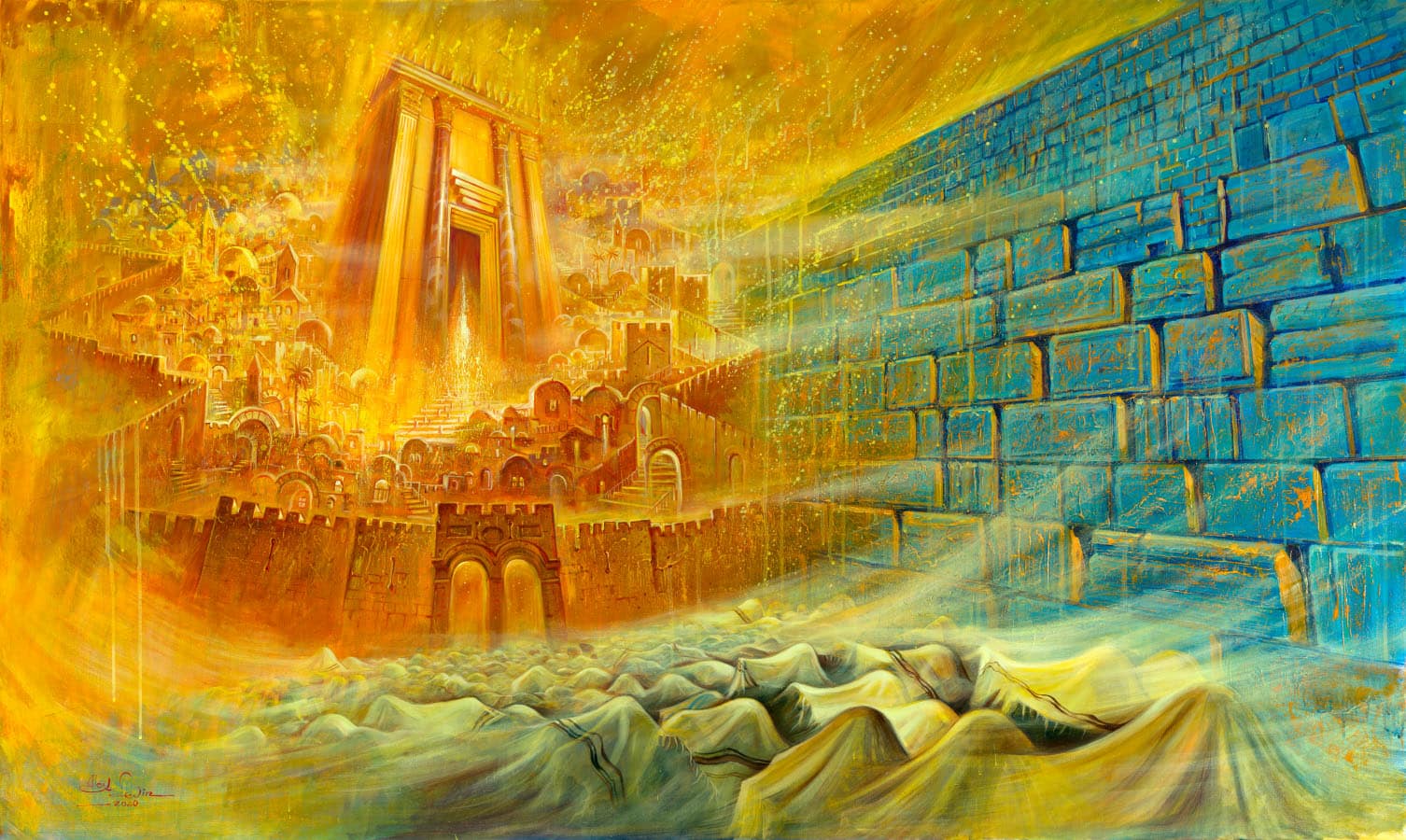
Explore Alex Levin’s collection of Jerusalem Temple paintings.
The Second Temple in Historical Jerusalem Paintings
The Second Temple period has also inspired countless reconstructions.
The Temple complex was dramatically expanded during the reign of Herod the Great, creating the enormous platform whose retaining structures include the area of today’s Western Wall.
Historical paintings often portray a monumental Temple dominating the Jerusalem skyline.
Because the complex was destroyed by Roman forces in 70 CE, modern artists again must work from archaeological, literary and architectural evidence rather than a surviving complete structure.
You can learn more in our guide to the First and Second Jerusalem Temples.
The Destruction of Jerusalem in Historical Art
The destruction of Jerusalem has itself become an important artistic subject.
The Babylonian destruction associated with the First Temple and the Roman destruction of the Second Temple provided later artists with dramatic scenes of fire, armies, ruined architecture and exile.
Such paintings generally tell viewers as much about the period in which the artist worked as about ancient Jerusalem.
Nineteenth-century artists, for example, often imagined biblical history through monumental architecture and dramatic landscape conventions familiar to European historical painting.
David Roberts and 19th-Century Jerusalem
The 19th century transformed Western visual representations of Jerusalem because increasing numbers of professional artists traveled to the region and worked directly from observation.
One of the most influential was Scottish artist David Roberts.
Roberts traveled through Egypt and the Holy Land in 1838-1839 and reached Jerusalem in 1839.
He produced extensive drawings and watercolors during his journey.
After returning to Britain, these works became the basis for a celebrated series of lithographs published between 1842 and 1849.
Roberts’ Jerusalem images were extraordinarily influential because they gave European audiences detailed views based on an artist who had actually traveled through the region.
David Roberts and the Imagined Ancient City
Roberts did not limit himself to recording the Jerusalem he saw.
He also created dramatic historical reconstructions.
One famous example depicts the Roman destruction of Jerusalem in 70 CE.
The enormous composition showed the city in flames as Roman forces overwhelmed Jerusalem.
Although the ancient architecture was largely imagined, Roberts had personally observed Jerusalem’s landscape and surrounding terrain during his earlier journey.
This combination of direct observation and historical imagination became important to later historical Jerusalem art.
Gustav Bauernfeind and Jerusalem
German painter Gustav Bauernfeind became another important 19th-century interpreter of Jerusalem and the Middle East.
Unlike artists who created generalized biblical fantasies, Bauernfeind became known for highly detailed architectural compositions.
He traveled repeatedly in the region and eventually lived in the Holy Land.
His paintings often contain carefully observed stone architecture, strong sunlight, shadow and figures placed within detailed urban environments.
His 1886 painting At the Entrance to the Temple Mount, Jerusalem demonstrates how Jerusalem’s architecture could become the central subject of a large and highly finished painting.
The Old City of Jerusalem in Historical Paintings
By the 19th century, artists increasingly portrayed recognizable locations throughout Jerusalem’s Old City.
The walls, gates, markets, religious landmarks and narrow streets became recurring artistic subjects.
Unlike imagined biblical reconstructions, these works preserve evidence of how artists encountered the living city during their own lifetimes.
Clothing, architecture, street activity and the surrounding landscape can all provide clues about Jerusalem before the major changes of the 20th and 21st centuries.
Jerusalem’s Gates in Art
The gates of the Old City are among Jerusalem’s most recognizable architectural features.
Jaffa Gate, Damascus Gate, Zion Gate, Lions’ Gate, Dung Gate, Herod’s Gate, the New Gate and the sealed Golden Gate each have their own history and visual character.
Artists often use a gate as both architecture and symbol.
A doorway through an ancient wall can suggest arrival, pilgrimage, transition, history or the passage between Jerusalem’s past and present.
Explore Alex Levin’s collection of Gates of Jerusalem paintings.
The Tower of David in Jerusalem Art
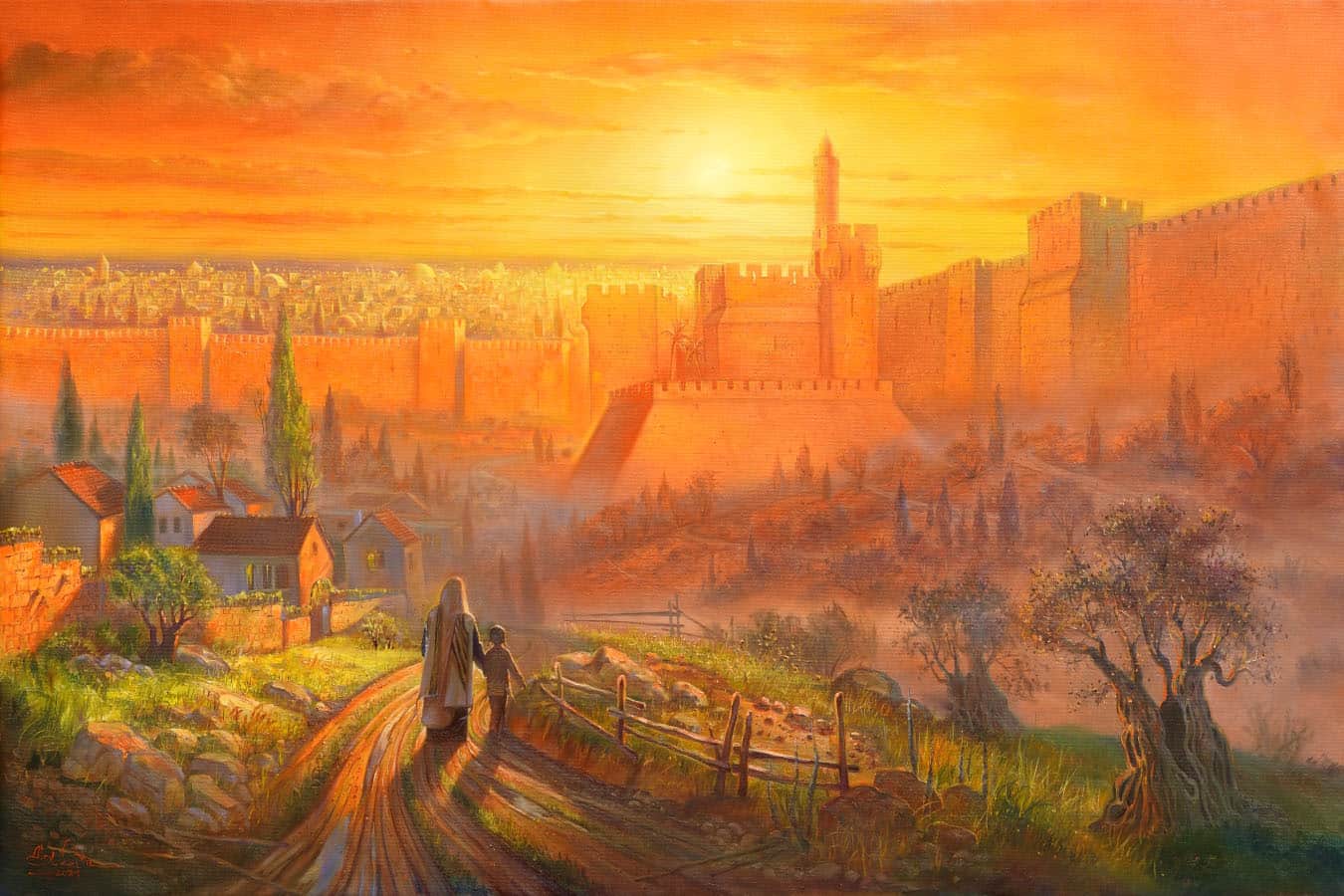
The Tower of David and the Jerusalem Citadel have long attracted artists because of their monumental position beside Jaffa Gate.
Despite its familiar name, the visible citadel is not literally a surviving palace or tower built by the biblical King David.
The complex contains architectural layers from different historical periods.
Its towers and fortifications nevertheless became powerful visual symbols of Jerusalem.
Explore Alex Levin’s Tower of David – Migdal David paintings.
The Western Wall in Historical Jerusalem Art
The Kotel, or Western Wall, became one of the most recognizable subjects in Jewish images of Jerusalem.
Historic paintings, prints and photographs preserve views of the Wall before the creation of today’s large Western Wall Plaza.
Earlier images generally show a much narrower prayer area bordered by buildings of the old Mughrabi Quarter.
This makes old visual records especially valuable for understanding how the site appeared before the dramatic changes that followed the 1967 Six-Day War.
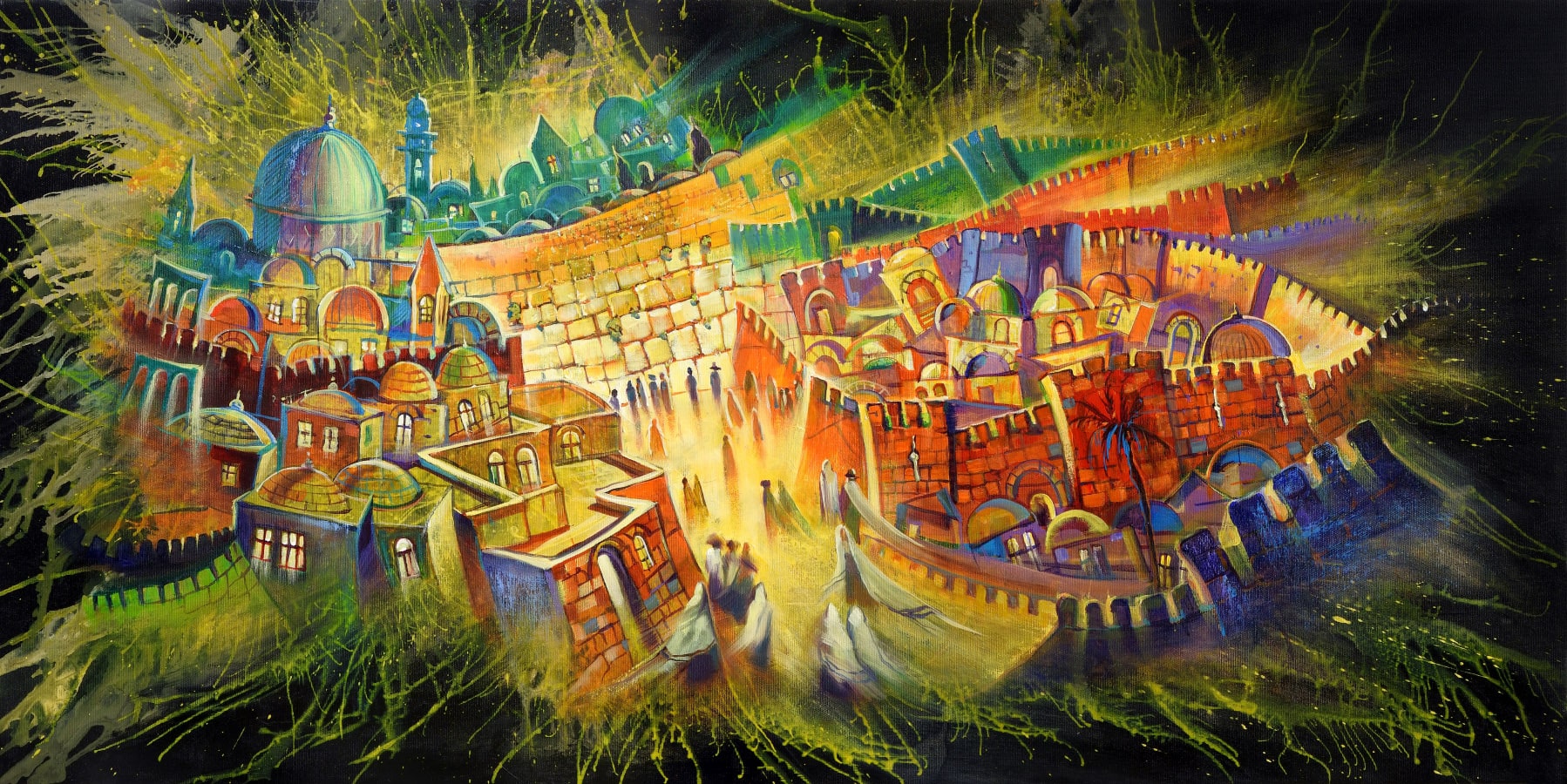
Explore Alex Levin’s collection of Kotel paintings.
Jerusalem Before Photography
Before photography, paintings, prints, maps and drawings were among the principal ways distant audiences encountered Jerusalem visually.
But viewers should remember that these images were interpretations rather than neutral records.
An artist might change scale, move buildings, emphasize certain sacred sites or alter the landscape to strengthen a composition.
A mapmaker might combine contemporary Jerusalem with biblical locations from much earlier periods.
Historical Jerusalem art is therefore most valuable when viewed both as evidence of the city and as evidence of how different generations imagined the city.
Early Photography of Jerusalem
The arrival of photography in the 19th century created a new type of visual record.
Photographers documented city walls, streets, holy places, residents and surrounding landscapes with a degree of physical detail impossible to reproduce exactly through drawing alone.
Photography did not replace painting.
Instead, painters gained a new reference source while remaining free to change color, light, atmosphere and composition.
Today, old photographs are extremely useful to artists who wish to reconstruct vanished Jerusalem streets and neighborhoods.
Bezalel and the Development of Modern Jerusalem Art
A major turning point came in 1906 when artist Boris Schatz founded the Bezalel School of Arts and Crafts in Jerusalem.
The school attempted to develop a distinctive Jewish visual culture by bringing together European artistic traditions, Jewish symbolism, biblical themes, Middle Eastern decorative influences and the local environment.
Jerusalem naturally became one of its central sources of inspiration.
Bezalel artists and craftsmen created paintings, prints, objects, carpets, metalwork and graphic designs featuring Jerusalem, biblical personalities and Jewish symbols.
The institution eventually developed into today’s Bezalel Academy of Arts and Design.
Jerusalem Stone and the Colors of the Old City
One characteristic repeatedly noticed by artists is the color of Jerusalem stone.
Under strong midday light, buildings may appear pale cream or almost white.
Near sunset, the same stone can become gold, pink or orange.
Deep shadows in narrow Old City streets create additional contrasts between warm illuminated stone and cooler shaded passages.
This changing light explains why two paintings of the same Jerusalem street can feel completely different.
Old Jerusalem Streets in Art
The narrow streets of Jerusalem’s Old City offer a more intimate subject than monumental panoramas.
Stone arches, stairs, doorways, balconies, flowers and small figures can communicate the feeling of walking through Jerusalem rather than viewing it from a distance.
Alex Levin frequently uses this perspective in his Jerusalem paintings.
In works such as Street in the Old City, the architecture itself becomes the main character of the composition.
Historical Accuracy vs. Artistic Imagination
A historical Jerusalem painting does not need to function like an archaeological diagram.
But viewers should understand the difference between documented architecture and artistic reconstruction.
This distinction is particularly important when portraying:
- Solomon’s Temple
- The Second Temple
- Biblical Jerusalem
- King David’s city
- Ancient ceremonies
- Events for which no visual record survives
A responsible historical artist can study archaeology, architecture, texts and surviving objects while still acknowledging areas where visual certainty is impossible.
Reconstructing Ancient Jerusalem Through Painting
Painting has an advantage that photography does not: it can attempt to visualize places that no longer exist.
An artist can reconstruct a disappeared neighborhood, recreate an ancient cityscape or show the Jerusalem Temple standing above the city.
This does not make the result a literal historical photograph.
Instead, it creates a visual hypothesis – an interpretation informed by available evidence.
When done carefully, such artwork can help viewers imagine scale, architecture and human activity that would otherwise remain abstract.
Jerusalem as a City of Memory
Much Jerusalem art is concerned not only with what the city looks like but with what it means.
For Jewish communities living outside Jerusalem for centuries, the city remained constantly present in prayer and religious imagination.
The phrase “If I forget you, O Jerusalem” expresses the depth of that attachment.
This connection allowed Jerusalem to remain a visual subject even for artists and viewers who had never seen the city personally.
See Alex Levin’s painting If I Forget You, O Jerusalem.
Jerusalem Then and Now
One of the most fascinating aspects of Jerusalem art is comparing historical images with the modern city.
Some landmarks remain immediately recognizable.
Other streets, neighborhoods and landscapes have changed almost beyond recognition.
Modern construction surrounds areas that once appeared rural. Old neighborhoods have disappeared or been rebuilt. Archaeological excavations have revealed structures that earlier artists could not see.
At the same time, the Old City walls, gates, sacred landmarks and Jerusalem stone continue to provide visual continuity between generations.
Contemporary Jerusalem Paintings
Contemporary artists are not limited to recreating Jerusalem realistically.
The city can be fragmented, abstracted, imagined or reconstructed symbolically.
Hebrew letters, ancient architecture, modern buildings, biblical scenes and contemporary Jerusalem may all appear in a single composition.
Such work reflects an important truth about Jerusalem itself: many historical periods coexist psychologically even when they cannot physically coexist on the same street.
Explore Alex Levin’s contemporary Jewish art.
Historical Jerusalem Paintings by Alex Levin
Israeli artist Alex Levin has made Jerusalem one of the central subjects of his artistic career.
His work ranges from contemporary views of the Old City to imagined reconstructions of ancient Jerusalem, the First and Second Temples, biblical scenes and symbolic visions connecting the city’s past with its present.
Some paintings emphasize detailed architecture and realistic light.
Others combine different periods of Jerusalem history within a single composition.
This allows the viewer to see Jerusalem not simply as it looks today, but as a city built from layers of history, memory and faith.
Explore Jerusalem Paintings by Alex Levin
Alex Levin’s larger Jerusalem Paintings collection includes Old City streets, Jerusalem panoramas, the Kotel, city gates, sacred landmarks and historical interpretations.
Collectors particularly interested in ancient Jerusalem can explore his Jerusalem Temple paintings.
For architectural subjects, see the Gates of Jerusalem, Tower of David and Kotel paintings collections.
Frequently Asked Questions About Ancient Jerusalem Art
What is ancient Jerusalem art?
Ancient Jerusalem art can refer to archaeological visual material produced in ancient Jerusalem or to later artwork depicting and reconstructing Jerusalem during biblical and ancient historical periods.
What is the earliest known map of Jerusalem?
One of the earliest and most important surviving cartographic representations of Jerusalem appears in the sixth-century Madaba mosaic map in present-day Jordan. It depicts Jerusalem as a walled city with streets and prominent buildings.
Are ancient Jerusalem paintings historically accurate?
It depends on the artwork. No complete painted visual record survives of Jerusalem during many biblical periods, so later artists must combine historical texts, archaeology, architecture and artistic interpretation. Such works should generally be understood as reconstructions rather than exact records.
Who was David Roberts?
David Roberts was a 19th-century Scottish artist who traveled through Egypt and the Holy Land in 1838-1839. His drawings and watercolors became the basis for a highly influential series of lithographs published during the 1840s.
Who was Gustav Bauernfeind?
Gustav Bauernfeind was a 19th-century German painter known for highly detailed architectural scenes of Jerusalem and other Middle Eastern cities. He traveled extensively in the region and eventually lived in the Holy Land.
Why does Jerusalem look different in old paintings?
The city itself changed substantially over time, but artists also interpreted Jerusalem according to their own period, religion and artistic style. Some works were painted from direct observation, while others were imagined from texts, maps or earlier pictures.
Why are there so many paintings of Jerusalem?
Jerusalem has exceptional significance in Jewish, Christian and Islamic history, while its ancient architecture, city walls, sacred landmarks and distinctive landscape make it visually compelling. These historical, spiritual and artistic qualities have inspired artists for centuries.
What are common subjects in historical Jerusalem paintings?
Common subjects include the Jerusalem Temple, Old City walls, the Kotel, Tower of David, city gates, Mount of Olives, Temple Mount, ancient biblical Jerusalem and narrow streets of the Old City.
Where can I find historical Jerusalem paintings?
ArtLevin.com features Jerusalem artwork by Israeli artist Alex Levin, including Old City scenes, architectural paintings, Kotel artwork and artistic reconstructions of ancient Jerusalem and the Jerusalem Temple.
Where can I buy Jerusalem paintings?
You can explore original artwork and fine-art reproductions in the Jerusalem Paintings collection by Alex Levin.