Judaica art brings Jewish history, faith, tradition, and identity into visual form. It can include ceremonial objects such as menorahs and Kiddush cups, but it can also describe paintings and artwork inspired by Jerusalem, Torah, Shabbat, Jewish holidays, rabbis, Jewish families, and centuries of Jewish life.
Jewish artists have approached these subjects in very different ways. Some work in traditional realism, while others use abstraction, symbolism, surrealism, contemporary design, or modern interpretations of ancient Jewish themes.
For collectors, Judaica art can be deeply personal. A painting of the Kotel may evoke Jerusalem. A Shabbat scene may recall family traditions. A Torah painting can symbolize learning and continuity, while a shtetl scene may preserve memories of Jewish communities that no longer exist.
Here are some of the most enduring themes found in Judaica art and Jewish painting.
What Is Judaica Art?
The word Judaica generally refers to objects, artwork, and cultural items connected with Judaism and Jewish life.
Traditional Judaica includes ceremonial objects used in the home and synagogue, such as menorahs, Shabbat candlesticks, mezuzah cases, Kiddush cups, Torah ornaments, Havdalah sets, and decorative ketubah marriage contracts.
In the broader art world, the term Judaica art can also include paintings and artwork portraying Jewish subjects, traditions, history, religious symbols, Jerusalem, Israel, and everyday Jewish life.
Judaica art therefore ranges from functional ritual objects to fine art intended primarily for display and contemplation.
Jerusalem in Judaica Art
Jerusalem is one of the most important subjects in Jewish art.
For centuries, Jews living far from the city included images of Jerusalem in synagogue decoration, manuscripts, ceremonial objects, ketubot, and household art.
The city represented not only a physical place but also Jewish history, prayer, memory, exile, return, and spiritual longing.
Modern Judaica paintings frequently portray the Old City walls, Jerusalem stone, narrow streets, sacred landmarks, city gates, and panoramic views of the Holy City.
Israeli artist Alex Levin has created an extensive collection of Jerusalem paintings ranging from detailed traditional scenes to contemporary and abstract interpretations of the city.
The Kotel – Western Wall Paintings
The Kotel, or Western Wall, is one of the most recognizable symbols in Judaica art.
Artists often portray worshippers standing close to the ancient stones, families visiting Jerusalem, soldiers at the Wall, people placing written prayers between the stones, or the plaza illuminated by changing Jerusalem light.
The Western Wall’s proximity to the Temple Mount connects the site with the ancient Jerusalem Temples and thousands of years of Jewish history.
For many viewers, a Kotel painting represents faith, prayer, Jewish continuity, and a personal connection with Jerusalem.
Explore Alex Levin’s collection of Kotel paintings.
Torah Art and Paintings of Jewish Learning
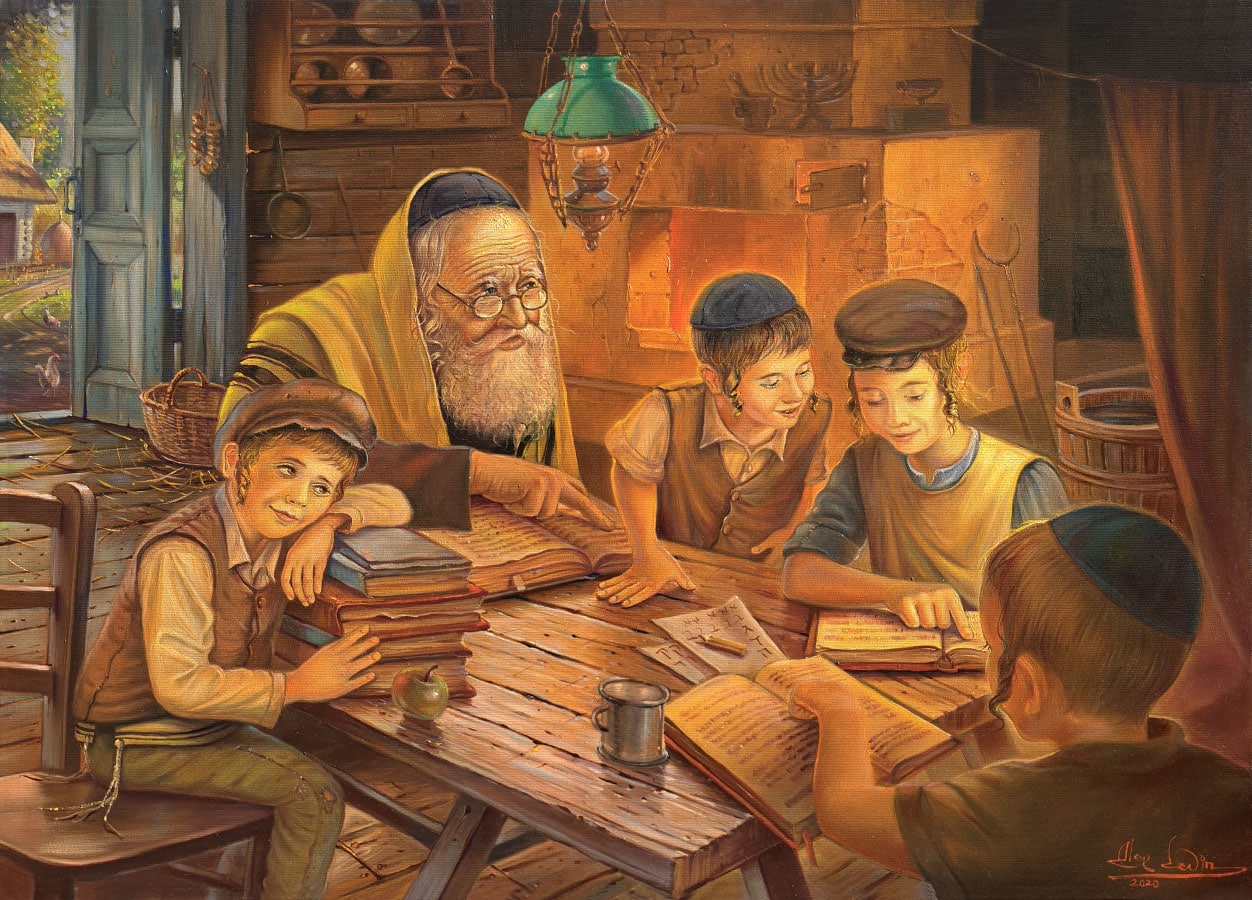
The Torah occupies a central place in Jewish life, making Torah study one of the most enduring subjects in Jewish art.
Paintings may depict rabbis studying sacred texts, children learning Hebrew, students gathered around a table, Torah scrolls in a synagogue, or generations studying together.
These scenes symbolize knowledge, faith, education, and the transmission of Jewish tradition from one generation to the next.
Torah imagery can appear in highly traditional Jewish paintings as well as contemporary compositions where Hebrew letters, scrolls, light, and symbolic forms become part of the artwork.
Explore Alex Levin’s Torah paintings.
Shabbat Art
Shabbat provides some of the most intimate and recognizable subjects in Judaica art.
Shabbat candles, challah, Kiddush wine, family gatherings, prayer, and the warm light of Friday evening all carry strong emotional and religious meaning.
A Shabbat painting may portray a mother lighting candles, a family gathered around the table, a synagogue service, or a quiet moment of prayer.
These images often represent peace, family, continuity, and the weekly rhythm of Jewish life.
View Alex Levin’s collection of Shabbat paintings.
The Jerusalem Temple in Jewish Art
The Beit Hamikdash, or Jerusalem Temple, is another powerful theme in Judaica art.
The First and Second Temples were central to ancient Jewish religious life, and the memory of the Temple continues to appear throughout Jewish prayer and tradition.
Because no complete visual record of the ancient Temples survives, artistic representations often combine historical research, architectural interpretation, biblical descriptions, and imagination.
Some contemporary Jewish artists also portray the future Temple as part of Jewish hopes associated with Jerusalem and redemption.
Alex Levin has created numerous detailed interpretations in his collection of Jerusalem Temple paintings.
Jewish Holiday Paintings
Jewish holidays provide artists with a rich range of visual traditions.
Each holiday has its own objects, rituals, colors, foods, and family customs.
Passover art may include the Seder table, matzah, wine cups, or scenes inspired by the Exodus from Egypt.
Sukkot paintings can show families inside decorated sukkahs or Jerusalem during the festival.
Hanukkah artwork often centers around the menorah and glowing candles, while Purim paintings may portray celebration, costumes, and traditional Jewish communities.
Rosh Hashanah imagery can include apples, honey, shofars, pomegranates, and wishes for a sweet new year.
Through art, these traditions can become part of the home throughout the year rather than only during the holiday itself.
Jewish Family Life in Art
Not all Judaica art focuses on monumental religious events.
Some of the most meaningful Jewish paintings portray everyday family life.
Parents teaching children, families celebrating Shabbat, grandparents sharing traditions, Jewish weddings, prayer, music, and community gatherings can all become subjects of Jewish art.
These scenes emphasize the continuity of Jewish culture through ordinary moments repeated across generations.
Explore Alex Levin’s collection of Jewish Life paintings.
Shtetl Paintings and the Vanished Jewish World
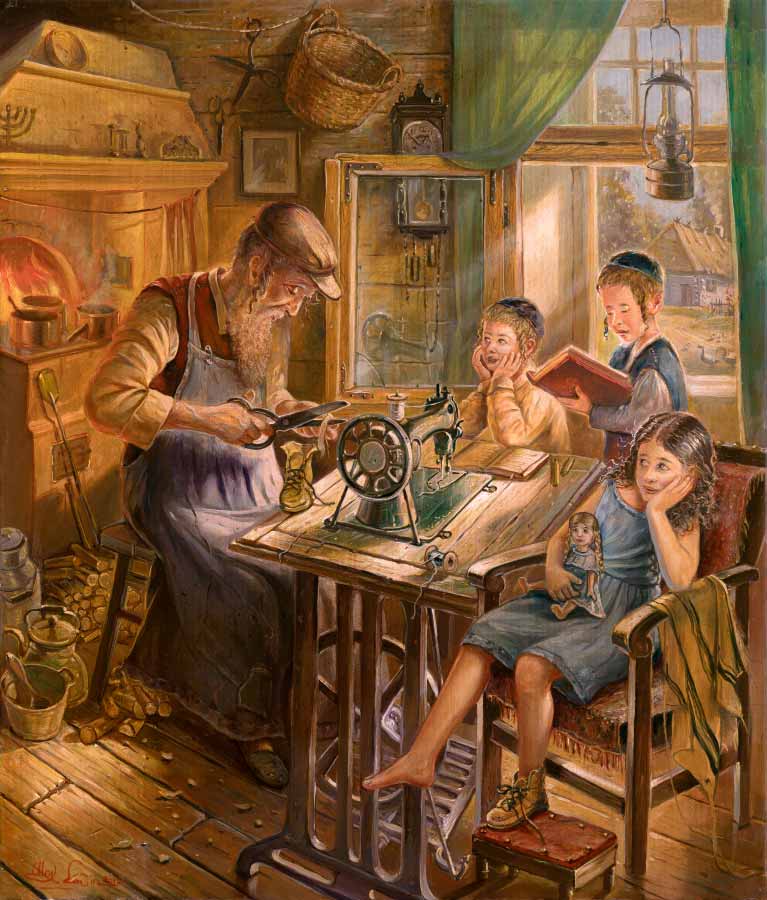
The Jewish shtetls of Eastern Europe have become an important subject in Jewish art and memory.
Before the Holocaust, thousands of Jewish communities existed throughout Poland, Ukraine, Lithuania, Belarus, and other parts of Eastern Europe.
Artists have portrayed shtetl streets, synagogues, rabbis, musicians, markets, weddings, Torah study, children, and family life.
After the destruction of so many of these communities, paintings of shtetl life became more than nostalgic scenes. They also became visual records of a Jewish world that largely disappeared.
For families whose ancestors came from Eastern Europe, shtetl art can create a deeply personal connection to family history.
Explore Alex Levin’s shtetl paintings.
Jewish Portraits and Rabbis in Art
Jewish portraiture has long included rabbis, scholars, Hasidic leaders, historical figures, and ordinary members of Jewish communities.
Traditional clothing, facial expression, books, prayer shawls, and surroundings can communicate much more than physical appearance.
A portrait may represent wisdom, leadership, spirituality, cultural identity, or the traditions of a particular Jewish community.
One of the most recognizable Jewish figures portrayed in contemporary Judaica art is Rabbi Menachem Mendel Schneerson, the Lubavitcher Rebbe.
Explore Alex Levin’s Lubavitcher Rebbe paintings and broader collection of Jewish portraits.
Jewish Weddings in Judaica Art
The Jewish wedding provides artists with some of the most joyful subjects in Judaica painting.
The chuppah, bride and groom, rabbis, musicians, dancing guests, and traditional clothing can create scenes filled with movement and emotion.
Jewish wedding paintings often symbolize not only the marriage of two people but also family, community, tradition, and continuity.
Some paintings recreate weddings in historic Eastern European communities, while others portray contemporary Jewish weddings in Jerusalem or Israel.
Hebrew Letters and Jewish Symbols
Contemporary Judaica art often incorporates Hebrew letters and familiar Jewish symbols directly into the composition.
Common symbols include the Star of David, menorah, Torah scroll, pomegranate, Tree of Life, Hebrew blessings, Jerusalem imagery, and the Hebrew alphabet.
In traditional artwork, these elements may be represented realistically. In modern Judaica, they can become abstract forms, patterns, fragments, or layers within a larger composition.
This allows contemporary artists to connect ancient Jewish symbols with modern visual language.
Contemporary Jewish Art
Judaica art is not limited to traditional imagery.
Contemporary Jewish artists work in abstraction, surrealism, mixed media, photography, sculpture, digital art, and experimental forms.
Modern Jewish artwork may address identity, Jerusalem, Israel, memory, antisemitism, migration, biblical themes, Hebrew language, Jewish history, or the relationship between tradition and modern life.
Some contemporary works remain immediately recognizable as Jewish art. Others use color, shapes, fragments of Hebrew letters, or symbolic imagery in subtler ways.
Explore Alex Levin’s collection of contemporary Jewish art.
Judaica Art for the Jewish Home
Judaica paintings are often chosen not simply as decoration but because the subject has personal meaning.
A Jerusalem painting can represent a connection to Israel. A Torah scene may be especially meaningful in a study or synagogue. Shabbat artwork can bring the atmosphere of Friday evening into a dining room, while a shtetl painting may recall family ancestry.
Jewish art is also commonly chosen for weddings, anniversaries, housewarmings, Bar and Bat Mitzvahs, synagogue dedications, and other important occasions.
The best choice is usually the artwork whose subject has a genuine connection with the person, family, or space where it will be displayed.
Traditional vs. Contemporary Judaica Art
Traditional Judaica art generally depicts recognizable Jewish subjects such as rabbis, Torah study, Jerusalem, synagogues, holidays, Shabbat, and family life.
Contemporary Judaica art may explore those same subjects using abstraction, unusual perspectives, surreal imagery, fragmented architecture, strong colors, or symbolic compositions.
Neither approach is inherently more authentically Jewish.
They represent different visual languages for expressing Jewish ideas and experiences.
Alex Levin works in both directions, creating detailed traditional scenes as well as contemporary interpretations of Jerusalem and Jewish identity.
Judaica Paintings by Alex Levin
Israeli artist Alex Levin has spent much of his career exploring Jerusalem, Jewish history, religious traditions, and everyday Jewish life through painting.
His Judaica artwork includes the Kotel, Torah study, Shabbat, Jewish holidays, rabbis, shtetl communities, the Lubavitcher Rebbe, the Jerusalem Temple, Jewish families, and contemporary interpretations of Jewish identity.
His work ranges from realistic historical scenes to modern and surreal compositions.
Browse the full Judaica art collection by Alex Levin.
Explore Jewish and Judaica Paintings by Alex Levin
You can also browse Jerusalem paintings and contemporary Jewish art.
Frequently Asked Questions About Judaica Art
What does Judaica mean?
Judaica generally refers to objects, artwork, books, ceremonial items, and cultural material connected with Judaism and Jewish life.
What is Judaica art?
Judaica art includes fine art and decorative art inspired by Jewish religion, history, traditions, symbols, Israel, Jerusalem, and Jewish communities. It can include paintings as well as ceremonial objects such as menorahs, Kiddush cups, Torah ornaments, and mezuzah cases.
What are common subjects in Judaica paintings?
Common subjects include Jerusalem, the Kotel, Torah study, Shabbat, rabbis, Jewish holidays, shtetl life, Jewish families, the Jerusalem Temple, synagogues, biblical stories, and contemporary Jewish identity.
Is all Jewish art religious?
No. Some Jewish art is explicitly religious, while other artwork explores history, identity, Israel, family, memory, language, culture, or contemporary Jewish experience without depicting religious practice.
What is contemporary Judaica art?
Contemporary Judaica art uses modern artistic styles to explore Jewish subjects and ideas. It may incorporate abstraction, surrealism, Hebrew letters, symbolic imagery, modern Jerusalem, Jewish history, or contemporary Jewish identity.
What Judaica art makes a meaningful gift?
Meaningful choices depend on the recipient. Jerusalem paintings, Shabbat artwork, Torah scenes, Jewish wedding paintings, blessings, and artwork connected with family heritage are often chosen for weddings, housewarmings, anniversaries, Bar and Bat Mitzvahs, and other important occasions.
Where can I buy Judaica paintings?
Judaica paintings are available through artists, galleries, Judaica stores, and specialized Jewish art websites. ArtLevin.com offers original artwork and fine-art reproductions by Israeli artist Alex Levin covering Jerusalem, Jewish Life, Torah, Shabbat, the Kotel, shtetl life, Jewish portraits, and contemporary Judaica.