Moses is one of the most frequently depicted biblical figures in the history of art. His life contains some of the most dramatic scenes in the Hebrew Bible – the burning bush, confrontation with Pharaoh, the Exodus from Egypt, crossing of the Red Sea, revelation at Mount Sinai, the Ten Commandments, and the long journey toward the Promised Land.
For thousands of years, Jewish and non-Jewish artists have interpreted these stories through painting, sculpture, illuminated manuscripts, murals, mosaics, and contemporary art.
Some artists portray Moses as a powerful prophet and leader. Others focus on moments of revelation, struggle, liberation, anger, faith, or responsibility.
From ancient synagogue murals to Renaissance sculpture and modern Jewish paintings, the image of Moses continues to inspire artists around the world.
Who Was Moses?
In the Hebrew Bible, Moses – Moshe in Hebrew – is the central human figure in the story of the Exodus.
According to the biblical narrative, Moses was born when the Israelites were enslaved in Egypt. After being saved as an infant and raised in Pharaoh’s household, he later fled Egypt and encountered God at the burning bush.
Moses returned to Egypt to demand the liberation of the Israelites, led them out of slavery, crossed the Red Sea, received the Torah at Mount Sinai, and guided the people through the wilderness.
These dramatic episodes have provided artists with an extraordinary range of subjects.
Why Is Moses Such an Important Subject in Art?
Moses combines several powerful artistic themes within a single biblical figure.
He is portrayed as a prophet, lawgiver, liberator, teacher, reluctant leader, and intermediary between God and the Israelites.
His story also contains visually dramatic events that naturally lend themselves to art:
- Moses as an infant on the Nile
- The burning bush
- Moses before Pharaoh
- The Ten Plagues
- The Exodus from Egypt
- The parting of the Red Sea
- Mount Sinai
- The Ten Commandments
- The Golden Calf
- The journey through the wilderness
- Moses looking toward the Promised Land
Each scene allows artists to interpret Moses differently – as a vulnerable child, a reluctant prophet, a commanding leader, or an elderly figure completing his life’s mission.
Ancient Jewish Depictions of Moses
Some of the most important surviving ancient Jewish images of Moses were discovered in the third-century synagogue at Dura-Europos, in what is now Syria.
The synagogue’s walls contained extensive painted scenes from the Hebrew Bible, including several episodes from the life of Moses.
Among them were scenes showing Moses as an infant and Moses leading the Israelites through the miraculous crossing of the sea.
These paintings are particularly important because they demonstrate that at least some ancient Jewish communities created sophisticated figurative biblical art.
The Dura-Europos synagogue contained dozens of painted biblical scenes and remains one of the most important archaeological discoveries for understanding ancient Jewish visual culture.
Moses as an Infant in Art
The story of Moses begins with danger.
According to Exodus, Pharaoh ordered that newborn Hebrew boys be killed. Moses’ mother placed him in a basket among the reeds of the Nile, where he was discovered by Pharaoh’s daughter.
Artists have frequently portrayed this scene because of its emotional contrast: a vulnerable infant whose future role would transform the history of the Israelites.
Paintings may focus on the small basket, the Nile landscape, Pharaoh’s daughter discovering the child, or Moses’ sister Miriam watching nearby.
Moses and the Burning Bush
The burning bush represents the moment when Moses receives his calling.
According to the Book of Exodus, Moses encounters a bush that burns without being consumed. God calls to him and commands him to return to Egypt and lead the Israelites out of slavery.
For artists, the scene presents the challenge of representing a divine encounter without attempting to portray God directly.
Light, fire, landscape, gesture, and Moses’ emotional reaction often become the central visual elements.
Alex Levin explores this subject in his paintings inspired by Moses and the Torah.
Moses Before Pharaoh
One of the most dramatic parts of the Exodus narrative is the confrontation between Moses and Pharaoh.
Moses repeatedly demands the release of the Israelites, while Pharaoh refuses.
Artists have interpreted the confrontation as a clash between earthly political power and divine authority.
Large palace interiors, Egyptian architecture, royal clothing, Moses’ staff, and contrasting groups of figures are frequently used to emphasize the difference between Pharaoh’s power and Moses’ mission.
The Exodus From Egypt in Art
The Exodus is one of the defining narratives of Jewish history and tradition.
According to the biblical account, after generations of slavery and the Ten Plagues, the Israelites finally leave Egypt under Moses’ leadership.
Artists depicting the Exodus face an enormous compositional challenge: how to portray the movement of an entire people rather than one individual.
Some works focus on Moses at the head of the Israelites. Others show families carrying possessions, children, animals, and crowds moving through the landscape.
The story has become a universal artistic symbol of liberation, freedom, faith, and escape from oppression.
Moses Parting the Red Sea in Art
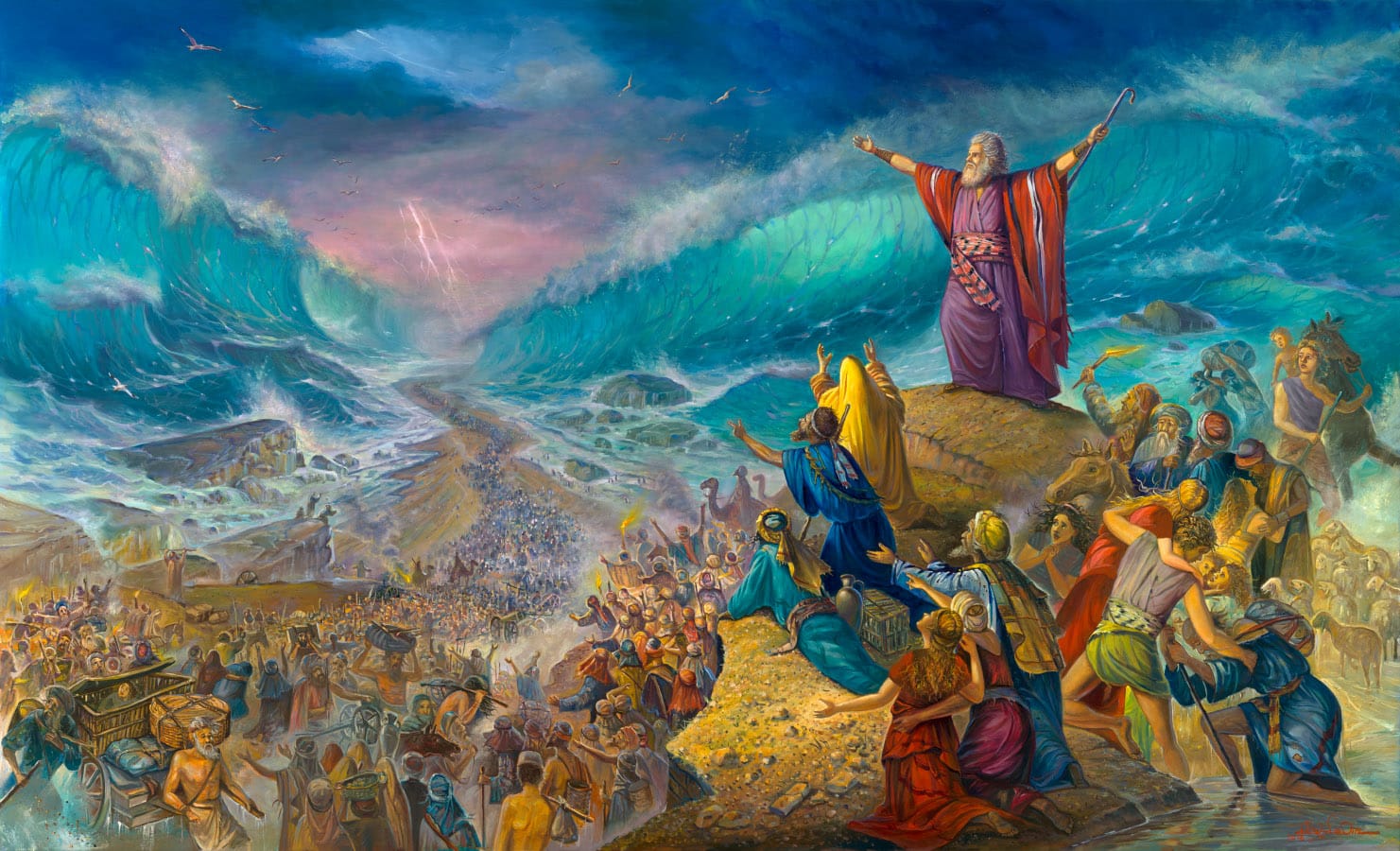
The crossing of the sea is perhaps the most visually dramatic scene in the Exodus story.
According to Exodus, the Israelites reach the sea while Pharaoh’s army pursues them from behind. Moses stretches out his hand, the waters divide, and the Israelites cross on dry ground.
After they reach safety, the waters return over the pursuing Egyptian forces.
Artists have portrayed the scene in many different ways. Some emphasize towering walls of water. Others concentrate on Moses raising his staff, frightened families crossing the sea, or the dramatic destruction of Pharaoh’s army.
The scene combines movement, danger, divine intervention, and liberation, making it one of the most enduring subjects in biblical art.
Nicolas Poussin’s The Crossing of the Red Sea
One of the best-known paintings of the Exodus is Nicolas Poussin’s The Crossing of the Red Sea, painted around 1632-1634.
Poussin depicts the moment after the Israelites have escaped and the sea has closed over the pursuing Egyptian army.
The composition contains a large number of figures arranged across the canvas, creating both drama and a sense of collective movement.
Today the painting is in the collection of the National Gallery of Victoria in Melbourne.
Poussin’s work demonstrates how a biblical narrative can become a monumental historical painting while retaining its religious meaning.
Moses at Mount Sinai
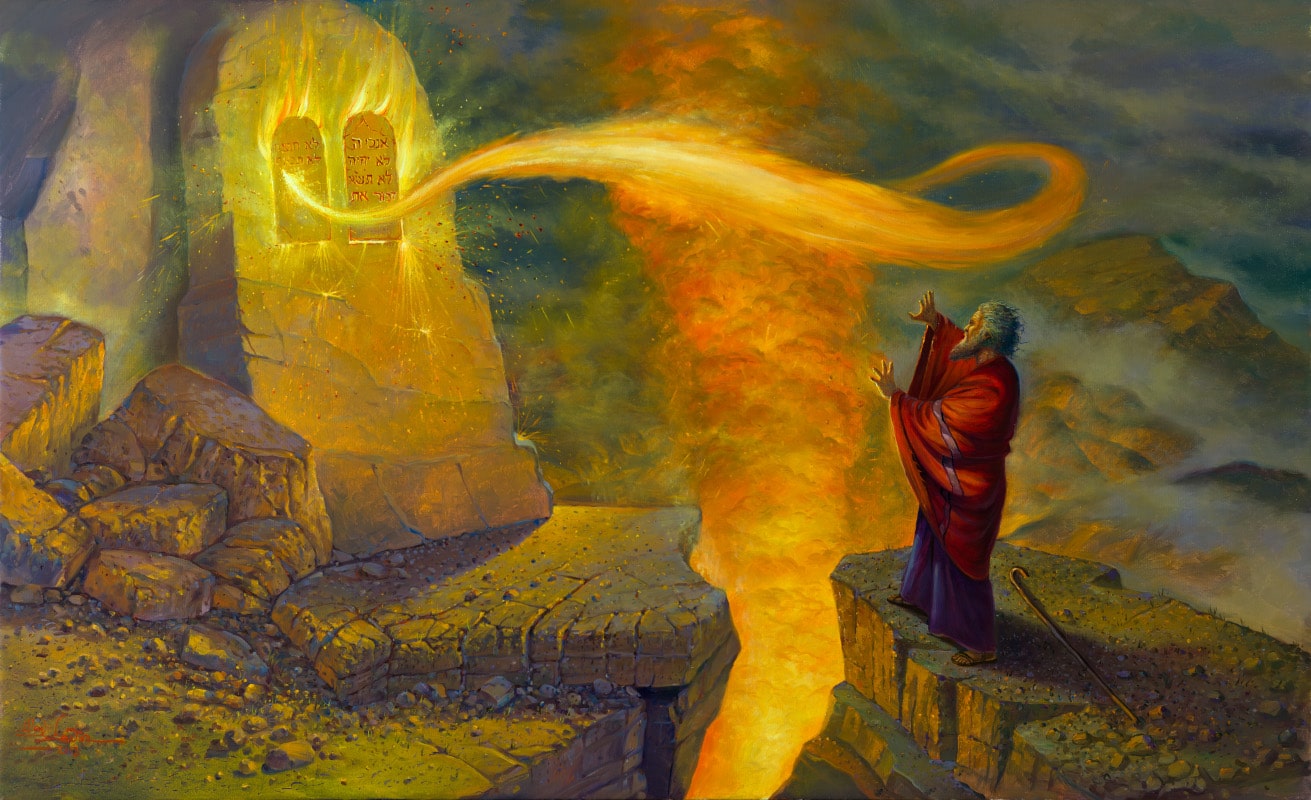
Mount Sinai is another central subject in depictions of Moses.
After the Exodus, the Israelites travel into the wilderness, where Moses ascends Mount Sinai.
According to Jewish tradition, this is where Moses receives the Torah and the commandments that form the foundation of the covenant between God and Israel.
Artists may portray Moses alone on the mountain, surrounded by clouds, fire, or dramatic light, while the Israelites wait below.
Other compositions focus on Moses descending from the mountain holding the stone tablets.
Moses and the Ten Commandments in Art
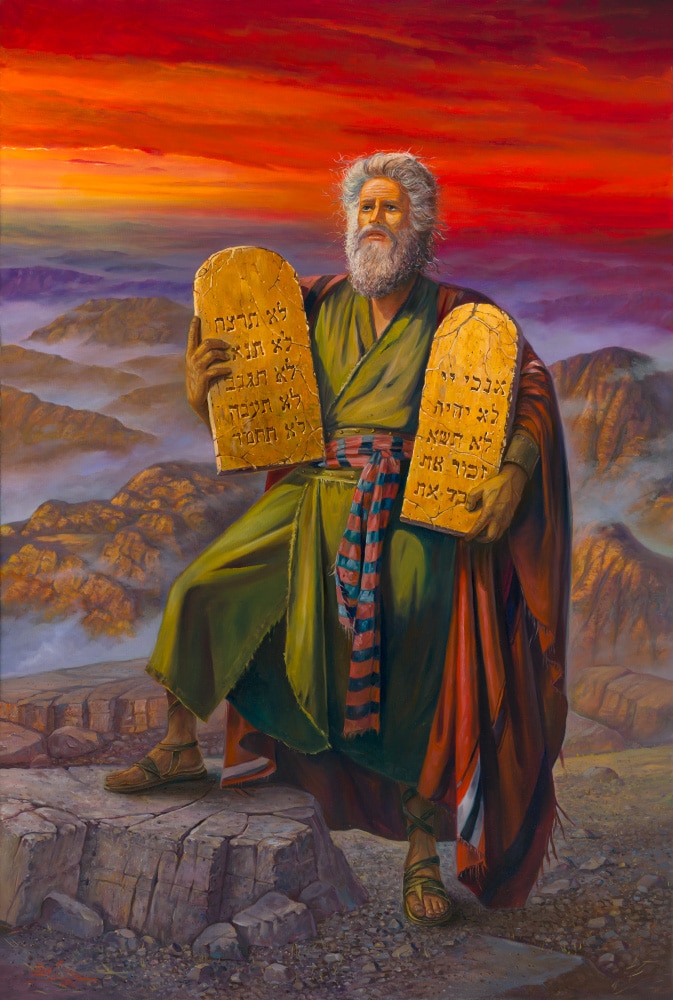
The image of Moses holding the Tablets of the Law has become one of the most recognizable representations of him.
Artists often use the tablets as the main visual attribute identifying Moses, especially in portraits where the larger biblical story is not shown.
Some works portray Moses receiving the commandments. Others show him presenting them to the Israelites or holding them after descending from Mount Sinai.
Alex Levin has also portrayed this moment in his painting of Moses receiving the Ten Commandments at Mount Sinai.
Rembrandt’s Moses With the Tablets of the Law
The Dutch master Rembrandt van Rijn painted one of the best-known images of Moses in 1659.
The painting, commonly known as Moses with the Tablets of the Law or Moses Breaking the Tablets of the Law, portrays the dramatic moment associated with Moses’ anger after discovering the Israelites worshipping the Golden Calf.
Rembrandt raises the tablets above Moses’ head, creating tension over whether the viewer is witnessing the instant before they are shattered.
The work is now in the Gemäldegalerie in Berlin.
Moses and the Golden Calf
The episode of the Golden Calf gave artists another dramatically different image of Moses.
After descending Mount Sinai, Moses discovers that the Israelites have created an idol during his absence.
The biblical narrative describes his anger as he throws down and breaks the stone tablets.
In art, this scene allows Moses to be portrayed not as a calm lawgiver but as an emotionally powerful leader confronting a crisis among his people.
The contrast between Moses holding the commandments and the crowd surrounding the Golden Calf creates one of the strongest dramatic compositions in biblical painting.
Michelangelo’s Moses
One of the most famous artistic representations of Moses is not a painting at all, but Michelangelo’s monumental marble sculpture of Moses in the church of San Pietro in Vincoli in Rome.
The sculpture portrays Moses seated with the Tablets of the Law, an enormous beard, powerful body, and intense expression.
One of its most famous features is the pair of horn-like forms on Moses’ head.
This imagery developed from the Latin biblical tradition surrounding the description of Moses’ face after descending Mount Sinai. The underlying Hebrew wording is associated with rays or radiance, while the Latin Vulgate tradition led Western artists to represent Moses with horns.
As a result, horned representations of Moses became familiar in medieval and Renaissance European art.
Moses in Medieval Jewish Art
Moses also appears extensively in medieval Jewish illuminated manuscripts.
The Haggadah, read during the Passover Seder, recounts the Exodus from Egypt and became an important form of Jewish manuscript art.
Illuminated Haggadot could contain scenes of Moses, Pharaoh, the plagues, the departure from Egypt, and the crossing of the sea.
The Rylands Haggadah, for example, contains richly illustrated scenes connected with the Exodus narrative.
These manuscripts demonstrate how Jewish artists and patrons interpreted the Exodus visually within medieval Jewish culture.
Moses in Jewish Art
Within Jewish art, Moses represents far more than a historical or biblical personality.
He symbolizes Torah, leadership, humility, responsibility, freedom, and the covenant between God and the Jewish people.
Unlike some biblical personalities who are associated primarily with one event, Moses’ story covers nearly an entire lifetime.
This gives Jewish artists a remarkable number of moments to interpret – from infancy to revelation, liberation, lawgiving, leadership, and his final view toward the Promised Land.
Moses and Passover Art
The story of Moses and the Exodus is inseparable from Passover.
Each year, the Passover Seder retells the story of the Israelites’ liberation from Egypt.
Traditional Haggadot and contemporary Jewish art frequently include imagery connected with Egypt, slavery, Pharaoh, the plagues, the crossing of the sea, matzah, and freedom.
Interestingly, Moses himself is not the central focus of the traditional Haggadah text because the story emphasizes divine redemption rather than one human leader.
In visual art, however, Moses remains one of the most recognizable figures associated with the Exodus.
Moses at the Promised Land
One of the most emotional episodes in the life of Moses occurs near the end of the Torah.
Moses is permitted to see the Promised Land from a distance but does not enter it.
For artists, the scene is quieter than the Red Sea or Mount Sinai but can be equally powerful.
An elderly Moses looking across the landscape toward the land he spent decades leading the Israelites toward can represent fulfillment, sacrifice, leadership, mortality, and hope for the next generation.
Alex Levin explores this moment in his painting Moses at the Promised Land and other works in his Moses collection.
Contemporary Paintings of Moses
Contemporary artists continue to reinterpret Moses through realism, abstraction, symbolism, and modern visual storytelling.
Some recreate the biblical world with detailed historical imagery, while others focus on spiritual themes such as freedom, revelation, responsibility, faith, and leadership.
Modern artists also have greater freedom to combine historical scenes with symbolic color, unusual perspectives, dramatic light, and contemporary design.
Moses Paintings by Alex Levin
Israeli artist Alex Levin has created a collection of paintings portraying major moments in the life of Moses.
His subjects include the burning bush, the Exodus, crossing of the Red Sea, Mount Sinai, the Ten Commandments, Moses approaching the Promised Land, and reflective portraits of the biblical leader.
Among the works are:
- Moses Crossing the Sea
- Exodus – Moses Crossing the Red Sea
- The Commandments Given to Moses at Mount Sinai
- Sacred Reflections of Moses
Explore All Moses Paintings by Alex Levin
You can also explore Alex Levin’s larger collection of Torah paintings and Jewish Life paintings.
Frequently Asked Questions About Moses in Art
Why is Moses famous in art?
Moses is associated with some of the most dramatic narratives in the Hebrew Bible, including the burning bush, Exodus from Egypt, crossing of the Red Sea, Mount Sinai, the Ten Commandments, and the journey toward the Promised Land. These scenes have inspired artists for centuries.
What are some famous artworks depicting Moses?
Famous examples include Michelangelo’s sculpture of Moses in Rome, Rembrandt’s 1659 painting of Moses with the Tablets of the Law, and Nicolas Poussin’s The Crossing of the Red Sea from the 17th century.
Are there ancient Jewish paintings of Moses?
Yes. The third-century synagogue at Dura-Europos contained numerous biblical wall paintings, including scenes from the life of Moses and the crossing of the sea.
Why does Michelangelo’s Moses have horns?
The horn-like forms reflect a long Western artistic tradition connected with the Latin translation of the biblical description of Moses after he descended from Mount Sinai. The Hebrew wording relates to radiance or rays, while the Latin tradition contributed to the image of a horned Moses.
What does Moses symbolize in Jewish art?
Moses can symbolize Torah, leadership, humility, freedom, responsibility, faith, revelation, and the covenant between God and the Jewish people.
What is the most famous painting of Moses crossing the Red Sea?
Nicolas Poussin’s The Crossing of the Red Sea, painted around 1632-1634, is one of the best-known historical paintings of the Exodus and is held by the National Gallery of Victoria in Melbourne.
Did Jewish artists depict the Exodus?
Yes. Ancient synagogue paintings and medieval illuminated Haggadot contain visual interpretations of the Exodus, including scenes connected with Moses and the crossing of the sea.
Where can I find Moses paintings by Alex Levin?
Alex Levin’s paintings of Moses, the Exodus, Red Sea, Mount Sinai, and the Ten Commandments can be viewed in the Moses Paintings collection on ArtLevin.com.