Contemporary Jewish art has a special power when it does more than decorate a wall. It can hold memory, prayer, history, and hope in one visual language. In Alex Levin’s Abstract Jerusalem Paintings – Modern and Contemporary Jewish Art collection, the city is not presented as a simple skyline. Instead, Jerusalem becomes atmosphere, light, and spiritual movement.
If you want to begin with the full collection, you can explore the Abstract Jerusalem Paintings – Modern and Contemporary Jewish Art collection and see how the artist transforms familiar sacred places into modern compositions. The result feels deeply rooted in Jewish tradition, yet fully alive in a contemporary home.
What makes this body of work especially compelling is the balance between recognition and abstraction. Viewers may see the Kotel, city walls, gates, stairs, or hints of the Temple, yet the paintings never stay at the level of illustration. Color and geometry carry the emotion. Gold suggests holiness, blue suggests distance and reflection, and layered forms suggest both the earthly city and the heavenly Jerusalem.
This is one reason the collection speaks so naturally to collectors looking for contemporary Jewish art. The paintings do not ask the viewer to choose between modern design and Jewish meaning. They offer both at once. That makes them especially strong for a living room, study, dining space, synagogue lobby, or any place where Jewish identity should feel present without becoming overly literal.
Jerusalem also carries a rare kind of visual weight. It is a city of prayer, but also of endurance. It is ancient, yet always current. In this collection, those layers are not separated. They appear together in a single image, so that a wall in one’s home can suggest memory, longing, and continuity in a way that feels refined rather than heavy-handed.
The strongest contemporary Jewish art often creates a bridge between the private and the communal. A collector may be drawn first to the color palette or composition, but then discover that the work opens into deeper themes: the Beit HaMikdash, the Western Wall, the gates of Jerusalem, or the idea of return. That is the quiet strength of Alex Levin’s approach. The paintings invite contemplation without demanding explanation.
How abstract Jerusalem works in a modern setting
Many people think of Judaica as something that must be traditional in style to feel authentic. This collection suggests otherwise. Abstract form can actually make sacred imagery more immediate in a modern interior. A gold field can evoke sanctity more gently than a literal scene. A procession of figures can feel universal while still remaining unmistakably Jewish. A skyline reduced to shapes and light can suit a contemporary space while preserving emotional depth.
That flexibility matters for collectors who want art that lives well with modern furniture, clean lines, and natural materials. Contemporary Jewish art should not feel stranded between old and new. It should belong fully to the present while carrying the past forward. These Jerusalem paintings do exactly that.
The collection also shows how variations in mood can change the experience of Jerusalem. Some works lean toward prayer and inward reflection. Others emphasize radiance, movement, or a more expansive city view. Some center the Kotel, while others reach toward the Temple or suggest the path of generations. Together, they create a visual conversation about Jewish continuity and sacred place.
Below are several paintings that capture different aspects of that conversation, from prayer at the Wall to the light of the Temple and the layered history of Jerusalem itself.
Discover the featured paintings
Light from the Kotel
This painting centers on the Western Wall as a place of gathering and prayer, using cool blues and warm gold to create a feeling of reverence and quiet movement. It is especially effective for viewers who want contemporary Jewish art that remains closely tied to a sacred landmark.
The composition suggests both intimacy and scale, making the Kotel feel present without overpowering the room. It offers a strong choice for collectors who want a Jerusalem work that feels modern, contemplative, and unmistakably rooted in Jewish life.
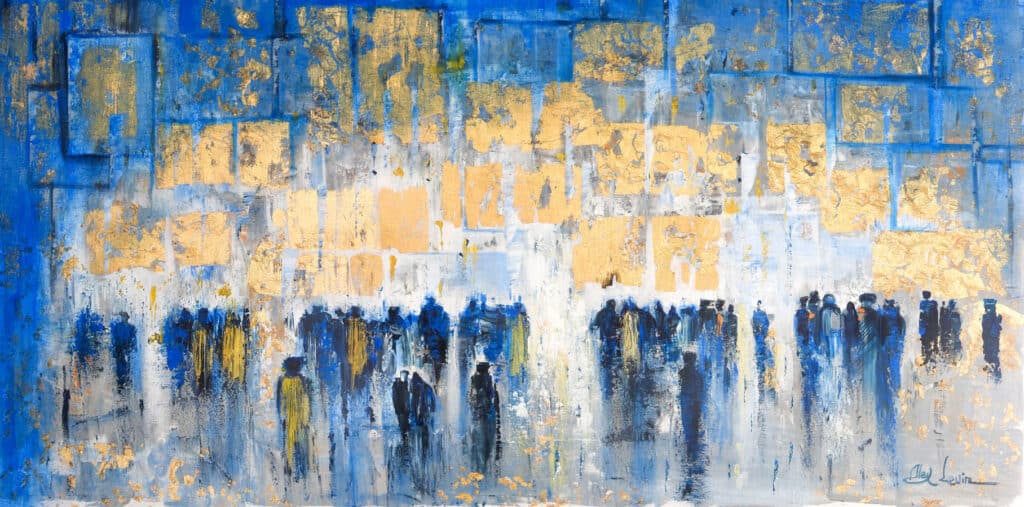
Prayerful Light
Here the emphasis is on worshippers and the atmosphere of prayer, with textured gold forms rising around the scene. The painting feels ceremonial but not static, as if light itself is part of the devotion.
This is a strong example of how abstract Jerusalem imagery can hold human presence without becoming overly detailed. It suits a collector looking for a piece that reflects communal prayer, holiness, and the emotional texture of contemporary Jewish art.

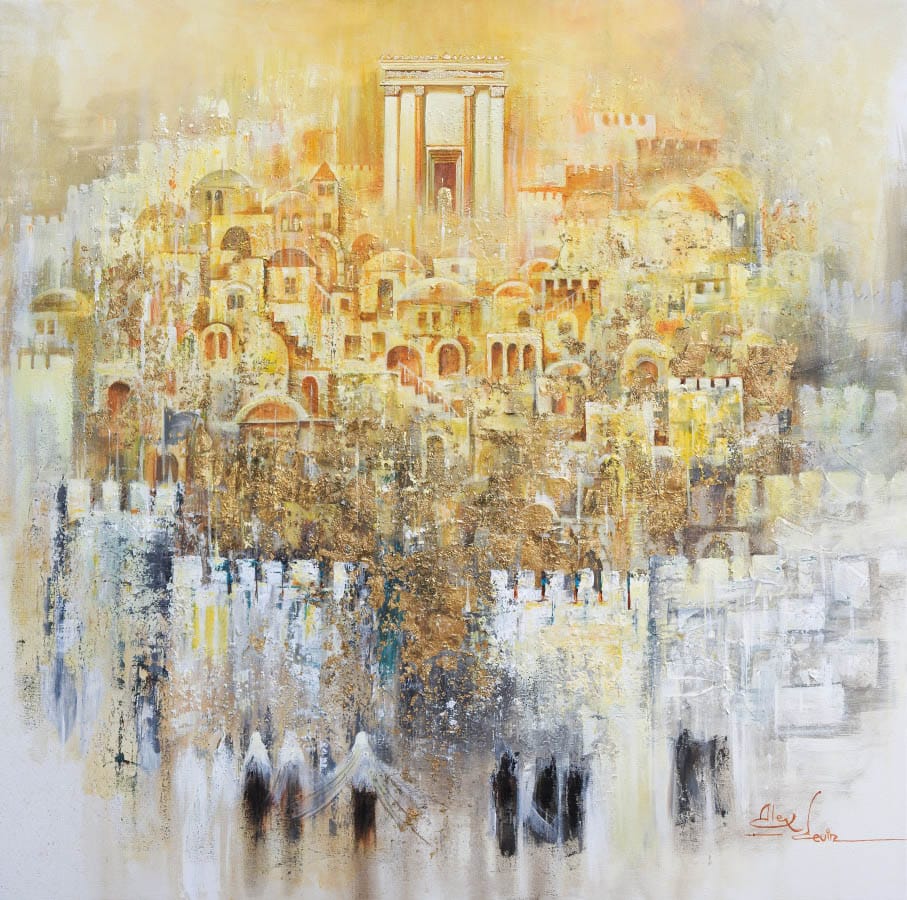
Light of the Temple
This work turns attention toward the Beit HaMikdash, placing the Temple in a luminous position above the city. The effect is symbolic and aspirational, suggesting not only history but also longing and spiritual return.
Its layered structure makes it especially meaningful for those drawn to the connection between Jerusalem today and the sacred center of Jewish memory. It is one of the clearest paintings in the collection for expressing the idea of sacred hope through modern abstraction.
Path Through the Ages
This painting focuses on the movement of generations, with figures receding into the distance beneath a golden Jerusalem horizon. The composition tells a story of continuity, pilgrimage, and Jewish endurance across time.
For collectors interested in art that feels narrative without becoming literal, this painting is an elegant choice. It captures one of the central themes of contemporary Jewish art: the way Jewish identity is carried forward through memory, passage, and return.

Golden Essence
Broad areas of gold and pale structure give this painting a radiant, almost ceremonial quality, while the city forms remain grounded and recognizable. It distills Jerusalem into color, texture, and luminous presence.
This piece is particularly suited to modern interiors because it balances abstraction with clear spiritual reference. It feels warm, elevated, and versatile, making it an appealing focal point for a home that wants Jewish meaning expressed with contemporary elegance.

Abstract Jerusalem has a unique role within contemporary Jewish art because it can carry several ideas at once – beauty, memory, prayer, and modern design. Alex Levin’s paintings do not simplify Jerusalem. They reveal different facets of it: the Wall, the Temple, the streets, the light, and the generations that continue to gather around it.
For collectors, that makes the collection especially rewarding. Each painting offers a different doorway into the same spiritual center, so you can choose the mood that best fits your space and your connection to Jerusalem. Whether you are drawn to prayer, history, or luminous abstraction, there is a work here that speaks with depth and dignity.
Explore the full Abstract Jerusalem Paintings – Modern and Contemporary Jewish Art collection to find the painting that brings that spirit into your home.