Modern Jewish art has a special way of making ancient meaning feel immediate. In Alex Levin’s Abstract Jerusalem Paintings – Modern and Contemporary Jewish Art collection, the city is not treated as a fixed monument. Instead, it becomes light, movement, memory, and prayer – all translated into a visual language that fits beautifully in a contemporary space.
What makes this body of work compelling is its balance. It is rooted in the symbols and spirit of Jerusalem, yet it does not depend on a literal view to communicate that feeling. Through color, texture, and layered composition, the paintings suggest the Western Wall, the Temple, the streets of Jerusalem, and the deep emotional pull of the city without reducing it to a postcard image. That is one reason collectors drawn to modern Jewish art often find themselves responding to these paintings so strongly: they feel both timeless and current.
For many homes, the question is not whether to choose Jewish art, but how to choose a piece that feels alive in a modern setting. Abstract Jerusalem answers that beautifully. Gold can imply holiness, blue can suggest distance and reflection, and soft white space can create the sense of air, silence, and spiritual openness. The result is art that can live comfortably in a living room, study, dining space, or entryway while still carrying a distinct Jewish identity.
There is also something deeply human in the way these paintings speak. Jerusalem is not only a place of history. It is a place of longing, return, and continuity. In modern Jewish art, those ideas are often the true subject. A viewer may be drawn first to the composition, then to the atmosphere, and finally to the feeling that the painting is asking a quiet spiritual question. What does Jerusalem mean today? How do we bring holiness into daily life? How do we honor tradition while living in the present?
Levin’s approach gives those questions room to breathe. The collection often moves between earthly and heavenly Jerusalem, suggesting both the stones of the city and the higher aspiration behind them. That makes it especially meaningful for collectors who want art that is decorative without being shallow, and spiritual without being overly formal.
Jerusalem as atmosphere, not just image
One of the strengths of modern Jewish art is its ability to tell a sacred story without relying on strict realism. In this collection, Jerusalem appears as a sequence of impressions: glowing walls, prayerful figures, architectural hints, and radiant openings that feel almost like gateways. This is not simply an artistic style choice. It reflects the emotional truth of Jerusalem as many people experience it – a city felt as much as seen.
That sensibility also makes the collection versatile. A home with clean modern lines can still welcome a painting rich in symbolism, because the abstraction prevents the image from becoming visually heavy. At the same time, the Jewish content remains unmistakable. The result is a rare combination: art that feels contemporary in form and deeply Jewish in meaning.
For collectors seeking a piece that bridges tradition and modern design, that combination matters. It means the work can serve as a focal point, a conversation piece, or a quiet spiritual anchor in everyday life.
Why this collection works so well today
Modern Jewish art often succeeds when it offers more than illustration. It should carry memory, but also mood. It should speak to heritage, but also to present-day taste. These Jerusalem paintings do exactly that. Their abstract language allows the viewer to engage personally, whether the painting is interpreted as prayer, resilience, redemption, or the enduring bond between Jewish people and Jerusalem.
If you are choosing art for a home, office, or gift, that flexibility can be valuable. One person may see the Western Wall. Another may feel the promise of the Temple. Another may simply respond to the golden light and layered calm. The painting remains open, which is part of its beauty.
To see how that vision comes together across different compositions, it helps to look closely at a few standout works from the collection.
Discover the featured paintings
Prayer at the Wall
This painting captures Jerusalem as a place of gathering and devotion. The soft figures below the luminous wall create a feeling of shared prayer, while the gold and pale tones suggest holiness without overwhelming the composition.
It is an especially strong choice for collectors who want modern Jewish art that feels serene, reverent, and visually balanced in a contemporary interior.

Roots of Light
Here the Temple rises through a language of facets and fire, turning sacred memory into a bold abstract statement. The composition gives the impression of ascent, as if the eye is being led upward from the city toward something higher.
Among modern Jewish art works, this one is particularly compelling for viewers who want the Beit HaMikdash theme expressed with energy, symbolism, and a strong contemporary presence.
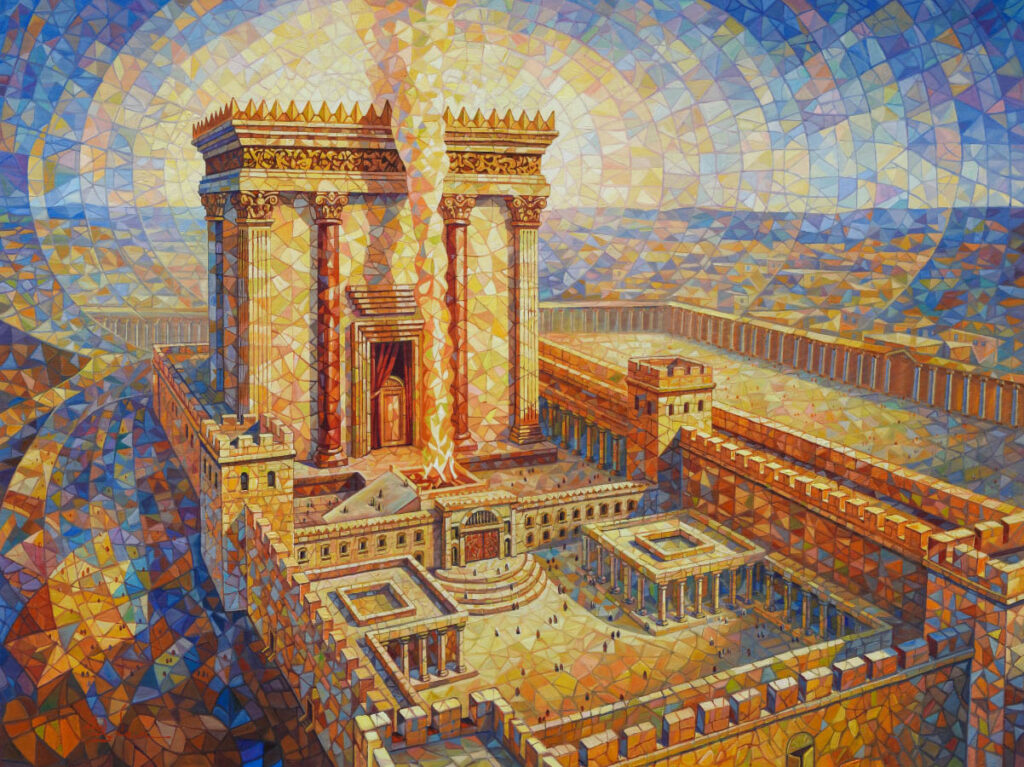
Golden Ascent
This painting weaves together Jerusalem architecture, worshippers, and the radiant form of the Temple into a layered spiritual scene. The arches and gold surfaces create a sense of movement between earthly city and heavenly vision.
It is well suited to anyone looking for a Jerusalem-centered work that feels elevated, luminous, and deeply connected to Jewish hope and continuity.

Quiet Faith
This work focuses on the emotional pull of the Western Wall through cool blues, pale gold, and reflective space. The figures feel small in the presence of the wall, which enhances the intimacy of the prayerful moment.
For collectors drawn to understated modern Jewish art, it offers a calm and contemplative interpretation of the Kotel that can anchor a room without dominating it.

Jerusalem in Gold
This panoramic composition emphasizes the city’s stone presence and the grandeur of light over it. The structure of the work gives Jerusalem a monumental quality while still preserving abstraction and openness.
It is a strong finishing piece for the collection because it brings together the essential mood of modern Jewish art: heritage, radiance, and a contemporary visual rhythm.

Modern Jewish art becomes especially powerful when it does not simply describe Jerusalem, but lets us feel its presence in a new way. Alex Levin’s abstract Jerusalem works do that with confidence and sensitivity, offering collectors paintings that are elegant, meaningful, and suited to modern living.
If you are exploring a piece for your home or searching for a gift with lasting spiritual depth, this collection offers many ways to connect with Jerusalem through color, light, and form. Each painting carries its own atmosphere, yet all of them speak the same language of faith and continuity.
We invite you to continue through the Abstract Jerusalem Paintings – Modern and Contemporary Jewish Art collection and discover the work that feels most at home with your space and your spirit.