
Jerusalem has inspired Jewish artists for generations because it is at once a real city, a place of memory, and a symbol of spiritual longing. In painting, Jerusalem can appear as a recognizable landscape of stone walls and narrow streets, or as an imagined city filled with light, prayer, and historical memory.
For Israeli artist Alex Levin, Jerusalem has been a central artistic subject for more than three decades. His work moves between detailed views of the Old City, scenes at the Western Wall, visions of the Beit HaMikdash, and contemporary interpretations built around color, light, and symbolism.

Why Jerusalem Holds a Central Place in Jewish Art
Jerusalem occupies an exceptional place in Jewish history, prayer, and collective memory. References to the city appear throughout Jewish tradition, which helps explain why Jerusalem is represented not only as architecture but also as an idea – a place associated with continuity, return, hope, and belonging.
That dual identity gives artists unusual freedom. A Jerusalem painting may document a street, wall, or skyline with careful realism, yet the same subject can also carry emotional or spiritual meaning that goes far beyond the physical view.
The Kotel: Prayer, Continuity and Memory
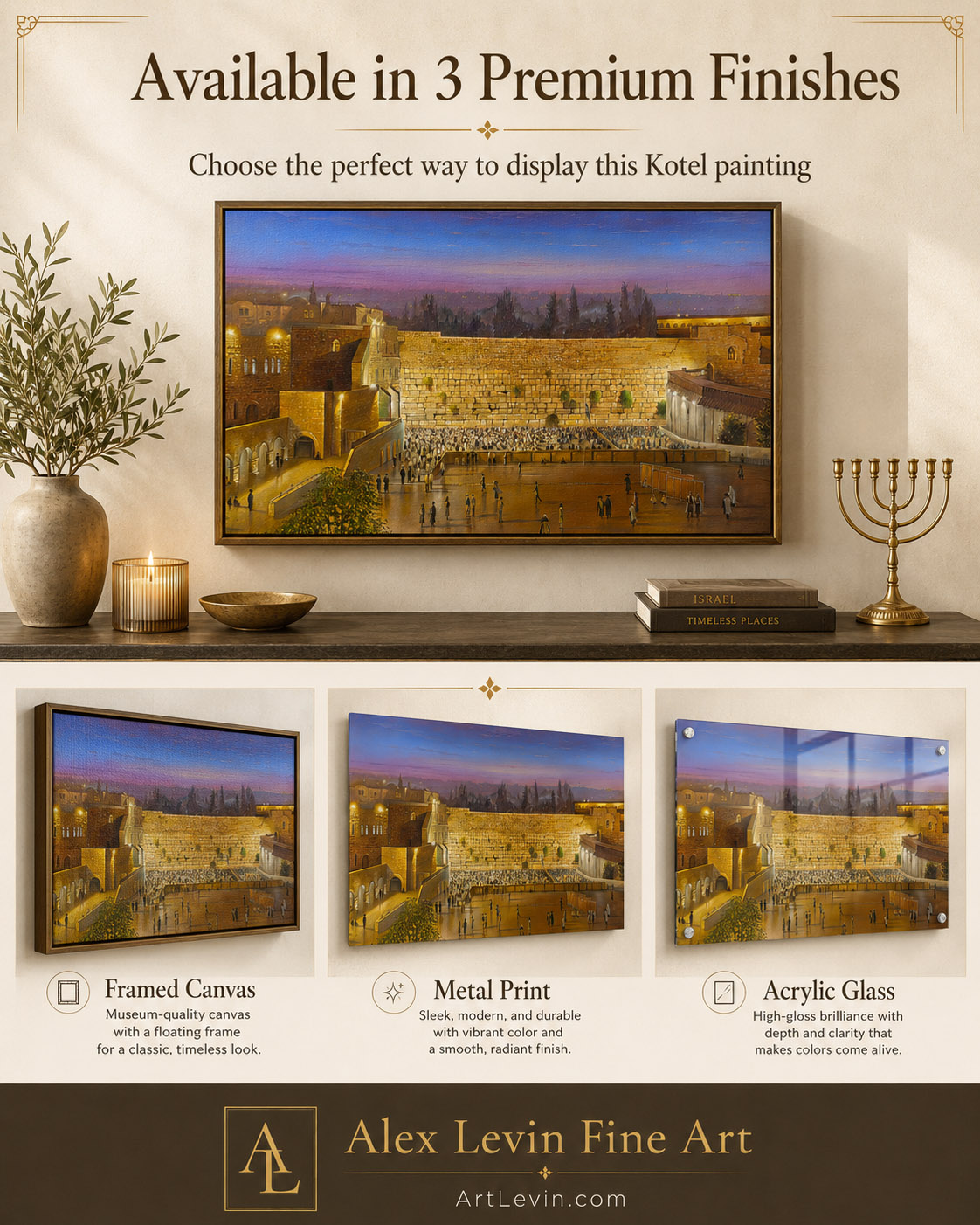
The Kotel, or Western Wall, is among the most recognizable subjects in Jewish and Jerusalem art. Artists often emphasize the contrast between monumental stone and the intimate human scale of prayer.
Figures standing close to the wall, notes placed between the stones, and changing light across the plaza can turn a familiar landmark into a deeply personal scene.
In Alex Levin’s Kotel paintings, the Western Wall appears in quiet moments as well as communal scenes. The subject allows the painting to connect Jerusalem’s ancient history with Jewish life in the present.
Explore Alex Levin’s Kotel Paintings collection
The Old City: Stone, Streets and Changing Light
Jerusalem’s Old City offers artists an endless study of texture and light. Stone arches, steps, courtyards, narrow streets, and weathered walls can look completely different in morning sun, late-afternoon warmth, or deep evening shadow.
For a painter, these streets are more than background. They create a sense of movement through layers of history. A quiet alley or doorway can communicate the age and intimacy of Jerusalem without showing a famous monument at all.
Explore Jerusalem Street Paintings
The Beit HaMikdash in Art and Imagination
The Jerusalem Temple is different from most city subjects because artists cannot simply paint it from direct observation. Artistic representations depend on historical descriptions, architectural research, religious tradition, and imagination.
That makes Temple art a meeting point between history and aspiration. Some works focus on the grandeur of ancient Jerusalem, while others emphasize themes of pilgrimage, loss, rebuilding, and hope.
Explore Jerusalem Temple Paintings – Beit HaMikdash

Jerusalem’s Gates and the Idea of Passage
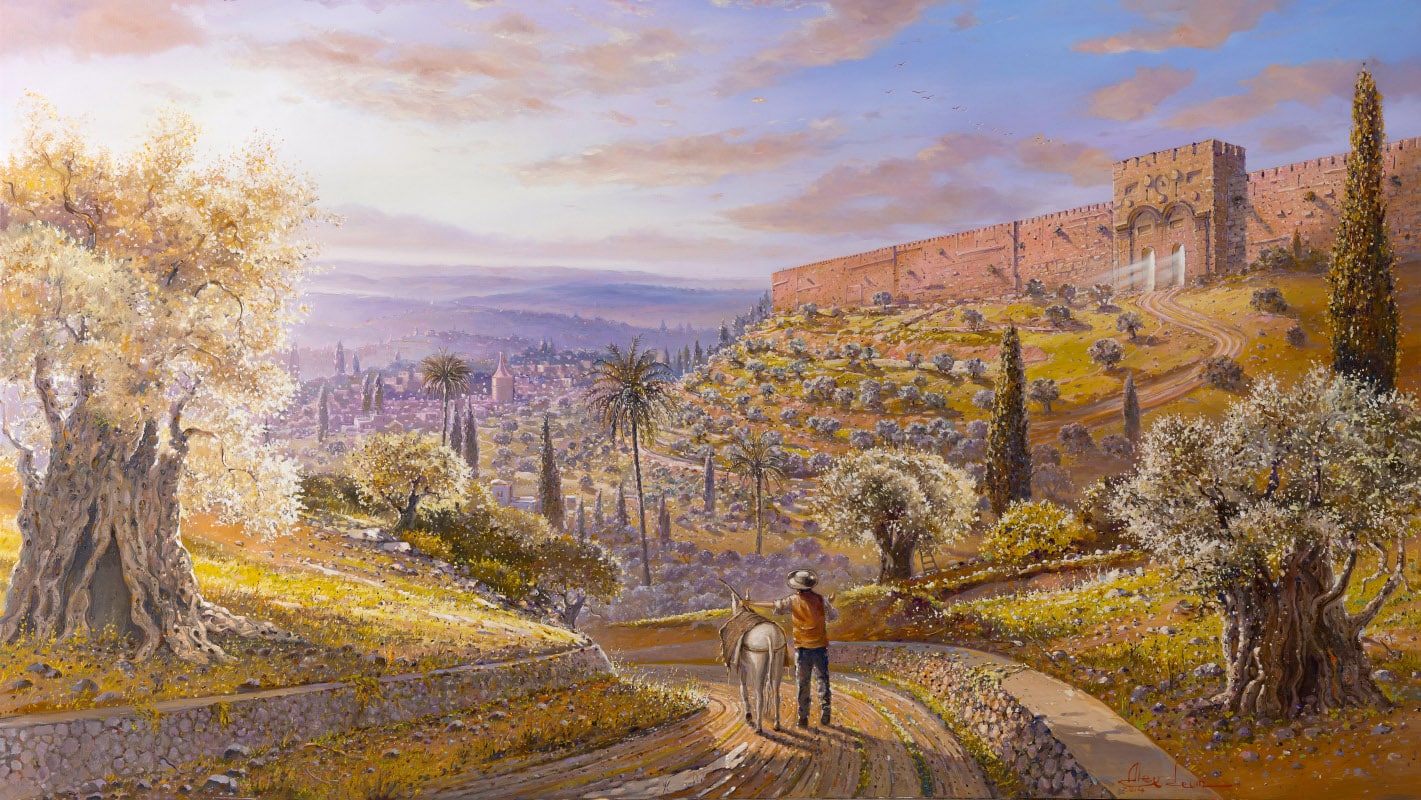
The gates of Jerusalem naturally lend themselves to symbolism. A gate marks a boundary, but it also creates an opening.
In visual art, a gate can suggest arrival, departure, protection, pilgrimage, transition, or the movement between past and present.
Historic entrances such as Jaffa Gate, Zion Gate, and the Golden Gate also give artists strong architectural forms that frame the city and its history.
Explore the Gates of Jerusalem collection
Migdal David and the Jerusalem Skyline
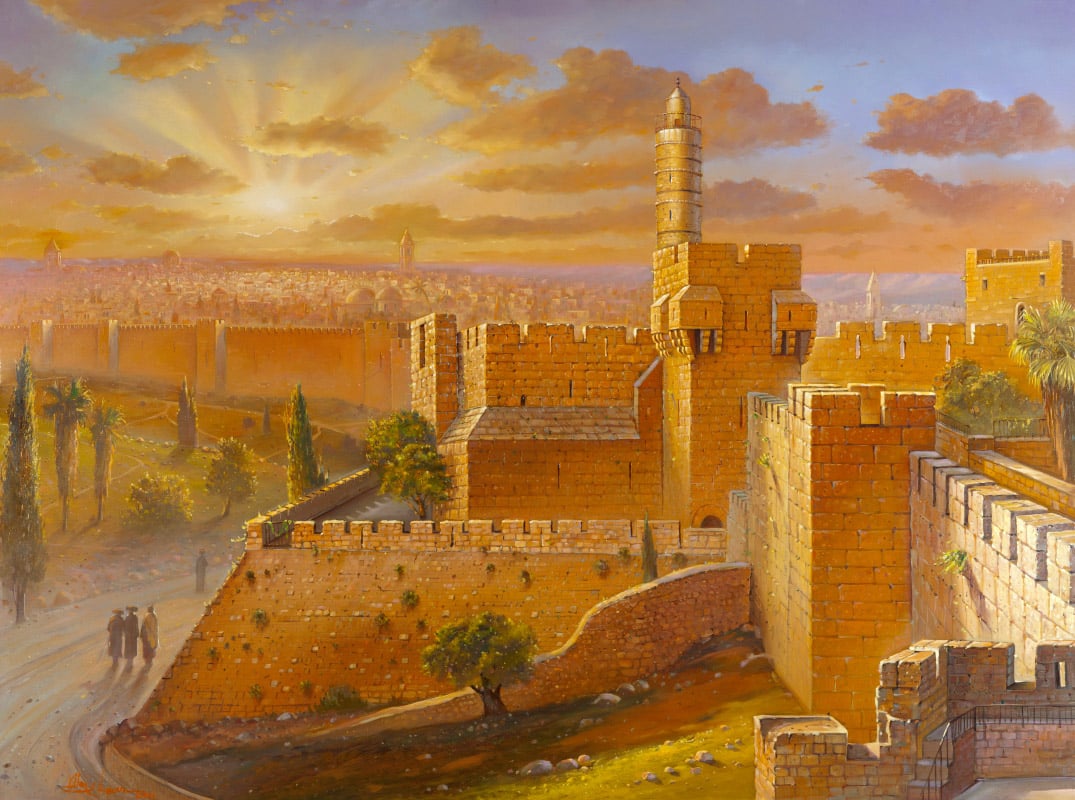
The Tower of David, or Migdal David, is one of the most familiar silhouettes near Jerusalem’s Old City.
Its vertical form, stone surfaces, and location beside Jaffa Gate make it a natural visual anchor in paintings of the western side of the Old City.
In art, the tower often functions as both landmark and symbol – immediately recognizable as Jerusalem while also suggesting the city’s long succession of historical periods.
Explore Migdal David Paintings
Traditional and Contemporary Visions of Jerusalem
Jerusalem art does not have to be realistic.
Contemporary artists may simplify the skyline, intensify color, combine several landmarks in one composition, or use abstraction to express the emotional energy of the city.
Alex Levin works across both representational and contemporary approaches. In some paintings, architectural details and Jerusalem stone dominate. In others, color, radiant light, and symbolic forms become the primary language.
Explore Contemporary Jerusalem Paintings

Alex Levin’s Jerusalem
Alex Levin’s relationship with Jerusalem is personal as well as artistic. After immigrating to Israel in 1990, Jerusalem became one of the defining subjects of his work.
His multilayered approach combines tempera underpainting with layers of oil paint, allowing light and depth to build gradually across the surface.
That technique is especially suited to a city whose stone can shift from pale gold to amber, rose, and shadow over the course of a day.
Across realistic and contemporary works, Levin returns to the same central idea: Jerusalem is not only a place to depict, but a city whose history, faith, memory, and light can be interpreted again and again.
Explore Alex Levin’s Jerusalem Paintings
Jerusalem Art as Part of the Jewish Home
Jerusalem artwork is often chosen for Jewish homes because it can carry meaning beyond decoration.
A Kotel scene may recall prayer or a personal visit to Jerusalem. An Old City street may evoke the experience of walking through ancient neighborhoods. A Temple painting may express historical memory and hope.
The style can range from highly detailed realism to contemporary abstraction, which allows Jerusalem art to work in traditional as well as modern interiors.
The most meaningful choice is often the image that creates an immediate personal connection to the city.
Explore Jerusalem Art by Subject
- Jerusalem Paintings
- Kotel Paintings
- Jerusalem Temple Paintings
- Jerusalem Street Paintings
- Contemporary Jerusalem Paintings
- Migdal David Paintings
- Gates of Jerusalem
Frequently Asked Questions About Jerusalem in Jewish Art
What does Jerusalem symbolize in Jewish art?
Jerusalem can symbolize Jewish history, prayer, spiritual longing, continuity, memory, and hope. The meaning depends on the subject and the artist’s interpretation.
What are common subjects in Jerusalem paintings?
Common subjects include the Kotel, Old City streets, Jerusalem’s walls and gates, the Tower of David, the Beit HaMikdash, and panoramic views of the city.
Why is the Kotel such an important subject in Jewish art?
The Kotel combines ancient Jerusalem stone with the living practice of prayer. In art, it can express both historical continuity and intimate personal connection.
Is Jerusalem art always religious?
No. Some Jerusalem art is explicitly religious, while other works focus on architecture, landscape, history, light, everyday life, or contemporary artistic interpretation.
What is the difference between traditional and contemporary Jerusalem art?
Traditional Jerusalem art usually emphasizes recognizable architecture, landscapes, and figures.
Contemporary Jerusalem art may use abstraction, intensified color, symbolic imagery, or unconventional compositions to express the city’s atmosphere and meaning.
What is the difference between Jerusalem art and Judaica?
Judaica is a broad category connected with Jewish life, ritual, history, and culture.
Jerusalem art can be part of Judaica, but it can also be collected as Israeli landscape, architectural, or contemporary art.
How do I choose a Jerusalem painting for my home?
Start with the subject that has the strongest personal meaning to you, then consider the room’s size, colors, and style.
Kotel, Old City, Temple, gates, and contemporary Jerusalem works each create a different atmosphere.