Israel has developed one of the most distinctive art scenes in the world, shaped by immigration, ancient history, religion, landscape, war, modernism, and the cultural diversity of Israeli society.
Israeli artists have worked in nearly every major artistic style, from early landscape painting and biblical art to abstraction, kinetic art, sculpture, photography, hyperrealism, and contemporary installations.
Some became internationally recognized for interpreting the landscapes and history of Israel, while others developed artistic styles that reached far beyond specifically Israeli subjects.
Here are ten famous Israeli artists and painters whose work has helped shape Israeli art and bring it to audiences around the world.


1. Reuven Rubin (1893-1974)
Reuven Rubin is one of the most recognizable figures in the history of Israeli painting.
Born in Romania, Rubin studied art in Jerusalem and Europe before settling permanently in the Land of Israel in the 1920s. His paintings helped create a visual language for the emerging Jewish society of the period.
Rubin became known for luminous landscapes, biblical scenes, views of Jerusalem and Galilee, portraits, and images of everyday life.
His paintings frequently feature olive trees, hills, farmers, Jewish families, Arab neighbors, and the distinctive light of the Mediterranean landscape.
Rubin’s combination of European modernism with the scenery and culture of the Land of Israel made him one of the foundational artists of Israeli art.
2. Mordecai Ardon (1896-1992)
Mordecai Ardon was an influential Israeli painter whose work combined modern European art with Jewish history, biblical symbolism, mysticism, and memories of the 20th century.
Born in what is now Poland, Ardon studied at the Bauhaus in Germany before immigrating to Mandatory Palestine in the 1930s.
He later became an important figure in Israeli art education and served as director of the Bezalel School of Arts and Crafts in Jerusalem.
Ardon’s paintings often contain symbolic forms, Hebrew letters, celestial imagery, and references to Jerusalem and Jewish history.
His work is especially associated with a sophisticated form of abstraction in which color and symbolism carry spiritual and historical meaning.
3. Nahum Gutman (1898-1980)
Nahum Gutman was a painter, illustrator, sculptor, and writer whose work documented the growth of Tel Aviv and life in the Land of Israel during the early 20th century.
Born in what is now Moldova, Gutman arrived in the region as a child and later studied at Bezalel in Jerusalem.
His paintings often depict Tel Aviv, Jaffa, orchards, workers, local landscapes, and scenes of daily life.
Gutman’s colorful and accessible style helped create some of the enduring visual images associated with early Tel Aviv and the development of modern Israeli society.
His influence extended beyond painting through his illustrations and children’s books, making him an important figure in Israeli culture as well as Israeli art.
4. Moshe Castel (1909-1991)
Moshe Castel was an Israeli painter known for combining modern art with ancient Jewish and Middle Eastern imagery.
Born in Jerusalem to a Sephardic Jewish family, Castel grew up surrounded by the visual culture and history of the Old City.
After studying at Bezalel, he continued his artistic development in Paris, where he encountered the major movements of European modernism.
Castel later developed a distinctive technique incorporating basalt and other materials into his work. Hebrew letters, ancient inscriptions, biblical references, and architectural forms became recurring elements in his paintings and reliefs.
His work represents a powerful connection between ancient Jewish civilization and modern Israeli art.
5. Yaacov Agam (b. 1928)
Yaacov Agam is one of Israel’s most internationally recognized modern artists and a pioneer of kinetic and optical art.
Born in Rishon LeZion, Agam developed artworks that change visually as the viewer moves around them.
Rather than presenting a single fixed image, his paintings, sculptures, and installations often create multiple compositions depending on the viewer’s position.
Agam became internationally associated with kinetic art during the second half of the 20th century, exhibiting extensively in Europe, Israel, and the United States.
His use of movement, geometry, color, and changing perception has made his work immediately recognizable and highly influential.
6. Menashe Kadishman (1932-2015)
Menashe Kadishman was an Israeli painter and sculptor best known internationally for his brightly colored sheep portraits and monumental sculptural works.
Before becoming an artist, Kadishman worked as a shepherd on a kibbutz, an experience that later influenced one of the most recognizable themes in his art.
The sheep became a recurring symbol in his paintings, representing ideas ranging from pastoral life and innocence to sacrifice and biblical history.
Kadishman also created large public sculptures and installations, many of which explore themes of memory, loss, identity, and Israeli history.
His ability to move between playful color and serious historical symbolism made him one of Israel’s most recognizable contemporary artists.
7. Michal Rovner (b. 1957)
Michal Rovner is a contemporary Israeli artist known for photography, video, installation, and large-scale multimedia works.
Her art frequently explores themes of identity, borders, migration, archaeology, memory, conflict, and human movement.
Rather than documenting political events literally, Rovner often transforms human figures into abstract patterns and repeating movements.
This approach allows her work to address questions about individuals, societies, territories, and history without being limited to one specific event.
Her installations have been exhibited internationally and have helped establish her as an important figure in contemporary Israeli art.
8. Sigalit Landau (b. 1969)
Sigalit Landau is a contemporary Israeli artist whose work includes sculpture, installation, video, photography, and performance.
Born in Jerusalem, Landau frequently explores themes connected with Israeli geography, politics, memory, the human body, and the relationship between people and landscape.
The Dead Sea has become one of the most recognizable elements in her work.
In several projects, Landau submerged everyday objects in the highly saline waters of the Dead Sea, allowing them to become covered in layers of white salt crystals.
The transformation of familiar objects into fragile, almost archaeological forms reflects many of the recurring themes in contemporary Israeli art – memory, place, history, beauty, and change.
9. Yigal Ozeri (b. 1958)
Yigal Ozeri is an Israeli painter best known for highly detailed, photorealistic and hyperrealistic paintings.
His large-scale works frequently portray figures outdoors surrounded by dramatic natural landscapes.
At first glance, many of Ozeri’s paintings appear to be photographs. Closer inspection reveals carefully constructed surfaces created through painting.
His work explores the relationship between photography and painting as well as the boundaries between reality, memory, beauty, and artistic interpretation.
Ozeri has exhibited internationally and represents a very different direction within modern Israeli painting from the historical, biblical, or symbolic traditions associated with earlier Israeli artists.
10. Alex Levin (b. 1975)
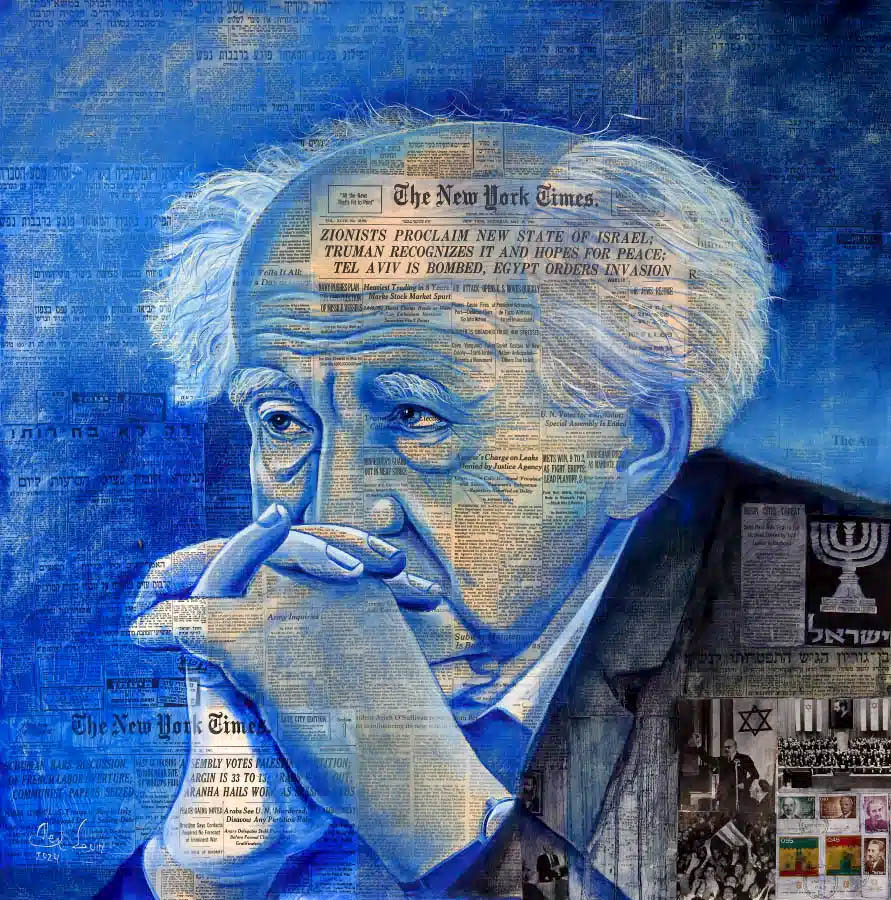
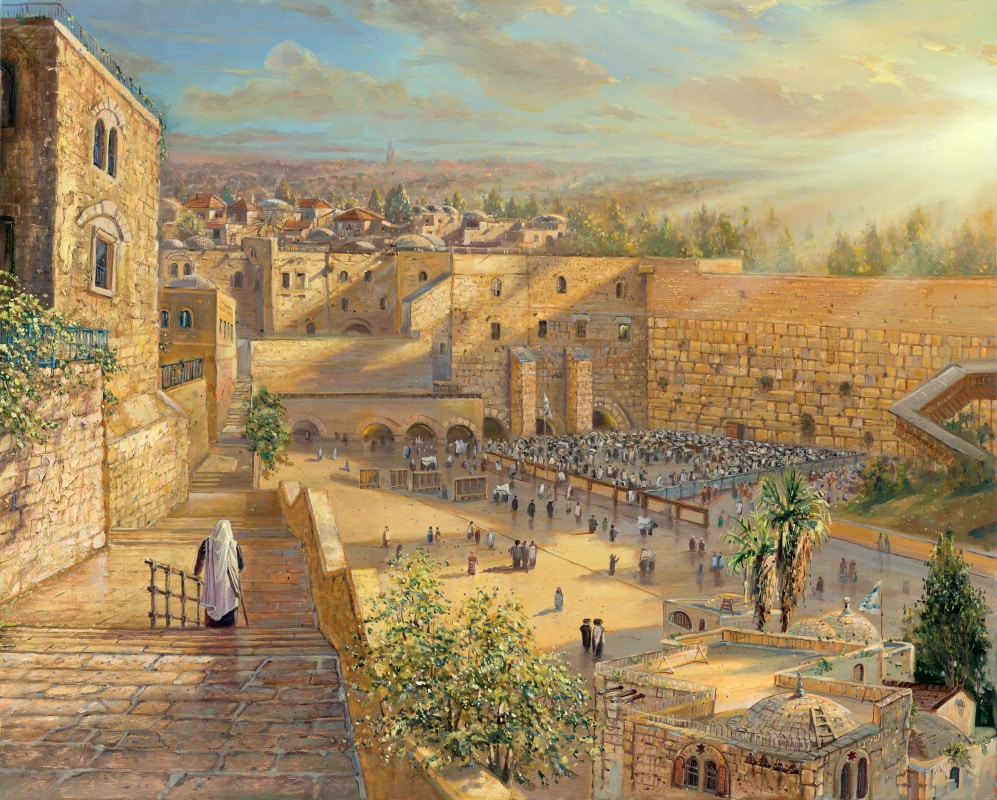
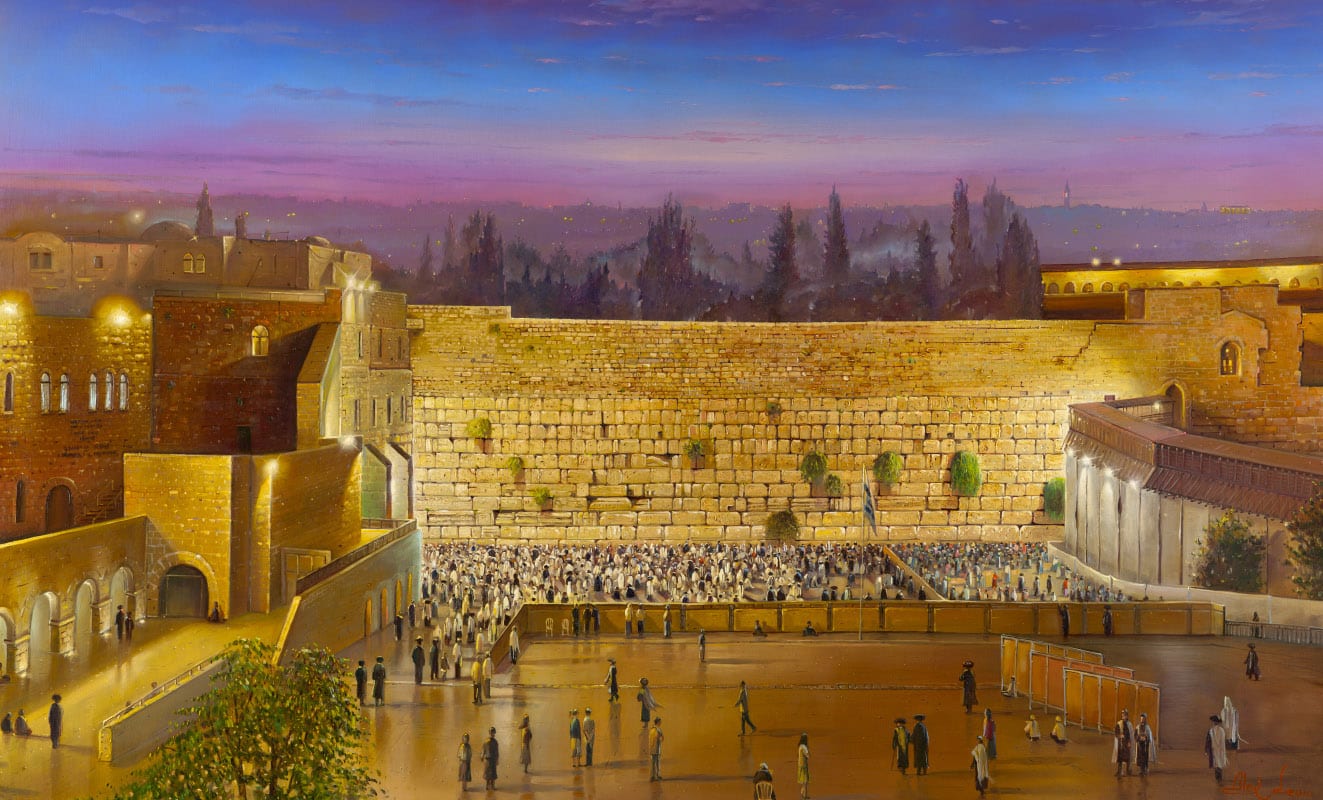
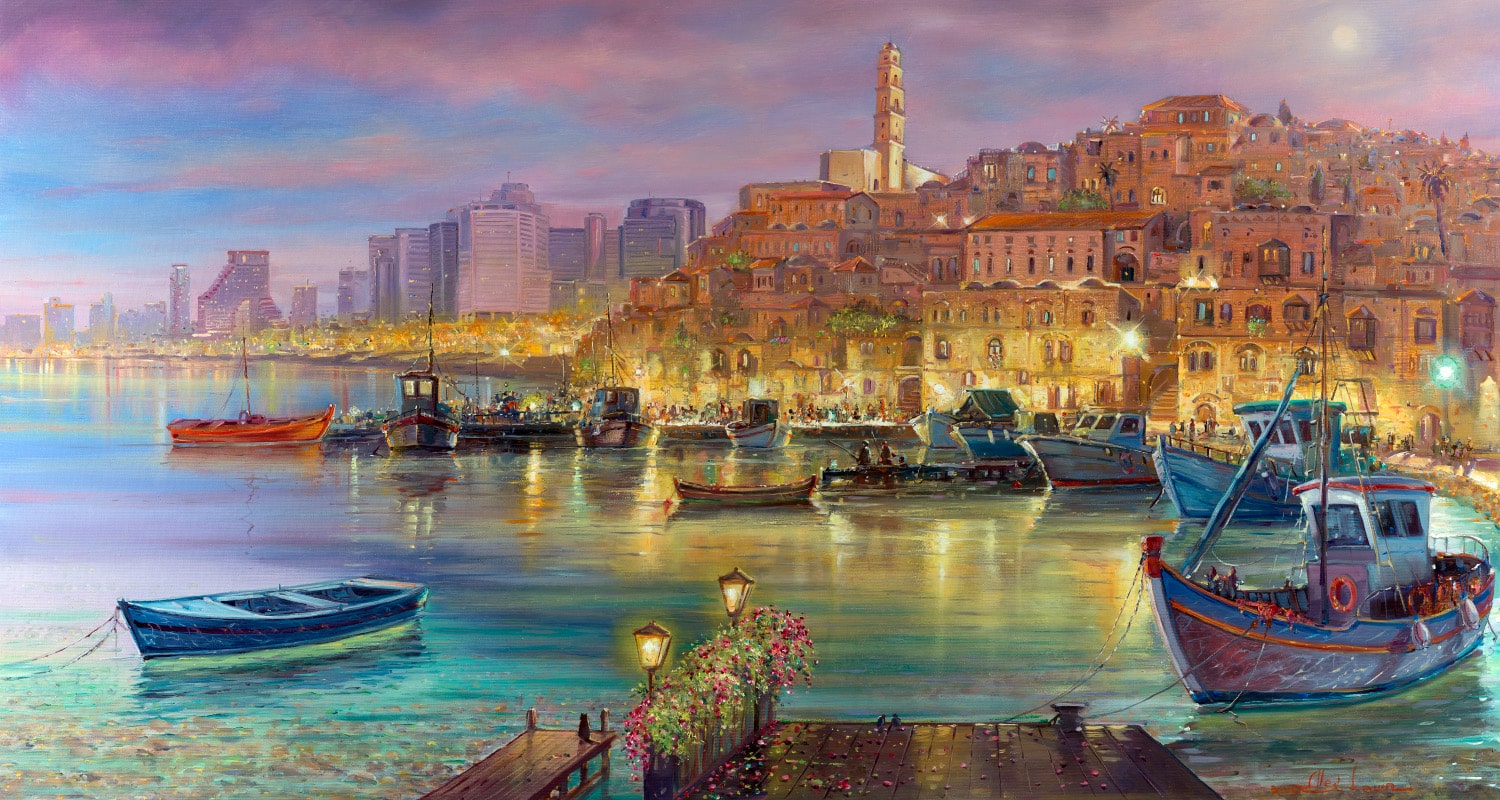
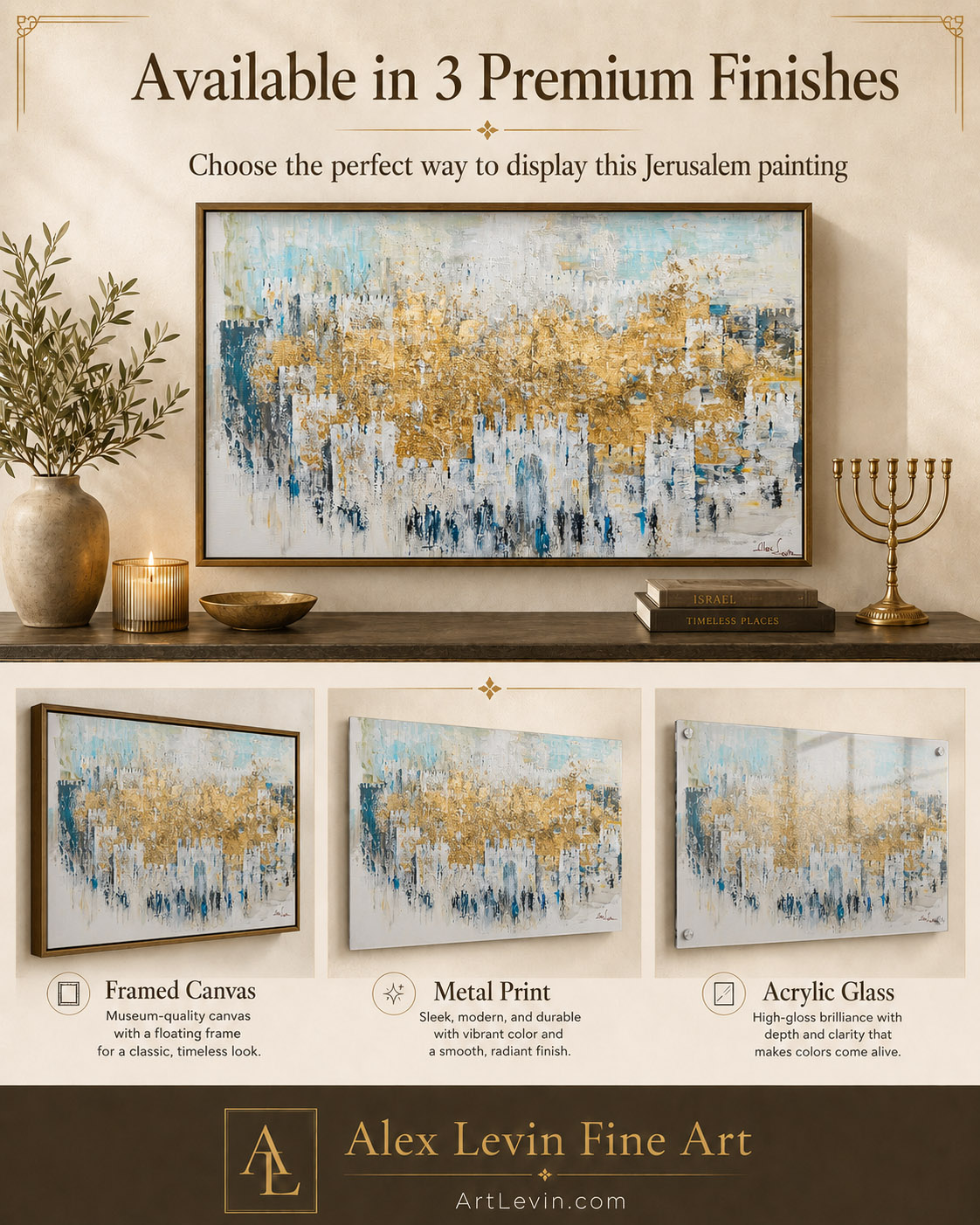
Alex Levin is a contemporary Israeli artist known particularly for paintings of Jerusalem, the Kotel, Jewish life, the Jerusalem Temple, Israel, and contemporary Jewish themes.
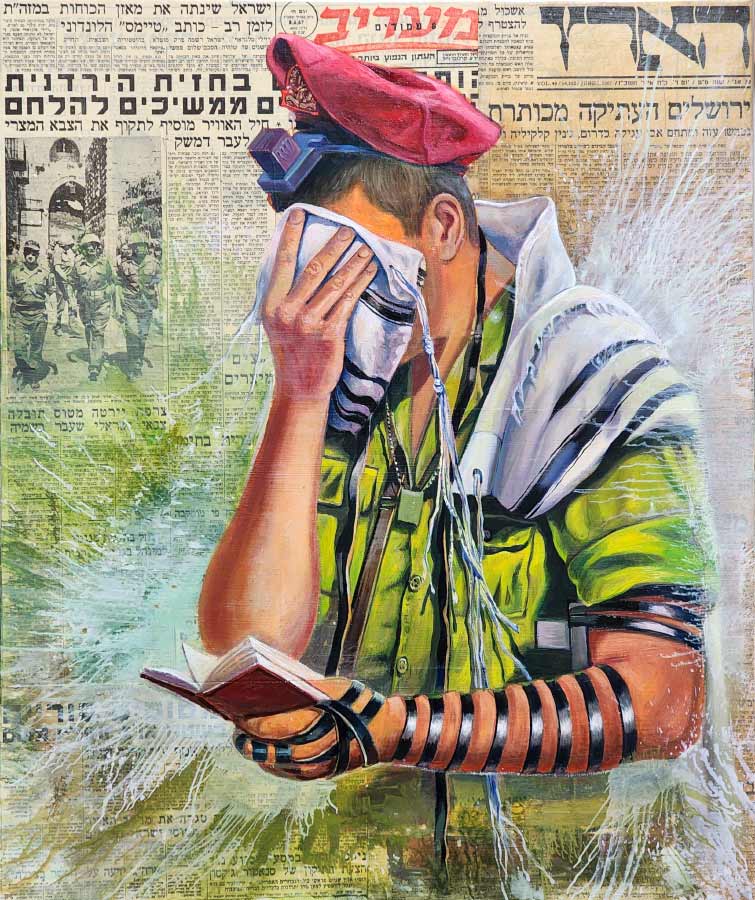
Born in Kyiv in 1975, Levin immigrated to Israel in 1990 and later served in the Israel Defense Forces.
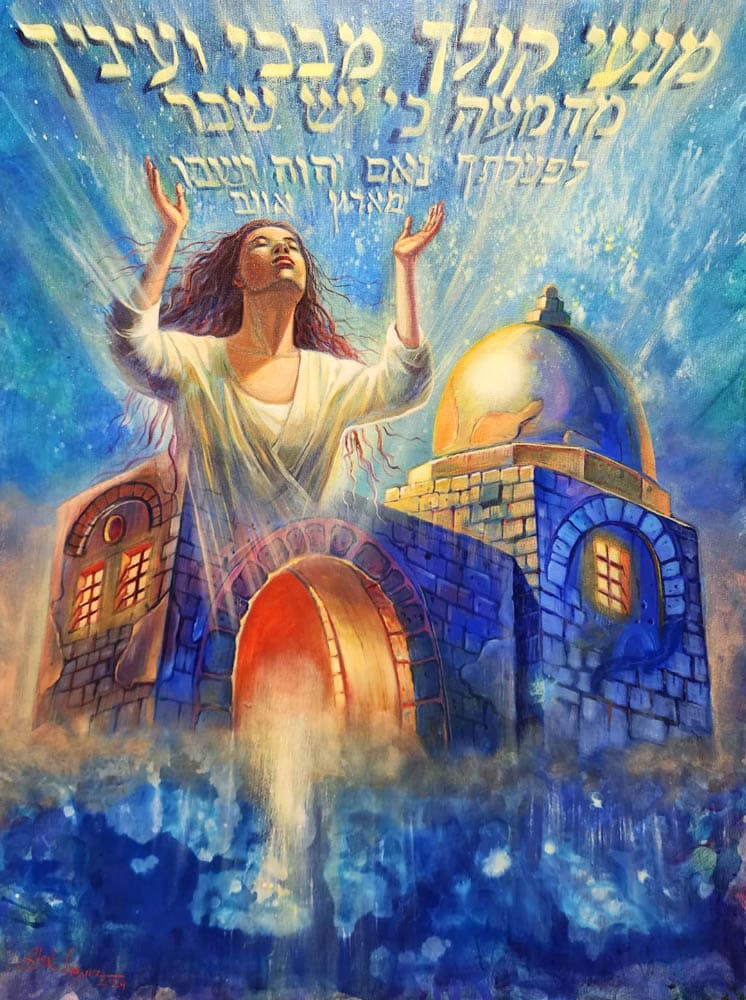
Jerusalem became one of the central subjects of his artistic career. His paintings portray the Western Wall, Old City streets, Jerusalem gates, panoramic city views, religious landmarks, and imaginative visions of the ancient Jerusalem Temple.
Levin also paints scenes of Jewish life, including Torah study, Shabbat, rabbis, Jewish holidays, shtetl communities, and family traditions.
His technique often begins with detailed preparatory work and develops through multiple layers of paint, allowing architectural detail and dramatic light to become important elements of the finished composition.
His work ranges from traditional realism to contemporary and surreal interpretations of Jerusalem and Jewish identity.
You can explore his Jerusalem paintings, Jewish Life paintings, and contemporary Jewish art.
What Makes Israeli Art Unique?
Israeli art does not have one single style.
The country’s artists come from different cultural backgrounds and have responded to dramatically different periods of Israeli and Jewish history.
Early Israeli painters often focused on the land itself – Jerusalem, Galilee, Tel Aviv, agricultural communities, biblical landscapes, and the people building a new society.
Later generations became increasingly connected with international modernism, abstraction, conceptual art, photography, installation, and multimedia work.
At the same time, subjects such as Jerusalem, Jewish history, immigration, conflict, religion, memory, archaeology, and the landscapes of Israel have continued to appear throughout Israeli art.
This combination of ancient history and contemporary experience is one of the characteristics that makes Israeli art so diverse.
Famous Israeli Painters vs. Contemporary Israeli Artists
Some of the best-known Israeli painters belong to the founding generations of Israeli art.
Artists such as Reuven Rubin, Nahum Gutman, Mordecai Ardon, and Moshe Castel helped establish new artistic identities during the first half of the 20th century.
Later artists such as Yaacov Agam and Menashe Kadishman gained international recognition while experimenting with new styles and materials.
Contemporary Israeli artists such as Michal Rovner, Sigalit Landau, Yigal Ozeri, and Alex Levin demonstrate how diverse Israeli art has become today.
Their work ranges from conceptual installations and multimedia projects to hyperrealistic painting and contemporary interpretations of Jerusalem and Jewish tradition.
Jerusalem in Israeli Art
Few subjects have inspired Israeli artists as consistently as Jerusalem.
The city’s ancient walls, narrow streets, religious sites, changing light, and layered history provide artists with an almost unlimited range of subjects.
Some painters portray Jerusalem realistically, while others interpret it through abstraction, symbolism, memory, or imagined historical scenes.
The Western Wall is particularly important in Jewish and Israeli art because it connects contemporary Jerusalem with the history of the ancient Temple Mount.
Alex Levin has created an extensive collection of Kotel paintings as well as broader Jerusalem paintings inspired by the spiritual and architectural character of the city.
Israeli Landscape Painting
The landscape of Israel has also played an important role in the development of Israeli painting.
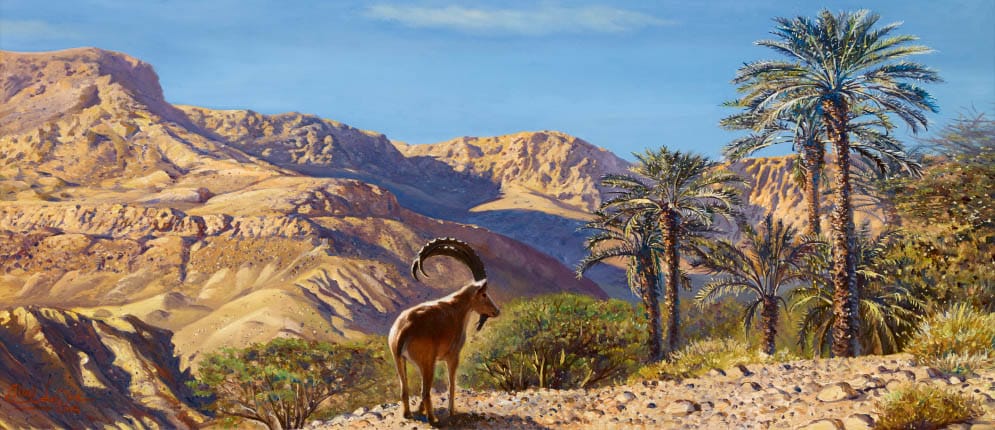
The Mediterranean coastline, Galilee, Judean Desert, Dead Sea, Jerusalem hills, olive trees, vineyards, and Sea of Galilee have all inspired generations of artists.
These landscapes are often more than simply geographic subjects. They can represent history, biblical memory, national identity, spirituality, or a personal connection with the Land of Israel.
Explore Alex Levin’s paintings of Israel and the Holy Land for contemporary interpretations of the Israeli landscape.
Explore Israeli Art by Alex Levin
Alex Levin’s artwork brings together several important traditions within Israeli art – Jerusalem, Jewish history, religious life, architecture, landscape, and contemporary artistic interpretation.
Explore Contemporary Jewish Art
Frequently Asked Questions About Israeli Artists
Who are some famous Israeli artists?
Famous Israeli artists include Reuven Rubin, Mordecai Ardon, Nahum Gutman, Moshe Castel, Yaacov Agam, Menashe Kadishman, Michal Rovner, Sigalit Landau, Yigal Ozeri, and Alex Levin. Together they represent many different periods and styles within Israeli art.
Who are some famous Israeli painters?
Well-known Israeli painters include Reuven Rubin, Mordecai Ardon, Nahum Gutman, Moshe Castel, Menashe Kadishman, Yigal Ozeri, and Alex Levin. Their styles range from early Israeli landscape painting and symbolism to hyperrealism and contemporary Jerusalem art.
What subjects are common in Israeli art?
Common subjects include Jerusalem, Israeli landscapes, Jewish history, biblical themes, immigration, identity, memory, conflict, archaeology, religion, and modern Israeli life. Contemporary Israeli artists also work extensively in abstraction, photography, video, sculpture, and installation.
Who is a contemporary Israeli artist known for Jerusalem paintings?
Alex Levin is a contemporary Israeli artist known for paintings of Jerusalem, including the Western Wall, Old City, Jerusalem Temple, streets, gates, and panoramic views of the city.
Where can I buy Israeli art?
Israeli art can be purchased through artists, galleries, museums, and specialized art websites. ArtLevin.com offers original artwork and fine-art reproductions by Israeli artist Alex Levin, including Jerusalem, Jewish Life, Israeli landscape, and contemporary Jewish art.
👉 Explore the finest Jerusalem and Jewish paintings at ArtLevin.com today!