Benjamin Netanyahu has been one of the most recognizable political figures in modern Israeli history, making his face immediately familiar both in Israel and around the world.
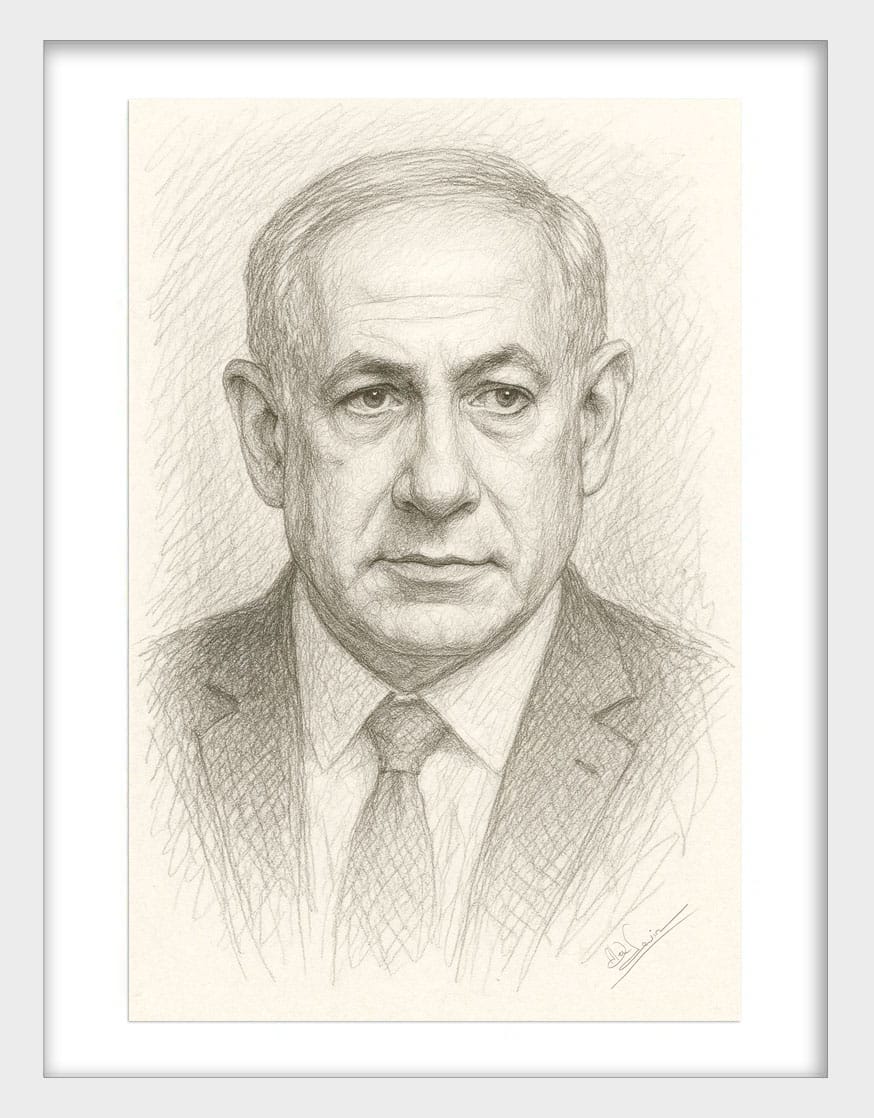
Israeli artist Alex Levin created a striking monochrome portrait of Netanyahu that focuses not on a political event or speech, but on expression, character and the visual presence of the individual.
The portrait generated significant discussion when Levin shared it publicly, demonstrating something artists have understood for centuries: a portrait of a prominent leader can become much more than a physical likeness. It can provoke questions about history, leadership, personality, memory and the relationship between art and public life.
Benjamin Netanyahu Portrait by Alex Levin
Alex Levin’s Benjamin Netanyahu portrait presents the Israeli leader in a restrained monochrome style.
Rather than surrounding the subject with flags, government buildings or political symbols, Levin concentrates attention on Netanyahu’s face.
The reduced palette places greater emphasis on light, shadow, facial structure and expression.
This approach allows the viewer to encounter the portrait first as a work of art rather than as an illustration of a particular political event.
View the Benjamin Netanyahu Portrait by Alex Levin
Why Paint Benjamin Netanyahu?
Portrait artists have always been drawn to people who become closely associated with particular periods of history.
Kings, presidents, generals, rabbis, writers, scientists and political leaders appear repeatedly in the history of portrait painting because their faces become connected with events much larger than their individual lives.
Benjamin Netanyahu has occupied a particularly prominent position in Israeli public life for decades and has served multiple terms as prime minister of Israel.
Regardless of a viewer’s political opinion, his image has become part of the visual history of contemporary Israel.
For a portrait artist, that creates an interesting challenge: how can a familiar face be transformed from a photograph or television image into a work that encourages the viewer to look more carefully?
Portraiture Is More Than Physical Resemblance
A successful portrait must usually do more than reproduce someone’s facial features accurately.
Artists also think about expression, posture, lighting, composition and atmosphere.
A slight change in the eyes, mouth, shadows or angle of the face can dramatically alter the emotional character of a portrait.
The challenge becomes especially interesting when the subject is famous.
Viewers arrive with existing memories and opinions. They may have seen the person thousands of times in photographs, speeches, interviews and news reports.
The artist must therefore find a way to make the viewer stop and look again.
The Expression in Alex Levin’s Netanyahu Portrait
In Levin’s portrait, much of the emotional weight comes from Netanyahu’s expression.
The face is presented with a serious, concentrated appearance rather than a ceremonial smile.
The viewer’s attention naturally moves toward the eyes and the strong contrasts created by the monochrome treatment.
Without a detailed background, there are few visual distractions.
The portrait becomes primarily an examination of the person.
Why Alex Levin Used a Monochrome Style
Color can immediately influence the emotional response to a painting.
Removing most color changes that relationship.
In a monochrome portrait, the artist relies more heavily on:
- Light and shadow
- Facial structure
- Line
- Texture
- Contrast
- Expression
This can give a portrait a more timeless quality.
It can also recall historic drawings, engravings and photographic portraiture while remaining a contemporary work.
Alex Levin has frequently worked with detailed tonal effects in his portraits and Jewish subjects, allowing small changes in light to define both physical appearance and emotion.
Political Leaders as Subjects in Art
Political portraiture has existed for thousands of years.
Ancient rulers placed their images on coins and monuments. European kings and queens commissioned official portraits. Modern presidents and prime ministers have been portrayed through painting, sculpture, photography, printmaking and contemporary media.
Yet not every political portrait is official or celebratory.
Artists may portray leaders admiringly, critically, neutrally or simply as historically important individuals.
The viewer can also respond in a completely different way from the artist.
This is one reason portraits of political figures often produce stronger reactions than landscapes or still lifes.
Can You Appreciate a Portrait Without Agreeing With the Subject?
Yes.
Art history contains countless portraits of controversial rulers, politicians, military leaders and public figures.
Evaluating the artistic qualities of a portrait does not require agreement with every action or belief of the person portrayed.
A viewer can study composition, technique, expression and historical context separately from political opinion.
At the same time, it is natural for personal beliefs to influence the way people respond to portraits of living political figures.
That tension is part of what makes contemporary political portraiture interesting.
The Public Reaction to the Netanyahu Portrait
When Alex Levin shared his portrait of Benjamin Netanyahu online, the image prompted a substantial public discussion.
Some viewers focused on the artistic qualities of the portrait and Levin’s ability to capture Netanyahu’s expression.
Others responded primarily to the political identity of the subject.
The range of reactions illustrated how quickly the meaning of a portrait can extend beyond technique.
Once a recognizable public figure enters an artwork, viewers bring their own history, emotions and opinions into the experience.
For the artist, that reaction can become part of the life of the artwork itself.
Art and Political Division
A portrait of a political leader can produce admiration and criticism at the same time.
This is particularly true in a society where politics generates strong emotions.
From an artistic perspective, however, disagreement does not necessarily reduce the significance of a work.
In some cases, the fact that people stop, comment, debate and examine an image demonstrates the ability of portraiture to engage viewers.
The artwork becomes a starting point for discussion about the subject, the artist and the historical moment being portrayed.
Benjamin Netanyahu in Israeli History
Benjamin Netanyahu was born in Tel Aviv in 1949 and has played a prominent role in Israeli political life for decades.
His career has included service as Israel’s ambassador to the United Nations, leadership of the Likud party and multiple periods as prime minister.
His long presence in Israeli public life means that portraits of Netanyahu can also function as visual documents of a particular era.
This is one of the traditional functions of portraiture: preserving the appearance of individuals whose lives became connected with major historical events.
Israeli Leaders in Art
Israeli artists have portrayed many of the country’s important leaders and historical personalities.
Portraits of David Ben-Gurion, Golda Meir, Menachem Begin, Yitzhak Rabin, Shimon Peres and other figures have become part of Israel’s visual culture.
These works can be found in museums, government institutions, private collections and public spaces.
Some are formal state portraits. Others are highly personal artistic interpretations.
Together they show how portraiture can help preserve the human faces associated with a nation’s history.
Portraits and Historical Memory
Photographs dominate modern political life, but painting offers something different.
A photograph captures a fraction of a second.
A painted portrait is created slowly through a series of artistic choices.
The artist decides which details to emphasize, which to reduce and how the viewer should encounter the subject.
As decades pass, these artistic interpretations can acquire historical value that goes beyond the circumstances in which they were created.
Alex Levin as an Israeli Artist
Alex Levin is an Israeli artist best known for paintings of Jerusalem, Jewish history, religious life and biblical subjects.
He was born in Kyiv in 1975 and immigrated to Israel in 1990.
His work frequently explores the relationship between contemporary Israel and thousands of years of Jewish history.
Although Jerusalem remains one of his central subjects, Levin also creates portraits, Israeli historical scenes and contemporary works.
You can learn more about his career and painting technique on the Alex Levin biography page.
Alex Levin’s Approach to Portrait Painting
Levin’s portrait work emphasizes detail and expression.
Rather than treating the face as a collection of isolated features, the composition attempts to create an overall psychological impression.
Light is especially important.
The transition between illuminated and shadowed areas can change the perceived character of a face, while subtle details around the eyes and mouth can communicate intensity, reflection, confidence or fatigue.
This attention to expression is particularly important when portraying a person already familiar to millions of viewers.
The Difference Between a Portrait and a Photograph
A photograph records light through a camera at a particular instant.
A painting or drawing is an interpretation built gradually by the artist.
The artist may spend far more time observing one expression than exists in any single moment.
Details can be emphasized or softened. Lighting can be reconstructed. Background information can be removed.
The resulting portrait may therefore feel familiar while also revealing qualities that viewers overlook in everyday photographs.
Why Black-and-White Portraits Can Feel Timeless
Monochrome portraiture has a strong connection with historical photography and traditional drawing.
Without bright color, viewers tend to notice facial structure, contrast and expression more immediately.
The limited palette can also separate the image from a specific moment.
Clothing, surroundings and contemporary colors may date an image quickly, while a monochrome face can appear more timeless.
This quality works particularly well for portraits intended to function as historical as well as personal images.
Benjamin Netanyahu Portrait as Fine Art
Alex Levin’s Netanyahu portrait is available as a framed fine-art reproduction.
The artwork presents Netanyahu in a vertical composition that emphasizes the face and expression rather than a complex background.
For collectors, it can function as political portraiture, contemporary Israeli art or a visual document connected with modern Israeli history.
View the Benjamin Netanyahu Portrait Fine Art Print
Collecting Portraits of Historical Figures
Collectors choose portraits for many different reasons.
Some admire the subject. Others are interested in history, politics, Jewish leadership or Israeli culture.
A portrait can also become part of a larger collection centered on a country, period or group of historical personalities.
Over time, contemporary political portraits may also become historical artwork documenting individuals who influenced their era.
Jewish and Israeli Portraits by Alex Levin
Portraiture forms one part of Alex Levin’s broader exploration of Jewish and Israeli life.
His subjects include rabbis, the Lubavitcher Rebbe, biblical personalities, Jewish families and contemporary Israeli figures.
These works range from detailed monochrome portraits to colorful and abstract interpretations.
Explore Jewish Portraits by Alex Levin
You can also explore Alex Levin’s Jewish Life paintings and learn about other prominent painters in our guide to famous Israeli artists.
Frequently Asked Questions About the Benjamin Netanyahu Portrait
Who painted the Benjamin Netanyahu portrait on ArtLevin.com?
The portrait was created by Israeli artist Alex Levin, whose work focuses on Jerusalem, Jewish heritage, biblical themes, Israeli history and portraiture.
Is there a Benjamin Netanyahu painting by Alex Levin?
Yes. Alex Levin created a monochrome portrait of Benjamin Netanyahu that is available as a framed fine-art reproduction on ArtLevin.com.
Where can I buy a Benjamin Netanyahu portrait?
The Benjamin Netanyahu portrait by Alex Levin is available directly through ArtLevin.com.
Why do artists paint political leaders?
Political leaders often become visual symbols of particular historical periods. Portraits can preserve their appearance, explore their personality and create artistic records of people closely associated with major events.
Is political portraiture always supportive of the person portrayed?
No. Political portraiture can be celebratory, critical, neutral, documentary or psychologically exploratory. The meaning depends on the artist, composition, context and interpretation of the viewer.
Why is the Netanyahu portrait monochrome?
The limited palette emphasizes facial structure, light, shadow and expression. It also gives the portrait a visual connection with traditional drawing and historic black-and-white photography.
Who is Benjamin Netanyahu?
Benjamin Netanyahu is an Israeli political leader who has served multiple terms as prime minister of Israel and previously served as Israel’s ambassador to the United Nations, among other government roles.
Does Alex Levin paint other Israeli and Jewish figures?
Yes. Alex Levin’s portrait work includes rabbis, the Lubavitcher Rebbe, biblical personalities and other figures connected with Jewish and Israeli history.