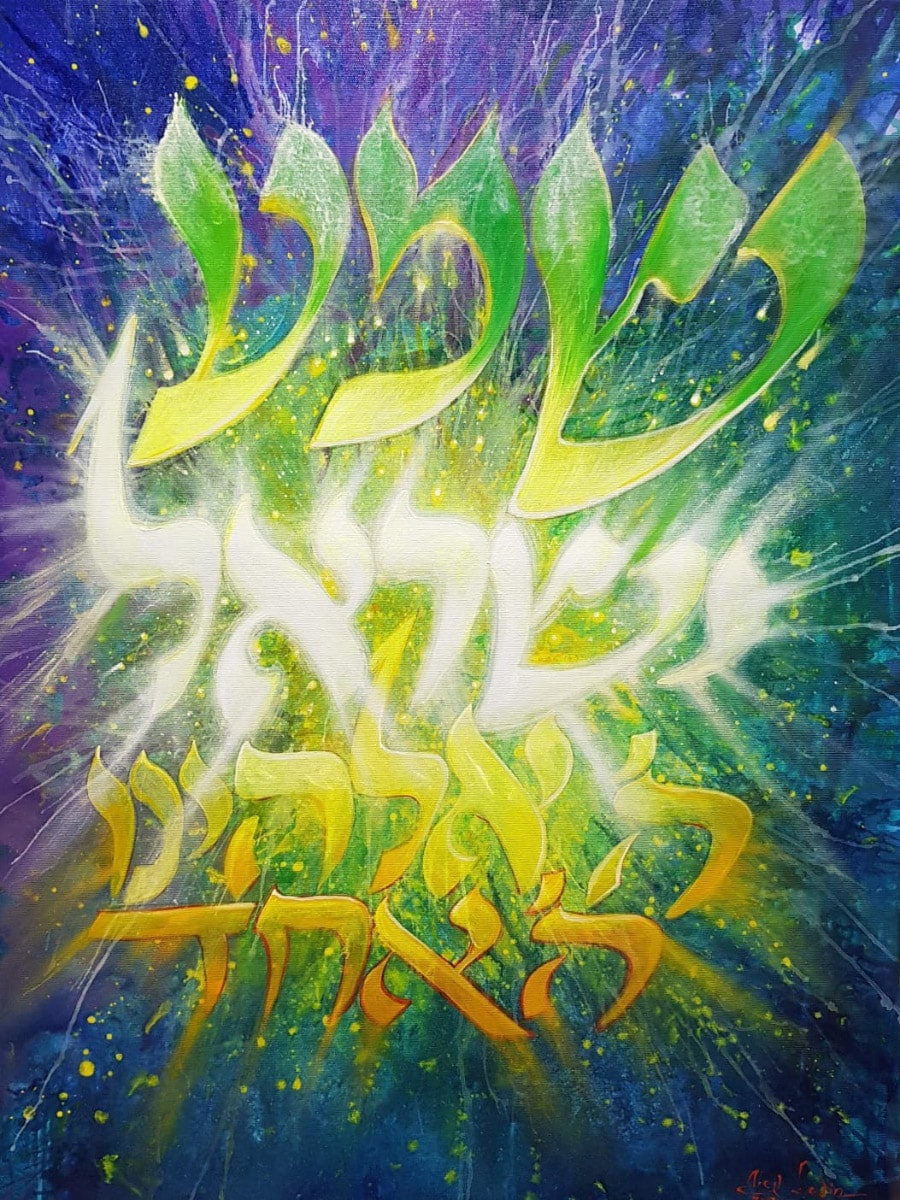
Hebrew art can describe many different forms of visual expression connected with the Hebrew language, the Bible, Jewish history, Israel, and Jewish religious and cultural traditions.
It is not one single artistic movement or style. The term may refer to ancient Israelite visual culture, Hebrew calligraphy, artwork incorporating Hebrew letters, biblical art, Judaica, Jewish painting, or contemporary Israeli art inspired by Hebrew language and Jewish identity.
From ancient inscriptions and sacred texts to modern paintings of Jerusalem, Torah, and Jewish life, Hebrew has played an important visual as well as linguistic role in Jewish art.
What Is Hebrew Art?
The phrase Hebrew art is commonly used to describe artwork connected with Hebrew language, biblical tradition, Jewish culture, or the Land of Israel.
Unlike terms such as Impressionism or Cubism, Hebrew art does not describe one formal art movement with a specific technique or period.
Instead, the term can encompass many forms of art, including ancient inscriptions and archaeological objects, Hebrew calligraphy, illuminated manuscripts, synagogue decoration, biblical paintings, Judaica, modern Israeli art, and contemporary artwork incorporating Hebrew letters and Jewish symbols.
Some Hebrew artwork is explicitly religious. Other works use the Hebrew alphabet, Jerusalem, Jewish history, or Israeli culture as visual inspiration without being intended for religious use.
Is Hebrew Art the Same as Jewish Art?
The terms overlap, but they are not exactly the same.
Jewish art is the broader term. It can include artwork related to Jewish religion, history, culture, communities, Israel, and Jewish identity even when no Hebrew language appears in the work.
Hebrew art often places greater emphasis on the Hebrew language, Hebrew letters, biblical texts, inscriptions, or visual traditions associated with ancient Israel and modern Hebrew culture.
Israeli art is another related but distinct term. Israeli artists may create Jewish or Hebrew-themed artwork, but Israeli art also includes secular landscapes, abstraction, conceptual art, photography, sculpture, and many other subjects unrelated to Judaism.
For a broader history, see our guide to Jewish art through history.
Ancient Hebrew Art
When people search for ancient Hebrew art, they are usually referring to the visual and material culture of the ancient Israelites and the kingdoms of Israel and Judah.
Unlike later European painting traditions, much of what survives from ancient Israel consists of archaeological material rather than paintings on canvas.
Archaeologists have discovered pottery, seals, carved objects, inscriptions, architectural remains, coins from later periods, religious objects, and decorative motifs that provide evidence of the visual culture of ancient Jewish society.
Written Hebrew itself also became an important part of this material culture. Ancient inscriptions preserve early forms of Hebrew writing and help historians understand the development of both the language and its script.
Ancient Hebrew Writing as Visual Culture
Writing was not simply a means of recording words. The shapes of Hebrew letters themselves became visual forms.
Ancient Hebrew inscriptions appeared on stone, pottery, seals, coins, and other objects.
The Hebrew alphabet developed over a long period. Ancient inscriptions used forms different from the square Hebrew letters familiar to readers today.
Over time, Hebrew writing evolved into the script used for Torah scrolls, prayer books, manuscripts, inscriptions, and modern Hebrew typography.
This connection between written language and visual design eventually became one of the defining elements of Hebrew and Jewish art.
Hebrew Letters in Art
The Hebrew alphabet has enormous visual potential.
Each letter has a distinctive structure, and Hebrew is written from right to left. Artists have used individual letters, complete words, biblical verses, prayers, and fragments of Hebrew text as part of visual compositions.
In traditional works, Hebrew may be presented carefully and legibly as sacred text or calligraphy.
Contemporary artists may enlarge letters, fragment them, layer them over images, turn them into abstract shapes, or combine ancient texts with modern visual styles.
As a result, a viewer does not always need to read Hebrew to experience the visual rhythm of Hebrew lettering.
Hebrew Calligraphy
Hebrew calligraphy transforms writing into visual art.
Calligraphers work with the structure, proportion, spacing, and movement of Hebrew letters to create compositions ranging from traditional religious texts to contemporary artworks.
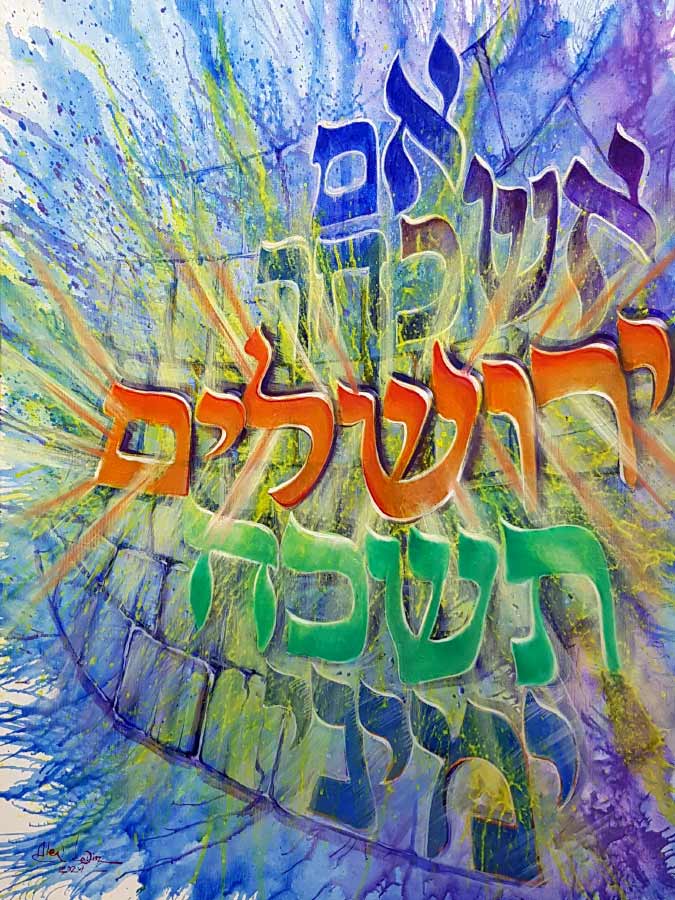
Hebrew calligraphy can appear in ketubah marriage contracts, blessings for the home, synagogue artwork, biblical quotations, Psalms, Torah verses, and decorative Judaica.
Modern artists may combine Hebrew calligraphy with watercolor, painting, digital design, gold leaf, abstract backgrounds, or images of Jerusalem.
Jewish Micrography
One particularly distinctive Jewish artistic tradition is micrography.
In micrographic art, extremely small Hebrew letters and words are arranged to form larger decorative designs or images.
A viewer standing at a distance may first see a geometric pattern, architectural shape, animal, or other image. When viewed closely, the image reveals itself to be constructed from lines of Hebrew text.
Jewish scribes and manuscript artists developed sophisticated forms of micrography over centuries, making the written Hebrew word both text and image simultaneously.
Biblical Hebrew Art
The Hebrew Bible has inspired artists for centuries.
Stories of Creation, Abraham, Isaac, Jacob, Joseph, Moses, King David, King Solomon, the Exodus, the Jerusalem Temple, and the prophets have all become subjects of art.
Biblical artwork can take many forms. Some artists attempt historically detailed scenes, while others use symbolism, abstraction, dramatic light, or contemporary settings to reinterpret ancient narratives.
The biblical stories are especially powerful visually because they deal with universal themes such as faith, freedom, family, leadership, exile, justice, hope, and redemption.
Moses and the Hebrew Bible in Art
Moses is one of the most frequently depicted figures from the Hebrew Bible.
Artists have portrayed him at the burning bush, confronting Pharaoh, leading the Israelites from Egypt, crossing the Red Sea, receiving the Torah at Mount Sinai, holding the Ten Commandments, and looking toward the Promised Land.
In Jewish art, Moses can symbolize Torah, leadership, freedom, responsibility, humility, and the covenant between God and the Jewish people.
Explore Alex Levin’s Moses paintings and Torah paintings.
Torah and Hebrew Art
The Torah naturally occupies an important place in Hebrew visual culture.
A Torah scroll is itself created through highly disciplined Hebrew writing by a trained scribe. The text must follow specific religious rules governing letters, spacing, materials, and preparation.
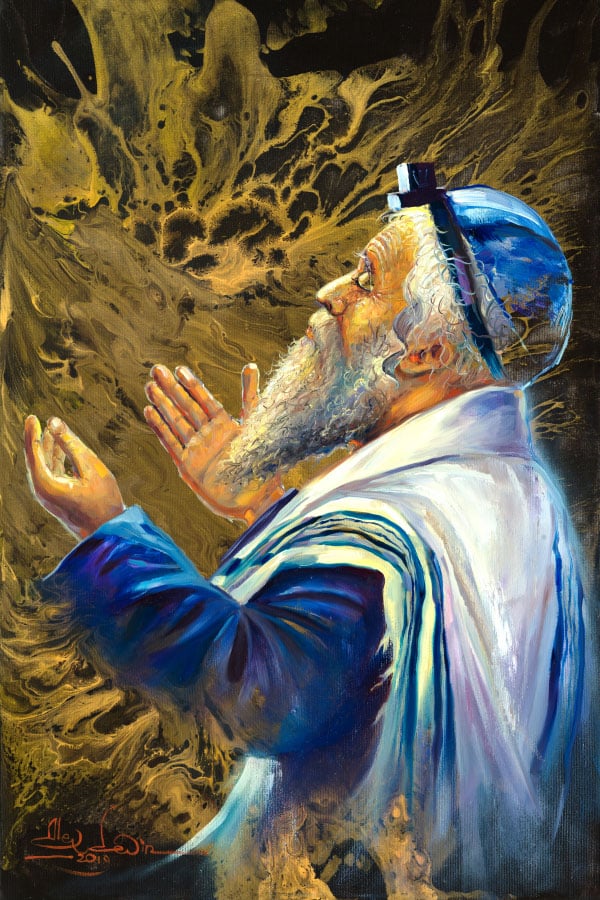
In painting, artists frequently portray Torah scrolls, rabbis studying sacred texts, children learning Hebrew, synagogues, and scholars gathered around books.
Contemporary Jewish artists may also use Hebrew verses or individual letters symbolically rather than portraying a Torah scroll realistically.
The Shema in Hebrew Art
One of the most recognizable Hebrew texts in Jewish tradition begins with the words Shema Yisrael – “Hear, O Israel.”
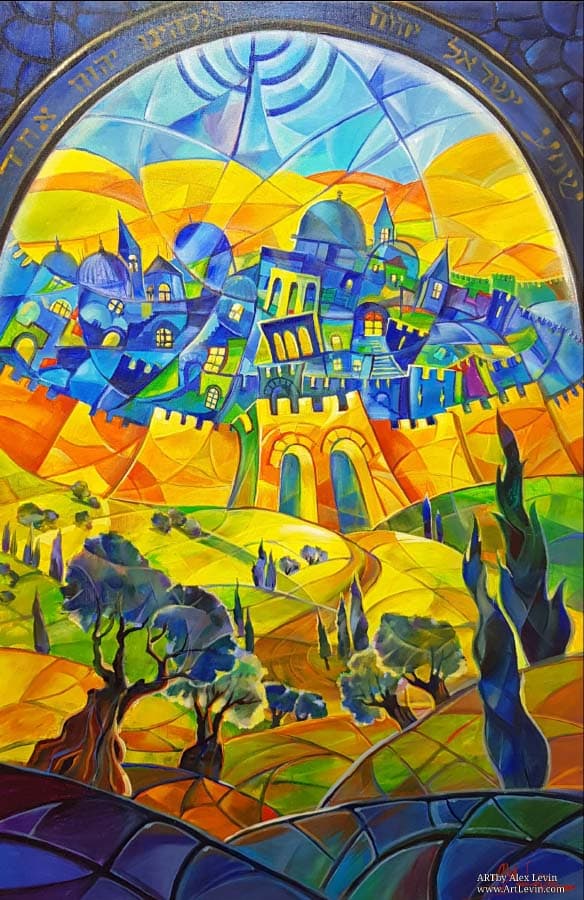
Because of its importance in Jewish prayer and identity, the words of the Shema frequently appear in Hebrew calligraphy, Judaica, synagogue decoration, jewelry, paintings, and contemporary Jewish artwork.
Artists may present the words clearly as text or integrate Hebrew letters into a larger composition involving Jerusalem, Torah, light, or symbolic imagery.
The combination of recognizable Hebrew words and visual art allows language itself to become part of the emotional meaning of the artwork.
The Menorah in Hebrew and Jewish Art
The menorah is one of the oldest recognizable Jewish symbols.
The seven-branched menorah is connected with the ancient Temple in Jerusalem and appears in Jewish visual culture going back to antiquity.
Artists have used the menorah in mosaics, carvings, manuscripts, ceremonial objects, paintings, and modern graphic design.
Today it can symbolize Jewish history, Jerusalem, the Temple, continuity, light, and Jewish identity.
Jerusalem in Hebrew Art
Jerusalem has been a central visual subject in Jewish and Hebrew art for centuries.
The city appears in manuscripts, synagogue decoration, ceremonial objects, maps, prints, paintings, and contemporary artwork.
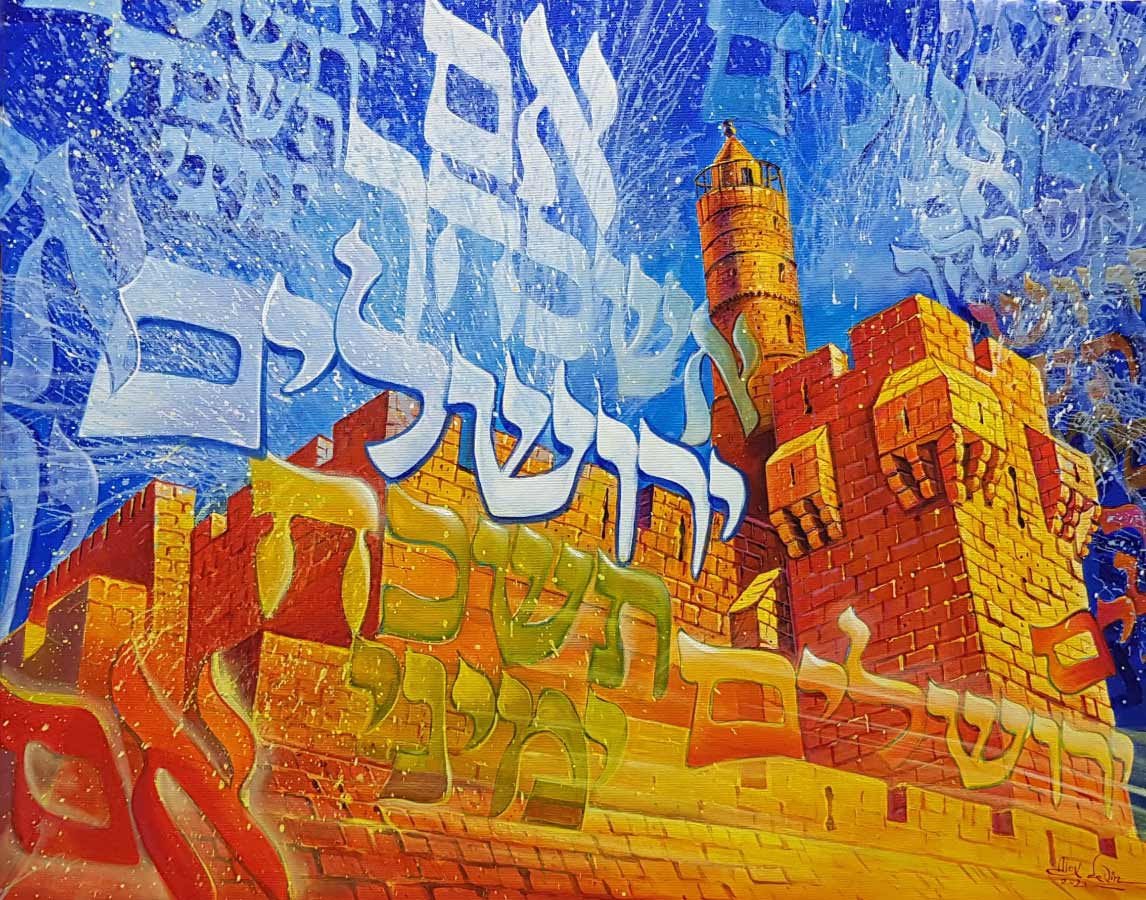
Hebrew verses and prayers about Jerusalem are often incorporated directly into these compositions.
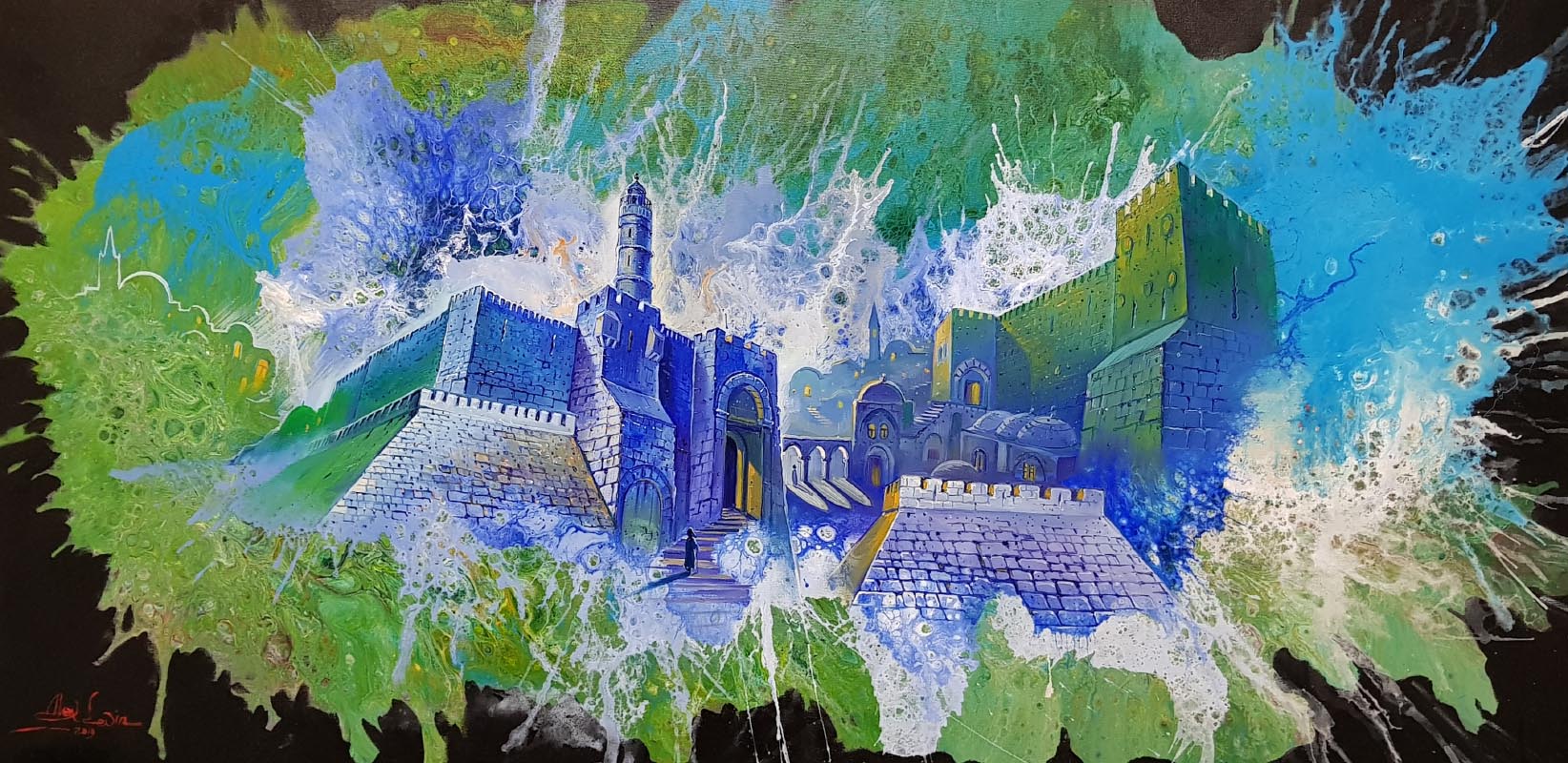
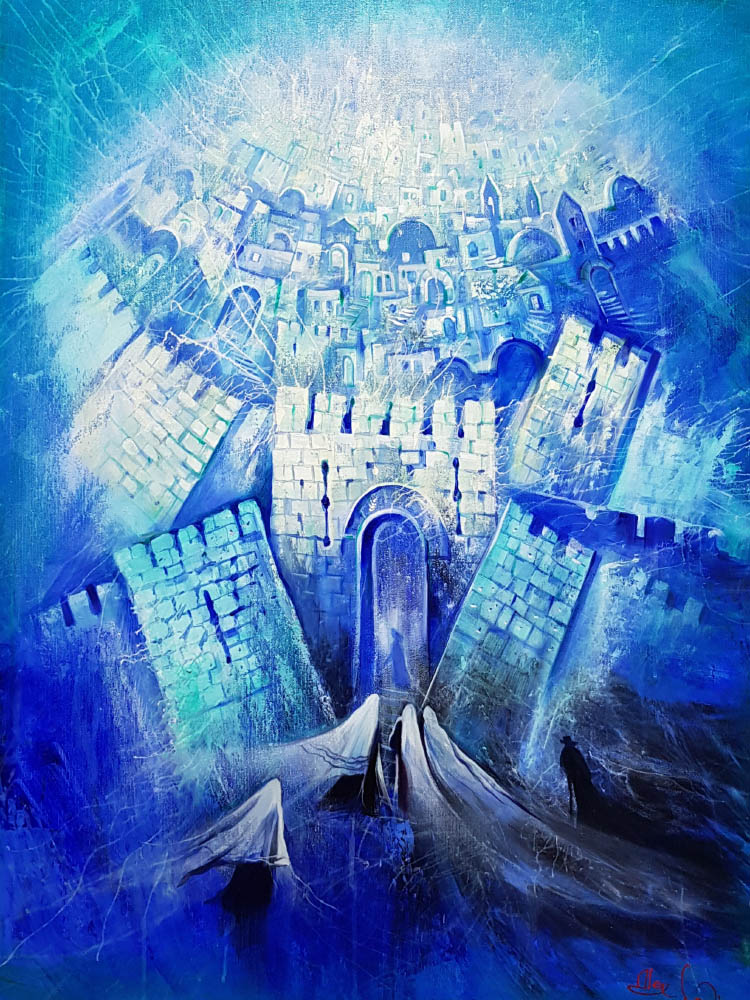
Modern artists portray the Old City, Kotel, Temple Mount, Jerusalem gates, streets, neighborhoods, and panoramic skyline while sometimes combining those images with Hebrew letters or biblical texts.
Explore Alex Levin’s collection of Jerusalem paintings.
The Kotel in Hebrew Art
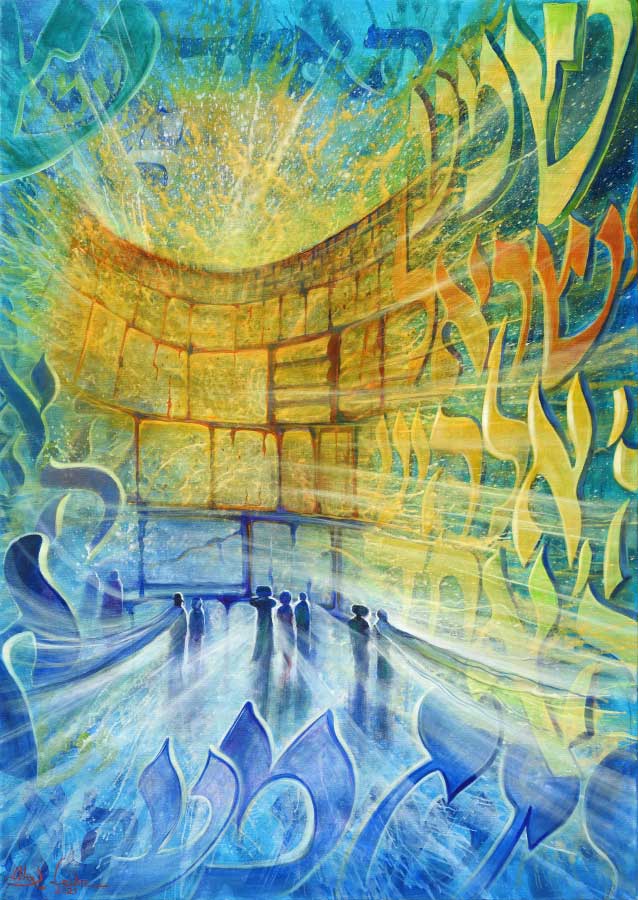
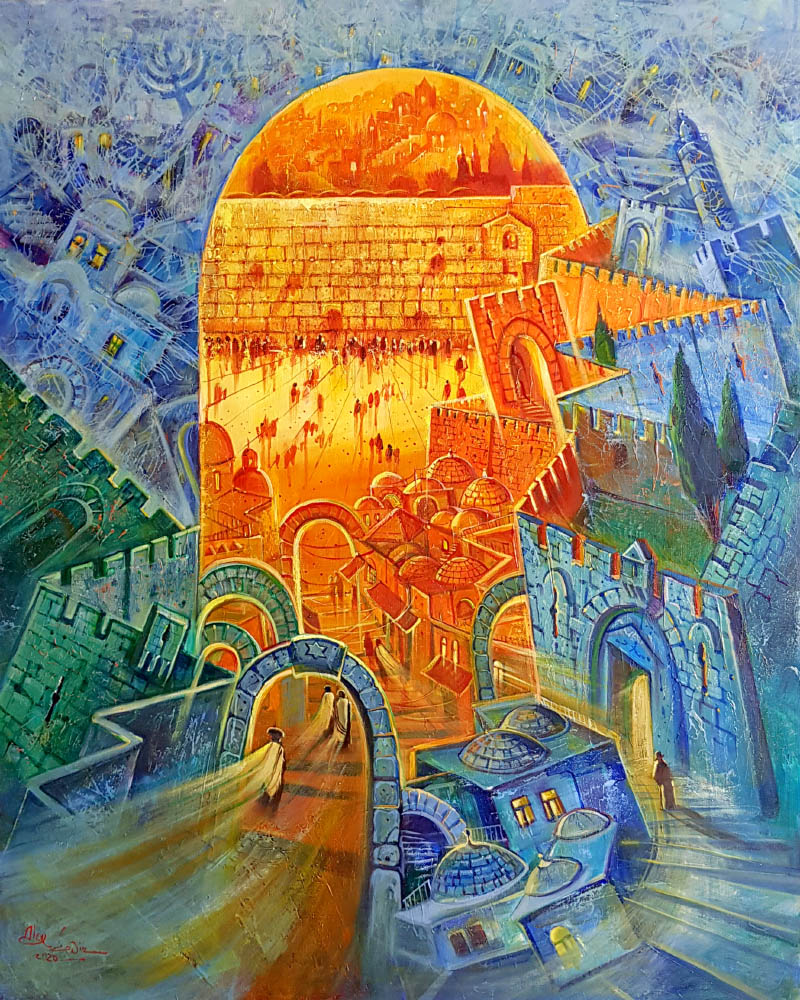
The Kotel, or Western Wall, combines architecture, history, prayer, and Hebrew language in one powerful artistic subject.
Visitors pray beside the ancient stones, read Hebrew prayer books, and place written prayers between cracks in the Wall.
Paintings of the Kotel may therefore contain both visual architecture and written Jewish tradition.
For artists, the Wall can symbolize Jerusalem, prayer, history, Jewish continuity, and the connection between contemporary Jewish life and the ancient Temple Mount.
View Alex Levin’s Kotel paintings.
Hebrew Art and the Jerusalem Temple
The First and Second Jerusalem Temples are another important subject in Jewish and Hebrew art.
Artists have attempted to visualize the Beit Hamikdash using biblical descriptions, historical sources, archaeology, architectural research, and imagination.
Hebrew inscriptions, sacred texts, menorah imagery, Temple vessels, priests, and views of ancient Jerusalem may all appear within these compositions.
Contemporary paintings can also connect the Temple with Jewish hopes concerning Jerusalem and the future.
Explore Alex Levin’s Jerusalem Temple paintings.
Modern Hebrew Art and the Revival of Hebrew
The revival of Hebrew as a modern spoken language had a profound cultural impact during the development of modern Jewish society in the Land of Israel.
As Hebrew became increasingly present in schools, newspapers, books, posters, street signs, advertising, and everyday conversation, it also became part of a new visual culture.
Early modern Jewish and Israeli artists combined European artistic influences with local landscapes, biblical imagery, Jewish symbols, Middle Eastern visual traditions, and Hebrew lettering.
The result was not one unified style but a rapidly developing artistic culture closely connected with the emergence of modern Israel.
Bezalel and Modern Jewish Art
The founding of the Bezalel School of Arts and Crafts in Jerusalem in 1906 was an important milestone in the development of modern art in the Land of Israel.
Founded by artist Boris Schatz, Bezalel encouraged artists and craftspeople to develop new forms of Jewish visual expression.
Early Bezalel works often combined biblical themes, Hebrew letters, Jewish symbols, Jerusalem imagery, European design, and decorative traditions associated with the Middle East.
The institution later developed into today’s Bezalel Academy of Arts and Design and remains an important part of Israel’s artistic culture.
Contemporary Hebrew Art
Contemporary Hebrew art can look completely different from traditional Judaica.
Artists today may combine Hebrew letters with abstraction, graffiti, digital art, surrealism, photography, sculpture, mixed media, or conceptual art.
A Hebrew word may become the central image. Individual letters may be enlarged until they become nearly abstract. Ancient texts may be layered with contemporary imagery of Jerusalem or Israel.
Other artists use Hebrew more subtly, allowing fragments of letters and text to emerge from the background of a composition.
Explore Alex Levin’s collection of contemporary Jewish art.
Hebrew Art in the Jewish Home
Hebrew artwork is commonly displayed in Jewish homes because it can combine decoration with personal meaning.
A work incorporating the Shema, a Hebrew blessing, Jerusalem, Torah, or another Jewish text can express identity and tradition while functioning as fine art.
Hebrew artwork is also frequently chosen for weddings, housewarmings, Bar and Bat Mitzvahs, anniversaries, synagogue dedications, and other meaningful occasions.
The most effective Hebrew art does not simply add Hebrew letters to a picture. The words, imagery, and composition should work together to create meaning.
Hebrew and Jewish Paintings by Alex Levin
Israeli artist Alex Levin frequently incorporates themes connected with Hebrew language, Jewish history, Torah, Jerusalem, the Kotel, and biblical tradition into his work.
His paintings range from realistic scenes of Jewish life and Jerusalem to contemporary and surreal compositions where Hebrew letters, religious symbols, architecture, light, and fragments of history become part of a larger visual narrative.
Explore Jewish Life Paintings by Alex Levin
You can also browse Torah paintings, Jerusalem paintings, and contemporary Jewish art.
Frequently Asked Questions About Hebrew Art
What is Hebrew art?
Hebrew art is a broad term for visual art connected with Hebrew language, biblical texts, Jewish history, Jewish symbols, Israel, or Hebrew cultural traditions. It can include calligraphy, manuscripts, paintings, Judaica, archaeological objects, and contemporary art.
Is Hebrew art the same as Jewish art?
Not exactly. Jewish art is the broader category and can include artwork connected with Jewish religion, history, culture, and identity. Hebrew art often emphasizes Hebrew language, letters, biblical text, or Hebrew cultural themes.
What is ancient Hebrew art?
Ancient Hebrew art generally refers to the visual and material culture associated with ancient Israelites and Judahites. Surviving evidence includes inscriptions, seals, pottery, architecture, carved and decorative objects, and other archaeological material.
What are Hebrew letters used for in art?
Artists use Hebrew letters as readable text, calligraphy, symbolic forms, patterns, or abstract visual elements. Hebrew verses, prayers, blessings, and individual letters can all become part of an artwork.
What is Hebrew calligraphy?
Hebrew calligraphy is the artistic writing and design of Hebrew letters. It can be used in biblical quotations, blessings, ketubot, Judaica, synagogue decoration, and contemporary artwork.
How do you say art in Hebrew?
The modern Hebrew word for art is אמנות (omanut).
How do you say painting in Hebrew?
A common Hebrew word for a painting or drawing is ציור (tsiyur). The verb “to draw” or “to paint” is לצייר (letsayer).
What subjects are common in Hebrew art?
Common subjects include Hebrew letters, Torah, Jerusalem, the Kotel, the menorah, biblical stories, Jewish holidays, rabbis, Jewish family life, Israel, prayers, blessings, and contemporary Jewish identity.
Where can I find contemporary Hebrew and Jewish art?
ArtLevin.com features paintings by Israeli artist Alex Levin inspired by Jerusalem, Torah, Hebrew and Jewish traditions, Jewish history, biblical themes, and contemporary Jewish identity.