Women lighting Shabbat candles is one of the most recognizable and emotionally powerful scenes in Jewish life.
As Friday afternoon turns toward evening, candles are lit before Shabbat begins. Their warm light marks the transition from the ordinary working week into the sacred atmosphere of the Sabbath.
For generations, artists have been drawn to this intimate moment: a woman standing beside the candles, covering her eyes in prayer, while the surrounding room is illuminated by soft light.
Israeli artist Alex Levin has portrayed Shabbat candle lighting in both traditional Jewish settings and contemporary compositions, using light itself as an important part of the story.
Why Do Jewish Women Light Shabbat Candles?
Lighting candles before Shabbat is a longstanding Jewish practice intended to honor the Sabbath and bring light and peace into the home.
Traditionally, the woman of the household has been given the special role of lighting the Shabbat candles.
However, candle lighting is fundamentally an obligation associated with the Jewish household rather than something that only women are permitted to perform. If there is no woman available to light, a man can fulfill the obligation.
In many contemporary Jewish families, customs surrounding who lights may vary, while traditional communities continue to place particular emphasis on the woman’s role.
What Do Shabbat Candles Symbolize?
Shabbat candles carry several layers of meaning.
Most immediately, they provide light for the home and help create an atmosphere of peace and dignity for the Sabbath meal.
Over generations, the candles also came to symbolize:
- Peace in the home
- The holiness of Shabbat
- Jewish family continuity
- Spiritual light
- The transition from weekday activity to sacred time
- Prayer and reflection
- Traditions passed between generations
Because of these associations, a painting of Shabbat candle lighting can communicate meaning even when very little else appears in the composition.
When Are Shabbat Candles Lit?
Shabbat candles are lit on Friday before sunset and before Shabbat begins.
The exact candle-lighting time depends on location, date and community custom.
Many communities use a published candle-lighting time before sunset, allowing a margin of time before the Sabbath begins.
Because the time changes throughout the year and differs by geographic location, Jewish households generally consult a local Jewish calendar or candle-lighting schedule.
Why Are Candles Lit Before Sunset?
Lighting the candles marks the approaching beginning of Shabbat.
Once Shabbat has begun, traditional Jewish law prohibits kindling a flame.
The candles must therefore be prepared and lit beforehand.
This creates one of the most noticeable weekly transitions in an observant Jewish home. Work and preparation come to an end, the candles are lit, and a different rhythm begins.
How Many Shabbat Candles Are Lit?
A widespread custom is to light two Shabbat candles.
The two candles are traditionally connected with the two biblical expressions concerning Shabbat: zachor, “remember,” and shamor, “observe” or “guard.”
However, customs vary.
Some families light additional candles, often adding one for each child. Other traditions use different numbers.
The number of candles therefore sometimes becomes a visual clue in Jewish art, suggesting details about the family portrayed.
Why Do Women Cover Their Eyes After Lighting Shabbat Candles?
One of the most familiar images of Shabbat is a woman standing in front of glowing candles with her hands covering her eyes.
In a widely practiced Ashkenazi custom, the candles are first lit, the woman covers her eyes and recites the blessing.
When she finishes the blessing and opens her eyes, she experiences the candlelight as part of welcoming Shabbat.
Customs concerning the exact order can differ among Jewish communities.
For artists, the covered eyes create an especially powerful composition because the figure is visibly engaged in an inward moment of prayer.
The Shabbat Candle-Lighting Blessing
The traditional blessing recited over the Shabbat candles is:
Baruch Atah Adonai Eloheinu Melech HaOlam, Asher Kiddeshanu B’Mitzvotav V’Tzivanu L’Hadlik Ner Shel Shabbat.
It expresses gratitude for the commandment of lighting the Shabbat light.
After the formal blessing, many women use the quiet moment to offer personal prayers for their families, children, health and other needs.
This combination of ritual and personal prayer helps explain why candle lighting has such deep emotional significance in Jewish family life.
Shabbat Candles and Prayer
The minutes surrounding candle lighting can become a particularly personal moment.
The house has often been busy with preparation for Shabbat. Food has been prepared, the table is set and family members are getting ready for the evening.
Then the candles are lit.
The physical activity stops and the atmosphere changes.
In paintings of Jewish women lighting Shabbat candles, artists often emphasize this transition by surrounding the woman with darkness while concentrating warm light around her face and hands.
Shabbat Candles and Peace in the Home
One traditional idea associated with Shabbat candles is shalom bayit – peace in the home.
Historically, having light during the evening meal was practical as well as symbolic. A dark home would hardly create a peaceful or enjoyable Sabbath meal.
Over time, this connection between candlelight and domestic peace acquired deeper spiritual meaning.
The candles became part of the atmosphere that separates Shabbat from the rest of the week.
Why Is Shabbat Candle Lighting Usually Associated With Women?
The practice became especially associated with Jewish women over many generations.
In traditional Jewish households, the woman of the home normally performs the mitzvah on behalf of the household.
This gave candle lighting a particularly strong association with Jewish mothers and the spiritual atmosphere of the Jewish home.
Yet it is important not to describe the practice as though men may never light. If a household has no woman available to perform the mitzvah, a man lights the Shabbat candles.
Girls Lighting Shabbat Candles
In some Jewish communities, girls also light their own Shabbat candle.
This is especially prominent within Chabad practice, where Rabbi Menachem Mendel Schneerson encouraged Jewish girls to begin lighting a Shabbat and holiday candle from a young age when able to participate appropriately.
The custom creates a particularly meaningful visual image: mothers and daughters bringing light into Shabbat together.
Artistically, such a scene communicates both ritual and the transmission of Jewish tradition between generations.
Shabbat as the Center of Jewish Family Life
Candle lighting is only the beginning of the Friday-night Shabbat experience.
Afterward, families may attend synagogue, return home for Kiddush over wine, bless the children, wash for bread, say the blessing over challah and share the Sabbath meal.
Each ritual contributes to a larger transformation of the home.
For an artist, the candles can therefore represent the entire Shabbat experience even when the painting portrays only the opening moments.
Shabbat Candles in Jewish Art
Shabbat candle lighting has appeared repeatedly in Jewish visual culture because it combines recognizable ritual with strong emotional and artistic possibilities.
The subject contains several visually compelling elements:
A woman’s hands can frame her face. Candlelight can illuminate the figure while the surrounding room remains dark. Silver candlesticks create reflections. White tablecloths and challah can suggest the Sabbath meal without distracting from the central moment.
The scene can be painted realistically, nostalgically, symbolically or abstractly.
The Importance of Light in Shabbat Paintings
Light is especially important in Alex Levin’s Jewish paintings.
A candle flame is physically small, yet in a dark composition it can control the entire visual atmosphere.
Warm highlights may appear on a woman’s face, hands, clothing and candlesticks while the surrounding environment recedes into shadow.
This allows physical light to become a metaphor for spiritual light.
Woman Lighting Shabbat Candles in the Shtetl
Alex Levin’s Woman Lighting Shabbat Candles in Shtetl portrays the tradition within the atmosphere of Eastern European Jewish life.
Rather than presenting candle lighting as an isolated ritual object, the painting places it within a world of Jewish family tradition.
The subject connects contemporary viewers with generations of Jewish women who welcomed Shabbat in communities throughout Eastern Europe.
For descendants of those communities, such imagery can also carry a strong sense of family memory.
Shabbat in the Shtetl
Friday evening transformed Jewish towns and villages throughout Eastern Europe.
Businesses closed, people prepared themselves for the Sabbath, candles were lit and families gathered around the Shabbat table.
After the destruction of so many European Jewish communities during the Holocaust, paintings of ordinary religious life acquired an additional importance.
They preserve visual memories of customs, interiors and family rituals belonging to a world that largely disappeared.
Explore Alex Levin’s Shtetl paintings.
Woman Honoring the Shabbat by Alex Levin
Alex Levin also interprets Shabbat candle lighting through contemporary Jewish art.
In Woman Honoring the Shabbat, the familiar ritual becomes part of a more modern composition.
The painting demonstrates how an ancient Jewish tradition can be presented through a contemporary artistic language without losing the identity of the subject.
The candles, woman and surrounding light remain immediately connected with Shabbat even as the visual treatment moves away from traditional historical realism.
Traditional vs. Contemporary Shabbat Art
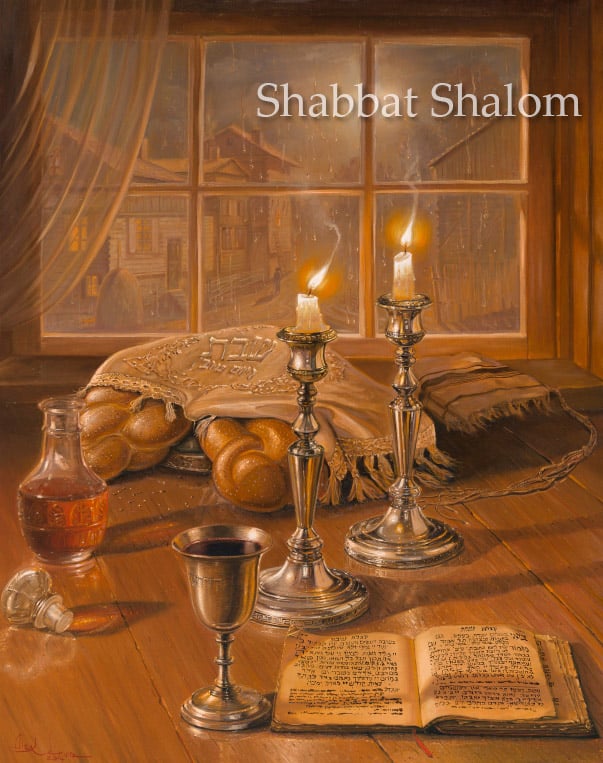
A traditional Shabbat painting may resemble a scene from family memory: a Jewish woman in a recognizable home, silver candlesticks, challah, wine and a carefully prepared table.
A contemporary artist can take the same ritual and reduce it to light, movement, color and symbolic forms.
Neither approach changes the underlying subject.
This makes Shabbat candle lighting especially adaptable to both traditional Judaica and contemporary Jewish interiors.
Jerusalem and Shabbat Candle Lighting
Jerusalem adds another layer of meaning to Shabbat artwork.
As Friday afternoon approaches, the city’s rhythm visibly changes in many Jewish neighborhoods.
Stores close, families prepare for the evening and Shabbat enters homes throughout the city.
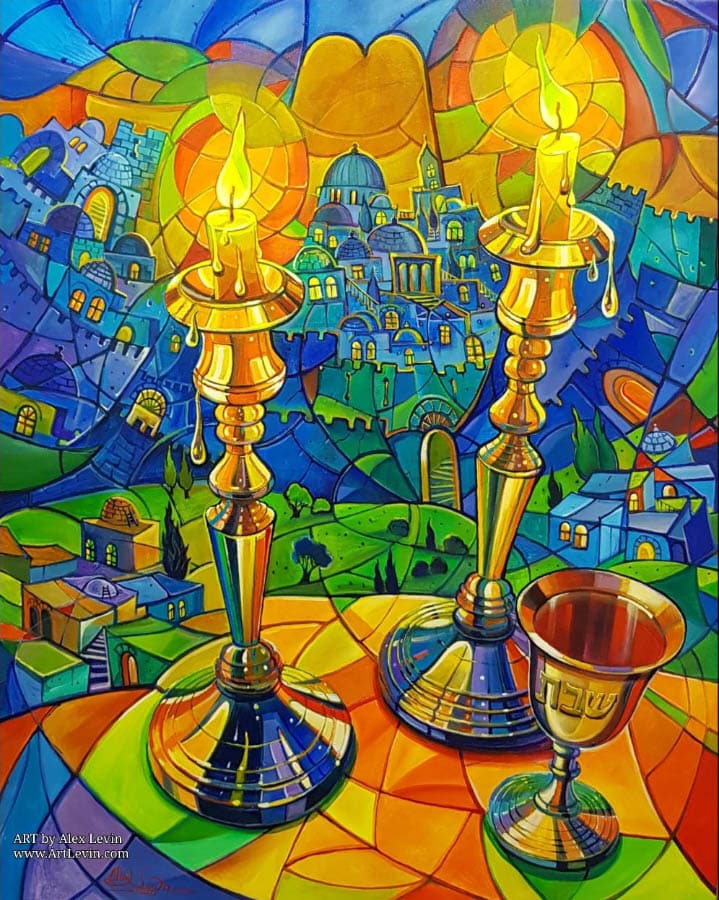
Artists can combine candle lighting with Jerusalem stone, Old City architecture or views of the Holy City to connect private family tradition with a broader Jewish landscape.
Explore Alex Levin’s Jerusalem paintings.
Shabbat Candles and Jewish Mothers
Images of Jewish mothers lighting Shabbat candles have become emotionally powerful because they often represent much more than one weekly ritual.
For many viewers, the image recalls mothers, grandmothers and family homes.
A painting may therefore trigger personal memories even when the viewer has never seen the particular woman depicted.
This is one reason Shabbat candle artwork frequently becomes family art rather than simply decorative Judaica.
Shabbat Candles and Jewish Continuity
One of the strongest themes in paintings of Shabbat is continuity.
The basic scene can occur in a European shtetl, modern Jerusalem, New York, Paris, Buenos Aires or almost anywhere a Jewish family lives.
The architecture and clothing may change dramatically, while the act of welcoming Shabbat through light remains recognizable.
Art can make that continuity visible by connecting different places and generations through one repeated ritual.
Women in Jewish Art
Shabbat candle lighting also provides an important subject for the representation of women in Jewish visual culture.
The moment places a woman at the spiritual center of the composition.
She is not simply a background figure observing a ritual performed by someone else. Her action defines the scene.
This makes the subject particularly meaningful within paintings of Jewish family and religious life.
Jewish Women and Personal Prayer
The quiet moment following candle lighting has often become associated with personal prayer.
Women may pray for children, family, health, peace and other personal needs.
This adds emotional depth to artistic depictions of candle lighting.
The viewer sees a woman physically standing before the candles but cannot know exactly what she is thinking or praying.
That unanswered question gives the painting an intimate quality.
Shabbat Candle Paintings for the Jewish Home
Shabbat candle artwork is particularly suited to a Jewish home because its meaning is not limited to one annual holiday.
Shabbat returns every week.
A painting of candle lighting can therefore represent:
Family tradition, Jewish identity, motherhood, prayer, peace, spiritual light and the rhythm of Jewish life.
It can work especially well in a dining room, living room or another space connected with family gatherings.
Shabbat Candle Art as a Jewish Gift
A painting of a woman lighting Shabbat candles can make a meaningful gift for a Jewish wedding, anniversary, housewarming, Bat Mitzvah or family celebration.
For a wedding, the imagery can represent the creation of a new Jewish home.
For a housewarming, it can symbolize peace and holiness entering the home.
For mothers and grandmothers, the subject may carry a particularly personal connection with generations of family tradition.
Shabbat Paintings by Alex Levin
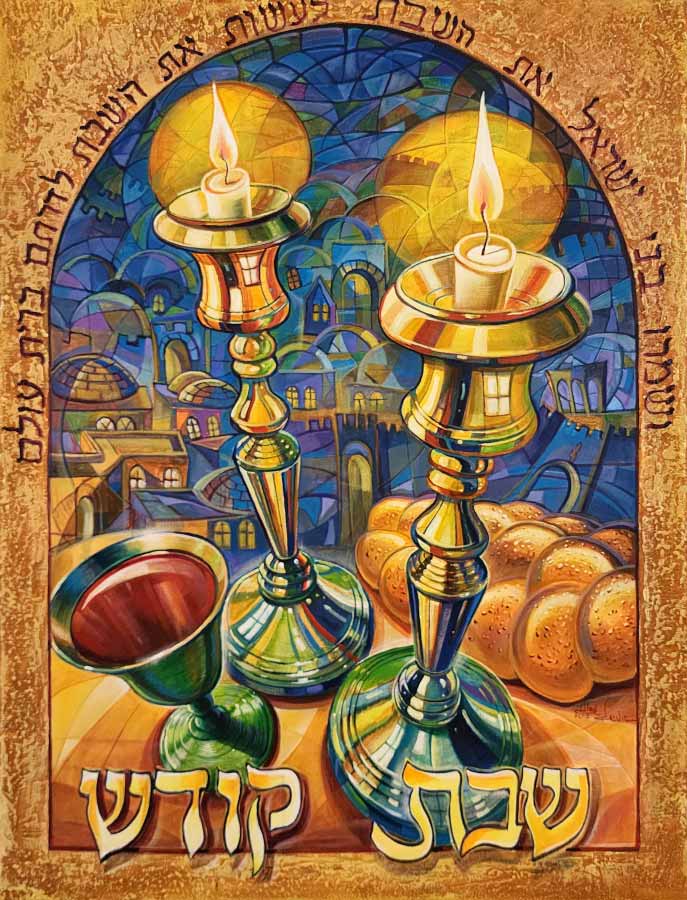
Israeli artist Alex Levin has created several paintings inspired by Shabbat.
His works range from traditional Jewish family scenes to contemporary compositions incorporating Jerusalem, candlelight, Jewish women and abstract elements.
Across these different styles, Shabbat is portrayed not simply as a day on the calendar but as an atmosphere created through light, prayer, family and tradition.
Explore Shabbat Paintings by Alex Levin
Woman Lighting Shabbat Candles in Shtetl
For collectors who prefer traditional Jewish imagery, Woman Lighting Shabbat Candles in Shtetl connects the weekly ritual with the atmosphere of historical Eastern European Jewish life.
The subject can carry particular meaning for families whose ancestors lived in those communities.
Rather than depicting a major historical event, the painting preserves an ordinary sacred moment repeated week after week.
Woman Honoring the Shabbat
For a more contemporary interpretation, Woman Honoring the Shabbat brings the same tradition into a modern artistic composition.
It demonstrates how Shabbat imagery can work in a contemporary Jewish home without abandoning the symbolism of candle lighting.
Explore Jewish Life Paintings
Shabbat forms part of Alex Levin’s larger exploration of Jewish family life and tradition.
The broader collection includes Torah study, prayer, weddings, Jewish holidays, rabbis, shtetl life and scenes from Jerusalem.
Explore Jewish Life Paintings by Alex Levin
You can also browse the dedicated Shabbat Paintings collection.
Frequently Asked Questions About Lighting Shabbat Candles
Why do Jewish women light Shabbat candles?
Lighting candles honors Shabbat and helps create a peaceful and festive atmosphere in the home. By longstanding Jewish custom, the woman of the household traditionally performs the mitzvah, although the obligation applies to the household and a man may light when necessary.
When are Shabbat candles lit?
They are lit before sunset on Friday and before Shabbat begins. Exact candle-lighting times vary according to location, date and community custom.
How many Shabbat candles should be lit?
Two candles are a widespread custom and are traditionally associated with the biblical concepts of zachor, remembering Shabbat, and shamor, observing it. Some families light additional candles according to their own customs.
Can a man light Shabbat candles?
Yes. Although candle lighting is traditionally especially associated with women, the obligation belongs to the household. If there is no woman available to light, a man can perform the mitzvah.
Why do women cover their eyes when lighting Shabbat candles?
In a widespread Ashkenazi custom, a woman lights the candles, covers her eyes and recites the blessing. She then opens her eyes and experiences the candlelight after the blessing. Practices can vary between Jewish communities.
What do Shabbat candles symbolize?
They are associated with honoring Shabbat, peace in the home, spiritual light, prayer and the transition from the ordinary week into sacred Sabbath time.
Why are there usually two Shabbat candles?
A traditional explanation connects the two candles with the Torah’s two expressions regarding Shabbat: zachor, “remember,” and shamor, “observe” or “guard.”
Do Jewish girls light Shabbat candles?
Practices vary. In some communities girls light their own candle. Chabad particularly encourages Jewish girls to participate in Shabbat and holiday candle lighting from a young age when appropriate.
What is a good Jewish painting for a wedding or housewarming?
A Shabbat candle-lighting painting can be especially meaningful because it represents the Jewish home, family, prayer, peace and continuity. Jerusalem, Torah and Jewish wedding artwork are other popular choices.
Where can I find Shabbat candle paintings?
ArtLevin.com offers traditional and contemporary Shabbat paintings by Israeli artist Alex Levin, including women lighting candles in shtetl and Jerusalem-inspired settings.
View Shabbat Paintings by Alex Levin