What makes a work of art Jewish?
Is it Jewish because the artist is Jewish? Because it depicts a Torah scroll, Jerusalem or Shabbat candles? Does Judaica count as Jewish art collection? And what about a completely abstract painting inspired by Jewish faith, memory or identity?
The answer is more interesting than a simple definition.
Jewish art paintings can express religion, history, memory, identity, family, Israel, Jerusalem and the everyday experiences of Jewish life. It can be traditional or contemporary, realistic or abstract, ceremonial or purely visual.
Throughout history, Jewish artists have used art not only to create beauty, but also to preserve stories, interpret sacred texts, remember communities, celebrate traditions and express what it means to belong to the Jewish people.
What Is Jewish Art?
There is no single universally accepted definition of Jewish art.
At its broadest, Jewish art includes visual works connected to Jewish religion, history, culture, identity or experience.
That can include:
- paintings of Jewish life and traditions;
- Judaica and ceremonial objects;
- Torah-inspired artwork;
- paintings of Jerusalem and the Land of Israel;
- biblical scenes;
- portraits of Jewish figures;
- depictions of Jewish holidays;
- shtetl life and Jewish historical memory;
- Holocaust remembrance;
- contemporary expressions of Jewish identity;
- abstract artwork inspired by Jewish ideas and spirituality.
Sometimes the Jewish character of an artwork is immediately recognizable.
A painting showing a man holding a Torah clearly contains Jewish imagery. A Shabbat scene illuminated by candles speaks directly to a Jewish ritual. The Western Wall immediately connects the viewer with Jerusalem.
Other works are more subtle.
A contemporary painting may contain Hebrew letters, fragments of Jerusalem stone, symbolic light or colors associated by the artist with Jewish memory. The Jewish meaning may be carried by the story behind the painting rather than by an obvious religious object.
That is part of what makes Jewish art so diverse.
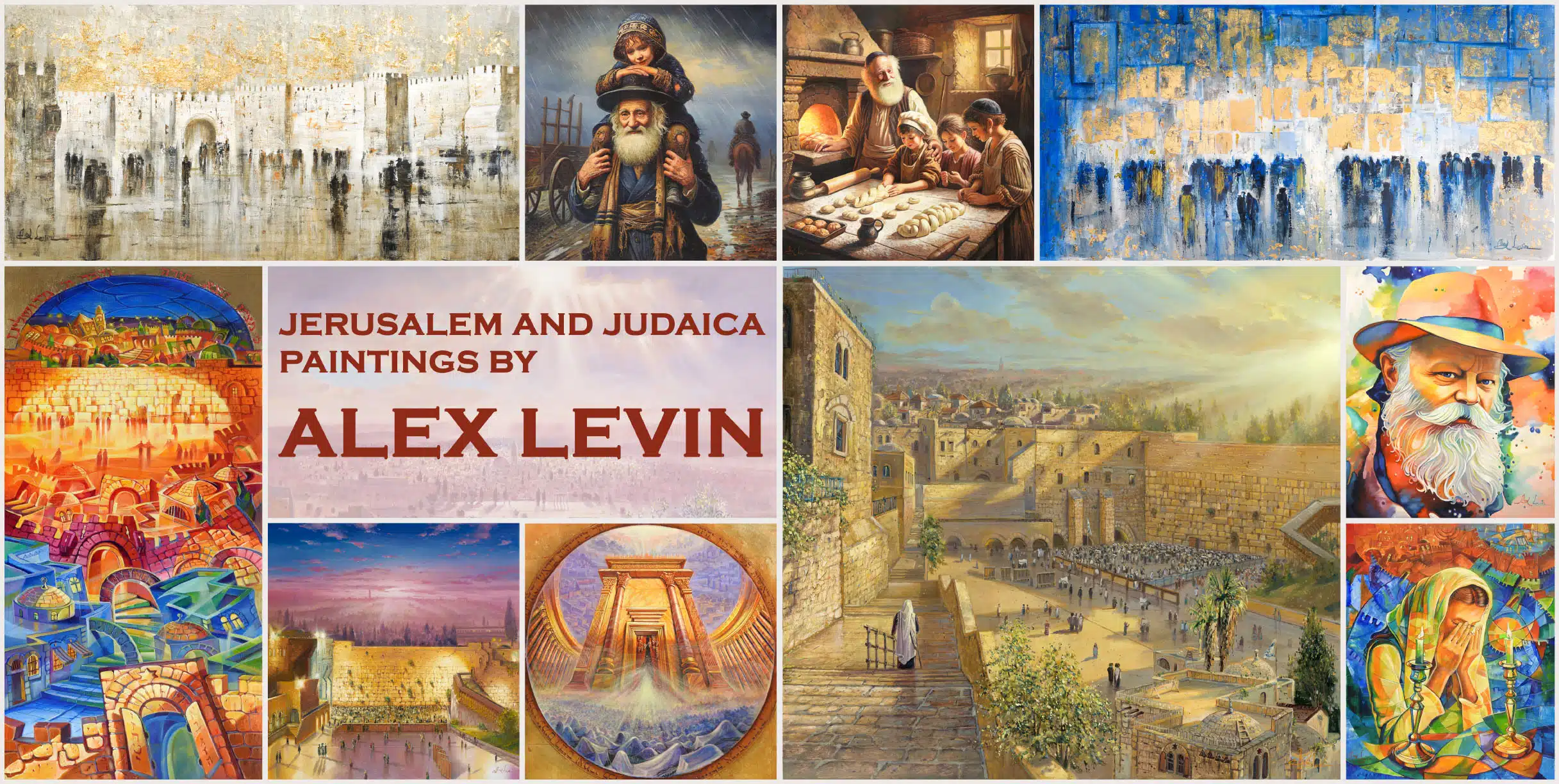
Explore Jewish and Judaica Paintings by Alex Levin


What Makes Jewish Art “Jewish”?
This question has been discussed by artists, historians and Jewish communities for generations.
There is no single test.
Instead, several elements can give artwork a distinctly Jewish character.
Jewish Subjects
The most obvious connection is subject matter.
A work might portray:
- the Torah;
- Shabbat;
- a synagogue;
- Jerusalem;
- the Western Wall;
- the Jewish holidays;
- a rabbi or Jewish historical figure;
- a shtetl;
- Jewish family life;
- biblical events.
These subjects immediately place the artwork within a Jewish cultural or religious context.
But Jewish art does not have to contain an obvious Jewish symbol.
Jewish Memory
Memory occupies an important place in Jewish culture.
Families remember previous generations. Communities preserve stories about places that no longer exist. Jewish holidays repeatedly connect events from thousands of years ago with life today.
Art can perform a similar function.
A painting of an Eastern European shtetl may preserve the atmosphere of a Jewish world largely destroyed during the Holocaust.
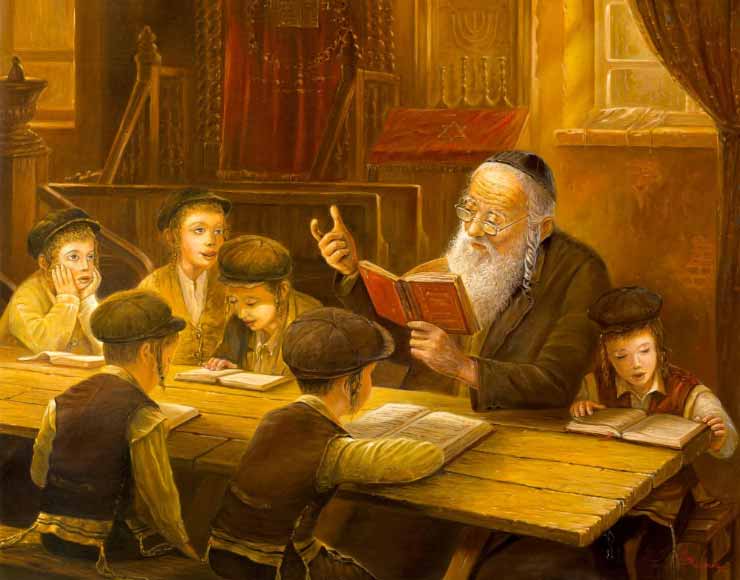
An image of a grandfather teaching his grandchildren can express the transmission of tradition from one generation to another.
A Jerusalem painting can evoke not only a physical city, but centuries of Jewish longing for Jerusalem.
In this way, art becomes a form of visual memory.
What Is the Difference Between Jewish Art and Judaica?
The terms Jewish art and Judaica overlap, but they are not exactly the same.
Traditionally, Judaica often refers to objects connected with Jewish religious or ceremonial life.
Examples include:
- menorahs;
- mezuzah cases;
- Kiddush cups;
- Torah ornaments;
- spice boxes for Havdalah;
- seder plates;
- candlesticks;
- ketubahs.
Many of these objects combine practical religious use with artistic design.
This reflects the Jewish concept of hiddur mitzvah – beautifying the performance of a mitzvah.
Jewish art is a broader category.
A painting of Jerusalem does not need to serve a ritual function to be Jewish art. Neither does a portrait of the Lubavitcher Rebbe or a painting depicting children studying Torah in a shtetl.
Today, the word Judaica is also frequently used more broadly to describe Jewish wall art, paintings and decorative artwork connected to Jewish culture.
So a Jewish painting may be described as Judaica art even when it is intended primarily for display rather than ritual use.
Explore Judaica Art and Jewish Paintings
Has Visual Art Always Been Part of Jewish Culture?
Sometimes people assume that Judaism historically discouraged visual art.
The history is more complicated.
The Torah prohibits the creation and worship of idols, but Jewish communities nevertheless produced visual and decorative art throughout history.
One of the earliest artistic figures described in the Torah is Bezalel, who was chosen to help construct and decorate the Tabernacle.
Jewish history also contains decorated manuscripts, synagogue mosaics, ceremonial objects, papercuts, illuminated Haggadot and other forms of visual expression.
Ancient synagogues have even been discovered with figurative biblical scenes.
So the relationship between Judaism and visual art has never been as simple as “Jews do not make images.”
Jewish communities in different periods and places interpreted artistic expression differently, but creativity has remained part of Jewish life for centuries.
The Torah in Jewish Art
Few symbols are as immediately connected with Judaism as the Torah.
Yet artists can portray the Torah in very different ways.
One painting may show a person studying quietly.
Another may depict someone dancing with a Torah during a celebration.
Another might show a father or grandfather teaching a child.
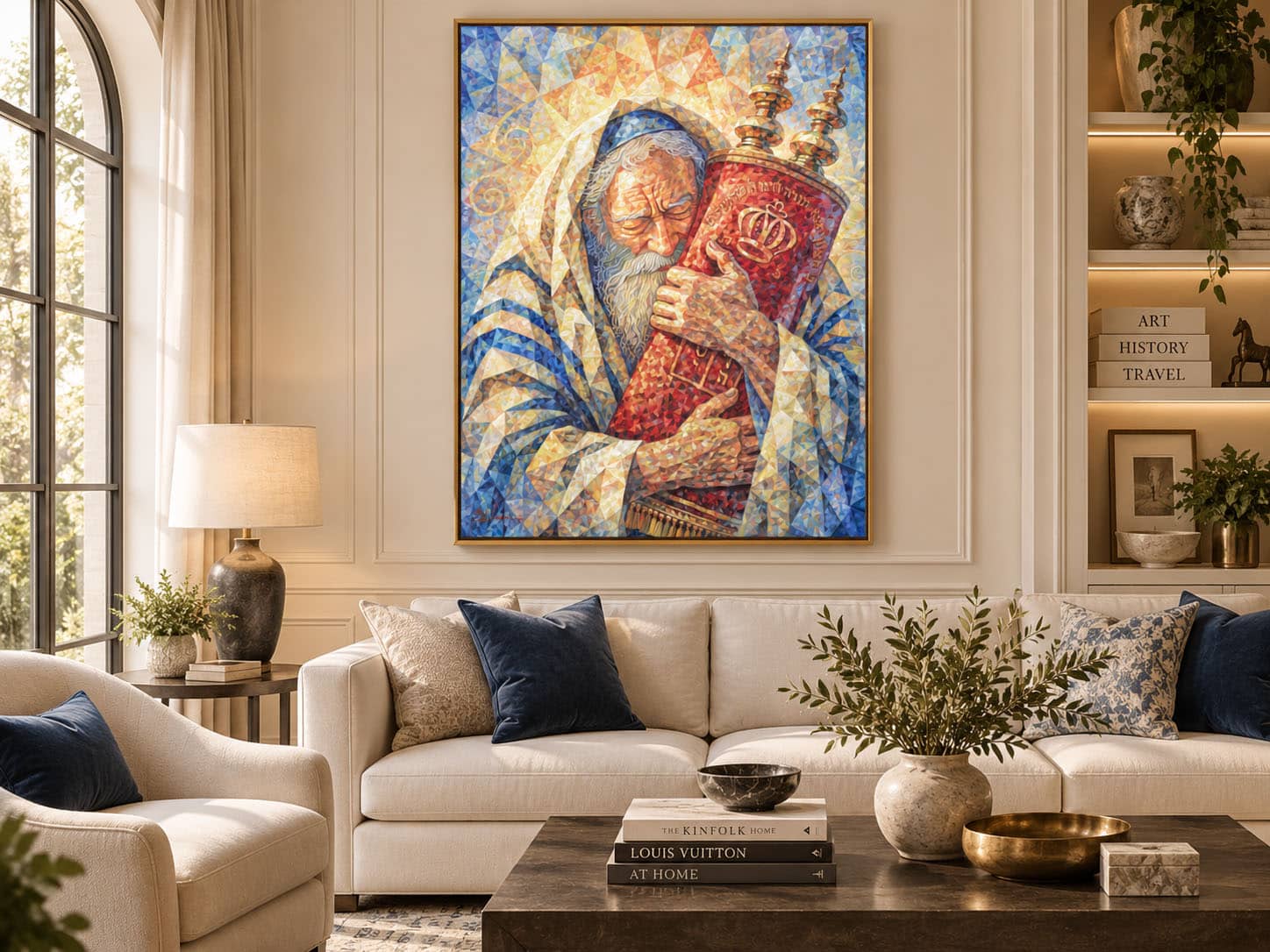
A contemporary artist may use the Torah almost symbolically, surrounding it with light, color or abstract forms.
In each case, the Torah represents more than a physical scroll.
It can symbolize knowledge, faith, continuity and the transmission of Jewish tradition.
This makes Torah imagery especially powerful in Jewish art because it connects the individual depicted in a painting with generations that came before and generations still to come.
Shabbat as a Subject in Jewish Paintings
Shabbat offers artists a completely different visual language.
Candles create light.
A table creates a sense of family.
The atmosphere becomes quieter.
Everyday activity gives way to reflection, prayer, family and tradition.
Because of this, Shabbat paintings frequently emphasize warmth rather than monumentality.
A Jerusalem panorama can feel grand.
A painting of Shabbat candles can feel intimate.
Both are Jewish art, but they communicate Jewish identity in very different ways.
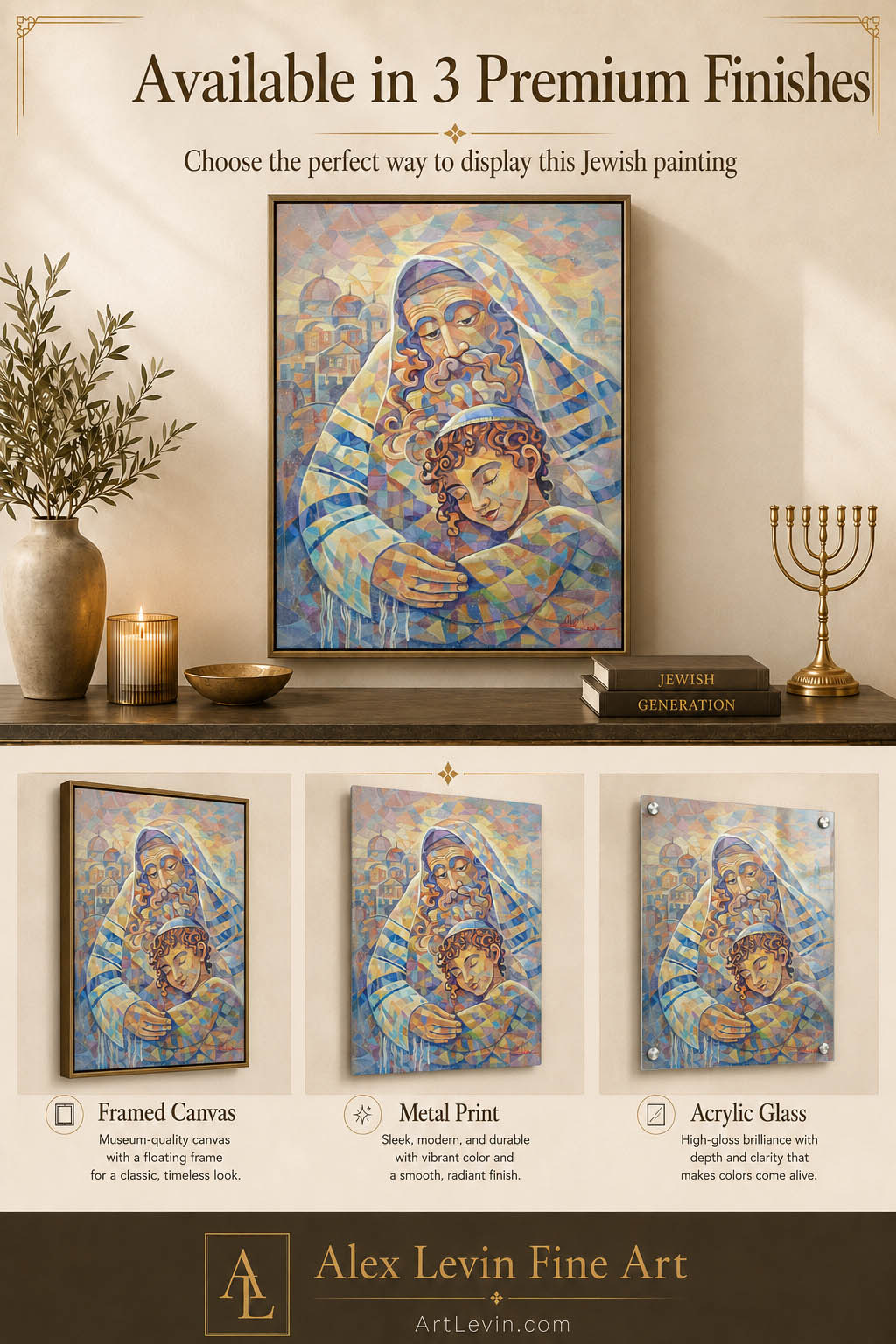
Contemporary Jewish artists can also reinterpret Shabbat using abstraction, strong colors and modern compositions while preserving recognizable elements such as candles, Jerusalem or the figure of a woman welcoming Shabbat.
Jerusalem and the Western Wall in Jewish Art
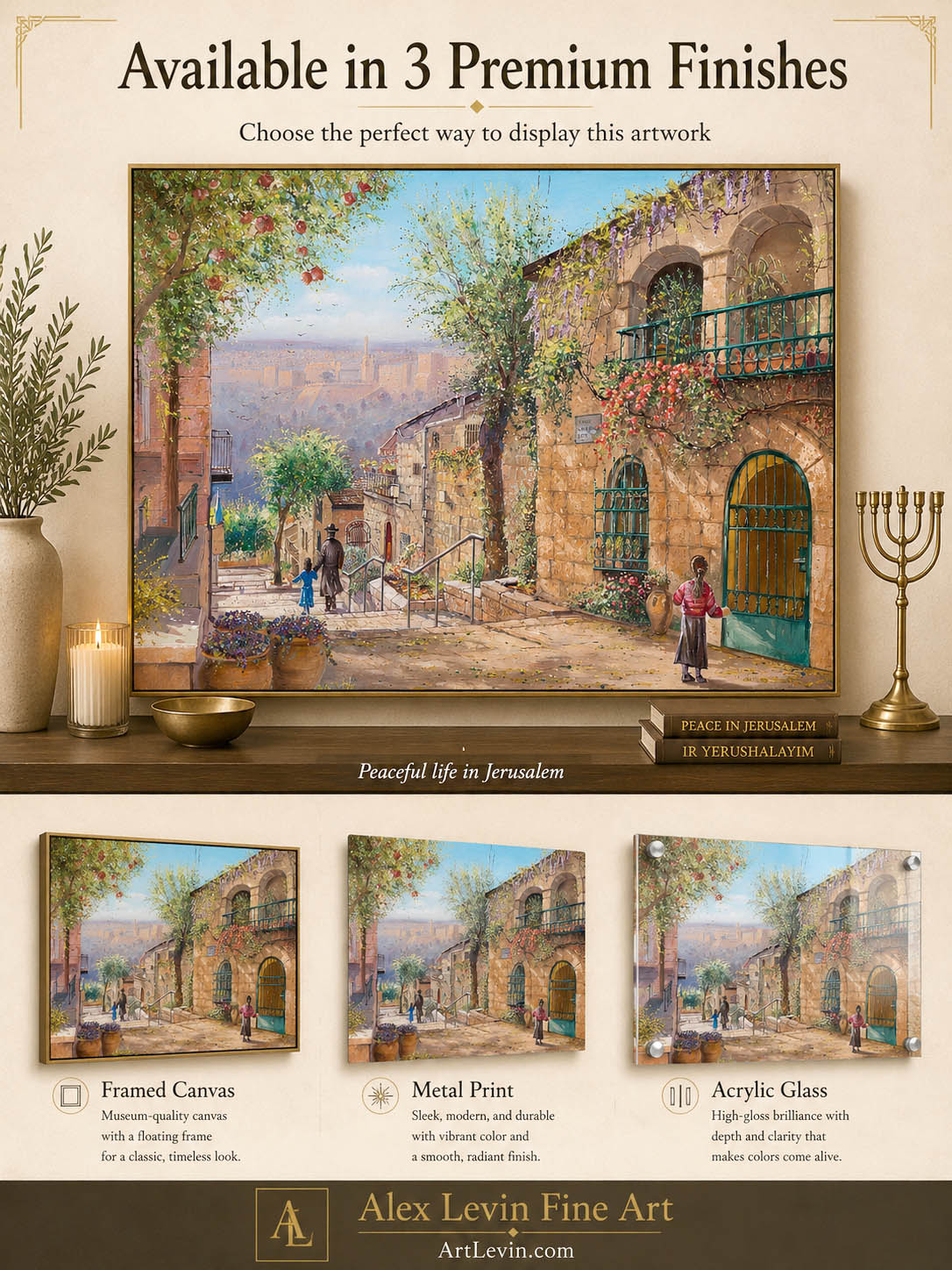
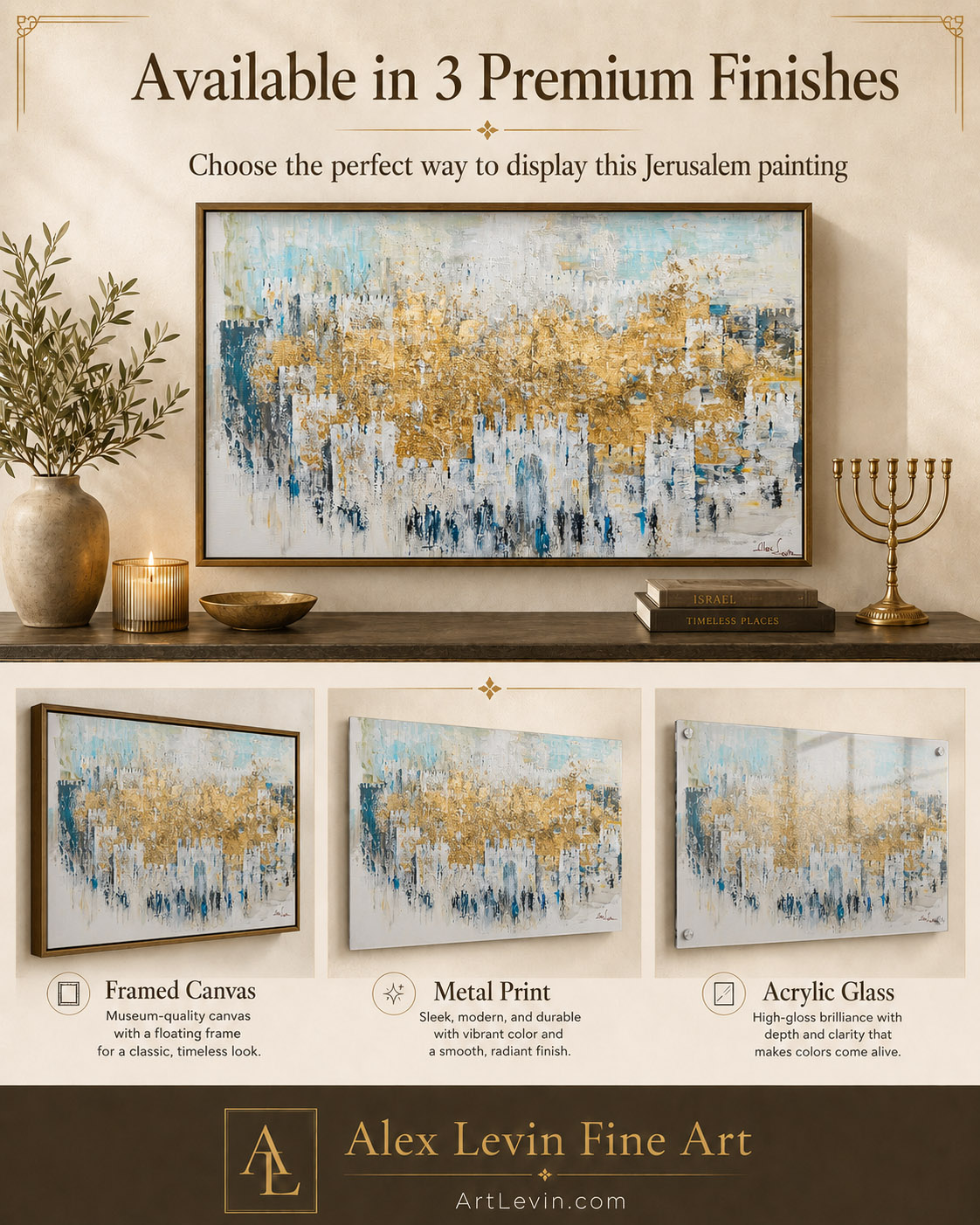
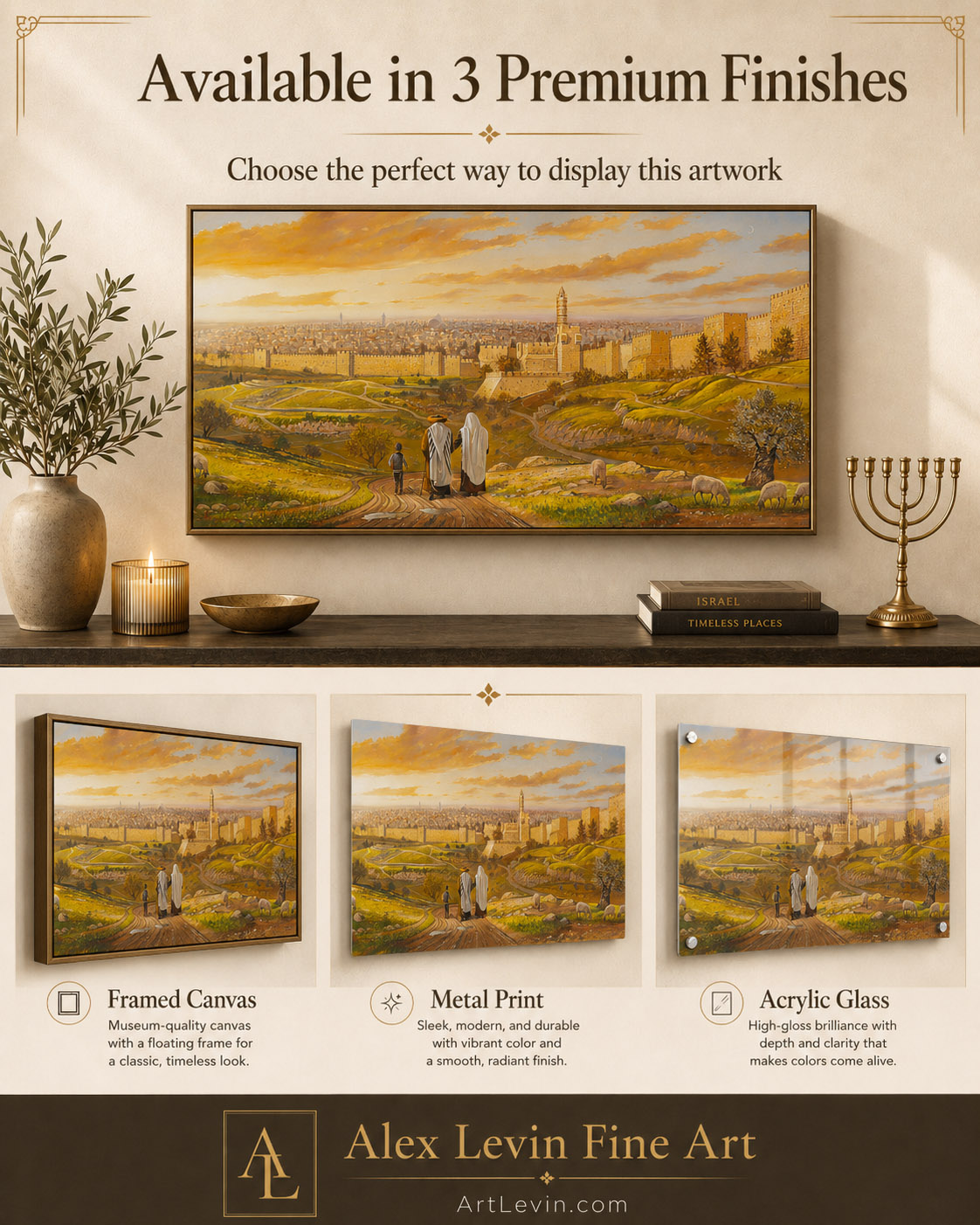
Jerusalem occupies a unique position in Jewish art.
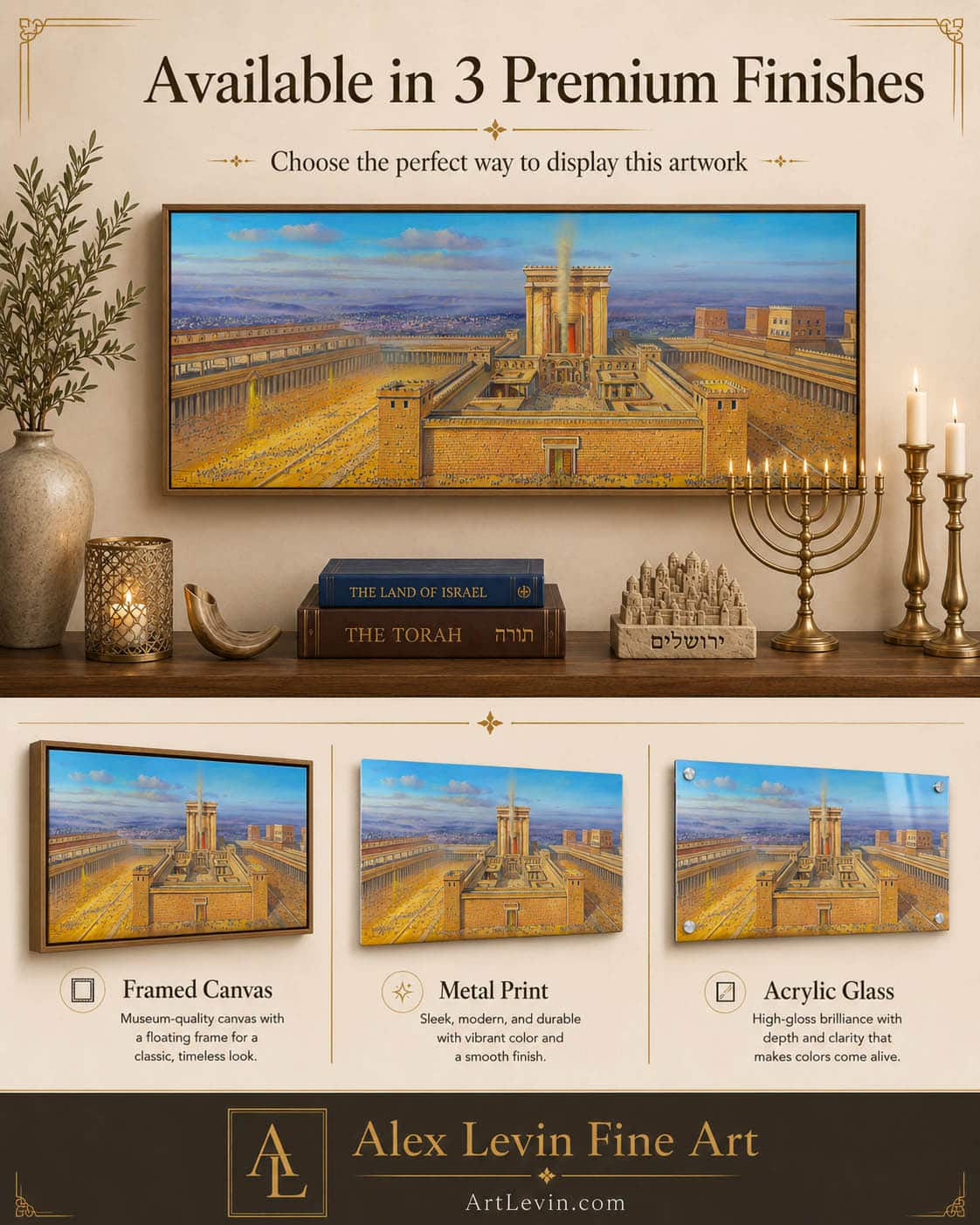
Artists have depicted Jerusalem realistically, symbolically and imaginatively for generations.
The city can represent history, faith, longing, memory and the connection between the Jewish people and the Land of Israel.
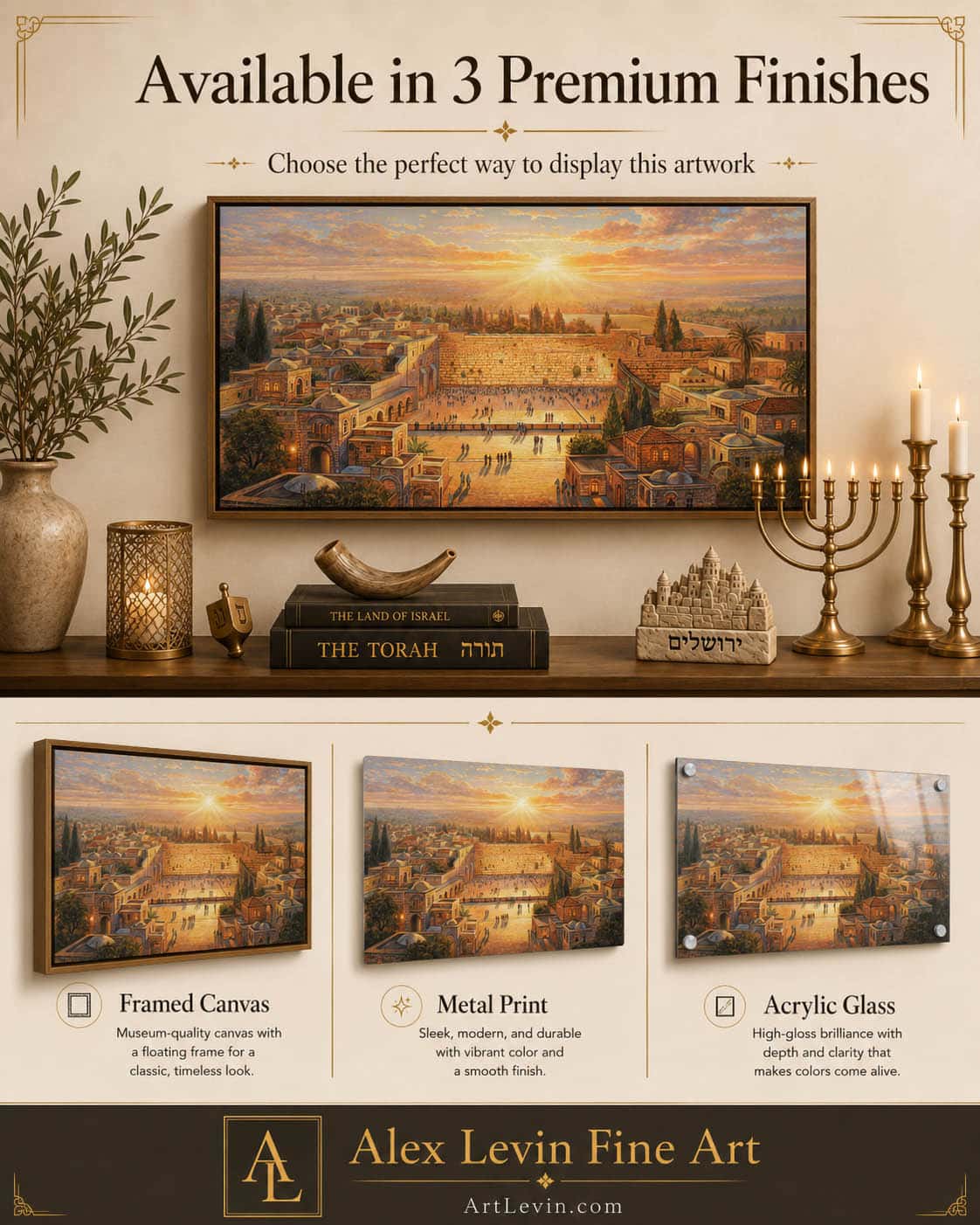
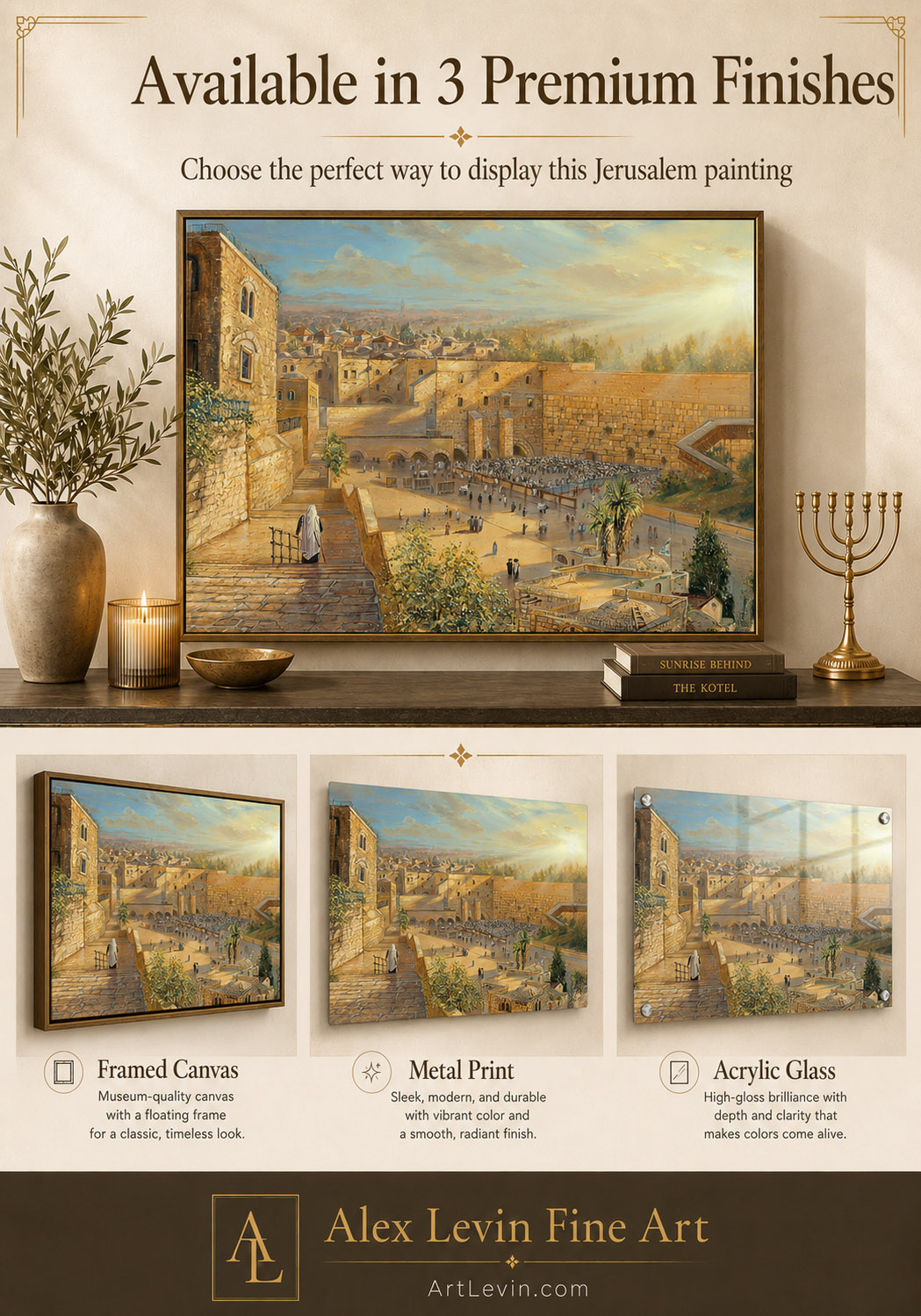
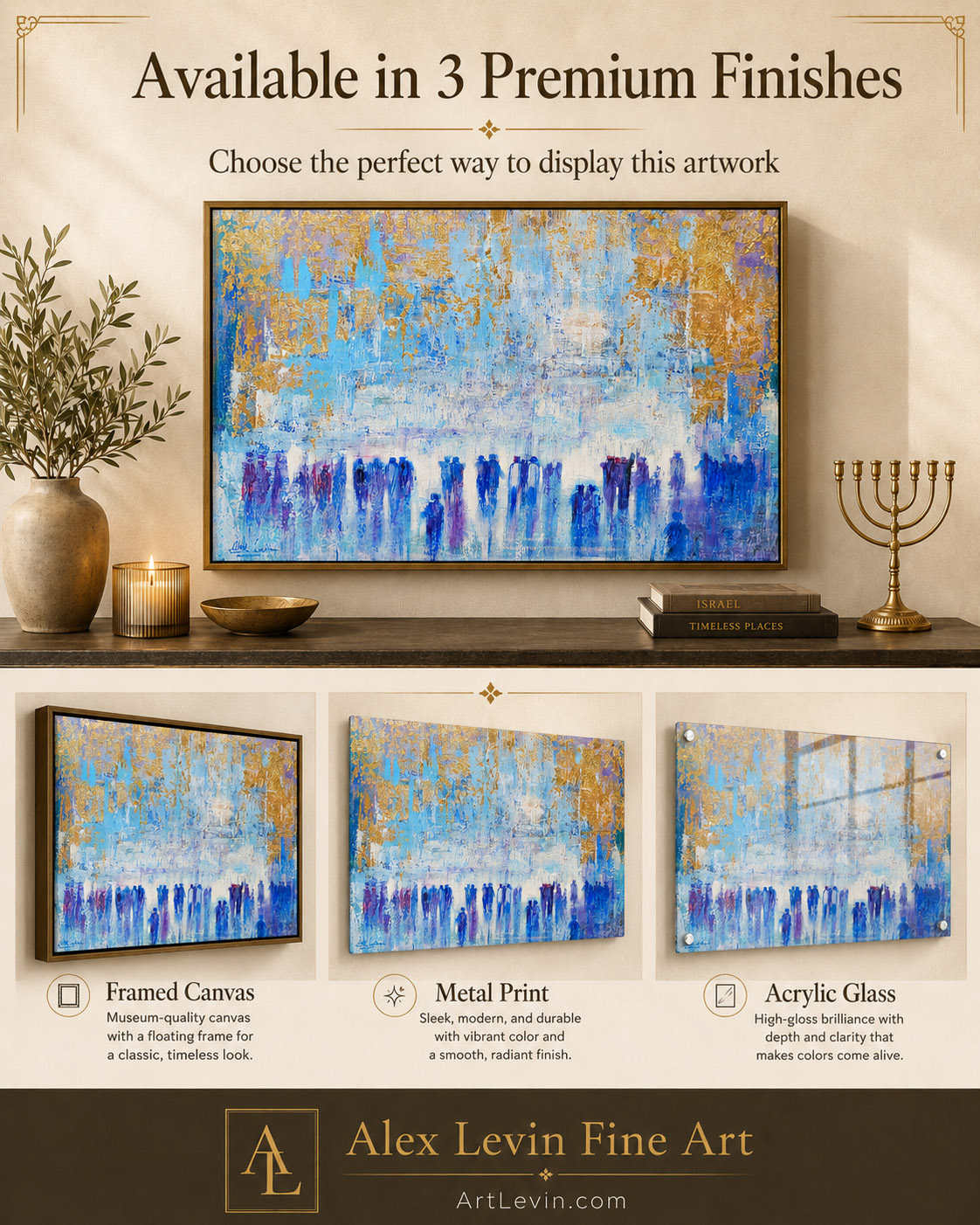
Within Jerusalem imagery, the Western Wall – the Kotel – is one of the most recognizable subjects in Jewish painting.
Some artists concentrate on its enormous stones.
Others emphasize the people praying beside them.
Some paint the Kotel during sunrise, sunset or at night, using changing light to transform the emotional atmosphere of the same location.
Contemporary artists may go even further, breaking Jerusalem into geometric forms, brilliant colors or symbolic fragments.
The result can look completely modern while remaining unmistakably connected with Jerusalem.




Shtetl Paintings and the Memory of Jewish Life
Another major theme in Jewish art is the shtetl.
Before World War II, many Jewish communities throughout Eastern Europe lived in small towns where religious life, family, education and community were deeply connected.
The Holocaust destroyed much of this world.
Today, paintings of shtetl life can therefore carry an additional meaning.
A street, a Hebrew school, a grandfather walking with a grandchild, musicians or a family preparing for Shabbat may appear to be an everyday scene.
But the painting also preserves a memory of a Jewish world that largely disappeared.
For descendants of families who came from Poland, Ukraine, Belarus, Lithuania and other parts of Eastern Europe, such images can create a surprisingly personal connection.
They may remind viewers of grandparents, stories heard as children or communities discovered through genealogy.
Explore Jewish Shtetl Paintings
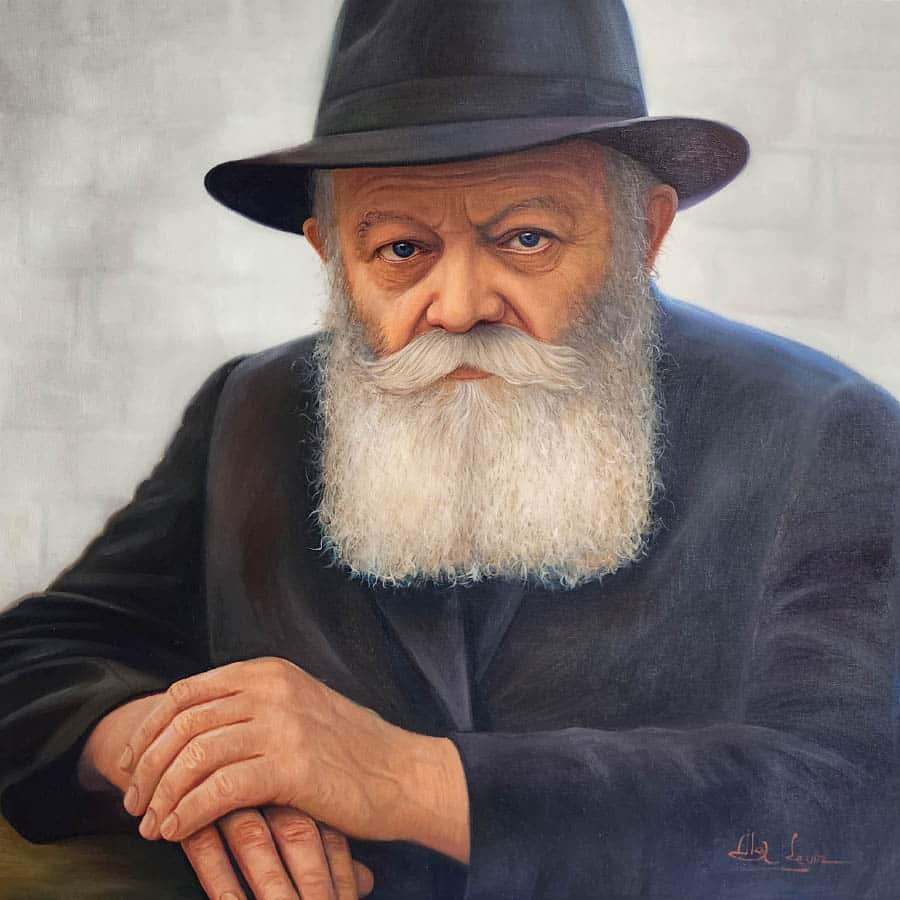
Jewish Portraits: Painting More Than a Face
Portraiture introduces another dimension to Jewish art.
A Jewish portrait may depict:
- a rabbi;
- a Jewish scholar;
- a biblical figure;
- an elderly man at prayer;
- a child studying;
- a historical Jewish leader;
- an ordinary person experiencing a meaningful moment.
The strongest portraits often communicate more than physical appearance.
Expression, posture, clothing, surroundings and light can suggest contemplation, faith, wisdom, struggle or memory.
A painting of someone praying with a Torah, for example, becomes both a portrait and a story about an individual’s relationship with Jewish tradition.
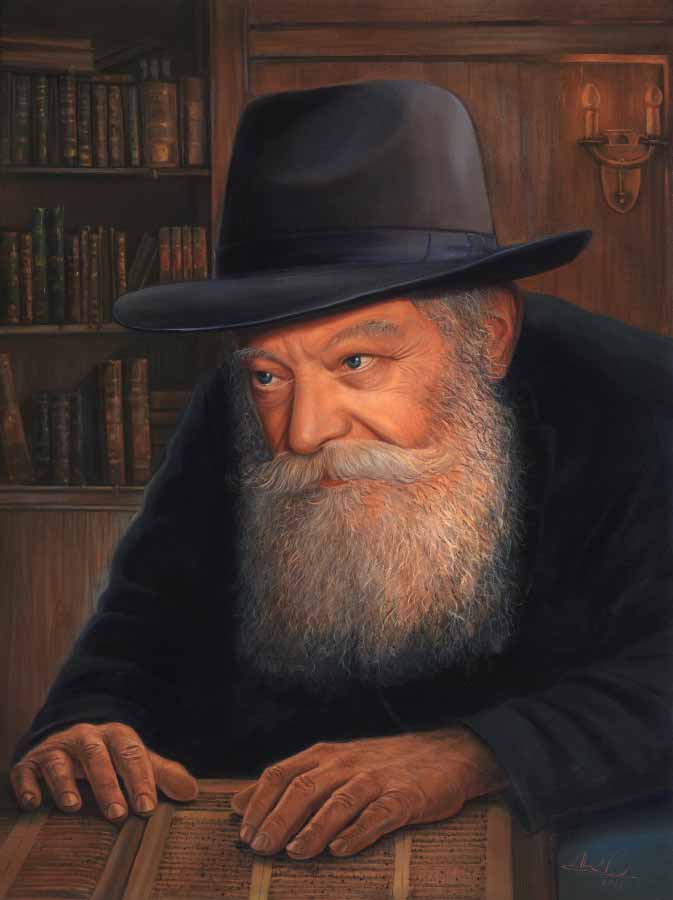
Portraits of well-known figures such as Rabbi Menachem Mendel Schneerson, the Lubavitcher Rebbe, carry another layer of meaning because viewers may already associate the person with particular teachings, historical events or communities.
Explore Jewish Portrait Paintings


Does Jewish Art Have to Be Religious?
No.
Jewish identity encompasses much more than religious ritual.
Jewish art can explore:
- migration;
- family;
- Israel;
- history;
- language;
- humor;
- persecution;
- survival;
- memory;
- community;
- modern Jewish identity.
An artist can create work that is deeply Jewish without depicting a Torah, synagogue or menorah.
This becomes especially important in contemporary Jewish art.
Instead of simply illustrating a ritual, a modern artist may explore questions of belonging, history or identity through abstraction and symbolism.
Traditional Jewish Art vs. Contemporary Jewish Art
Traditional Jewish paintings often rely on recognizable scenes and subjects.
A viewer may immediately understand that they are seeing Jerusalem, a Torah procession or a Jewish family preparing for Shabbat.
Contemporary Jewish art can approach the same ideas differently.
A Torah may become the visual center of an abstract composition.
Jerusalem may be reconstructed from fragments of color.
A historical figure may emerge from geometric shapes.
Hebrew letters might become part of the composition itself.
The style changes, but the underlying subject remains connected to Jewish life.
This interaction between old and new is one of the most interesting aspects of contemporary Judaica.
The artist does not have to abandon tradition in order to create modern art.
Tradition itself can become the source material for something new.
Explore Contemporary Jewish Art
Jewish Art as a Bridge Between Generations
Perhaps one of the most powerful roles of Jewish art is its ability to connect generations.
A child may see a painting of a grandfather studying Torah and recognize something from his own family.
Someone whose ancestors left Eastern Europe may see a shtetl painting and imagine the streets they once walked.
A visitor to Israel may see a painting of the Kotel and remember standing beside its stones.
A contemporary Jewish family may choose an abstract Jerusalem painting precisely because it expresses Jewish identity without looking like traditional religious art.
The styles may change.
The connection remains.
Jewish art allows memory to enter a physical space.
It places history on a wall where another generation can encounter it.
Jewish Art by Alex Levin
Israeli artist Alex Levin explores Jewish life through several different artistic approaches.
His work includes realistic paintings of Jerusalem, Jewish families and shtetl life alongside contemporary compositions built from color, light and abstraction.
Recurring themes include the Torah, Shabbat, Jerusalem, the Western Wall, Jewish education, family, the Lubavitcher Rebbe and the connection between generations.
The styles may differ dramatically, but they share a common idea – Jewish history and tradition are not simply subjects from the past.
They remain part of Jewish life today.
That is one of the reasons Jewish art continues to evolve.
It remembers the past while allowing every generation to interpret Jewish identity through its own visual language.
Explore Jewish Paintings by Alex Levin
Frequently Asked Questions About Jewish Art
What is Jewish art?
Jewish art is visual art connected to Jewish religion, history, culture, identity or experience. It can include Judaica, paintings, sculpture, ceremonial objects, biblical art, Jerusalem art, Jewish portraits and contemporary abstract work.
What makes a painting Jewish?
A painting may be considered Jewish because of its subject, symbolism, historical context, connection to Jewish experience or the intention of the artist. There is no single requirement that determines whether artwork is Jewish.
Is Judaica the same as Jewish art?
Not exactly. Judaica traditionally refers especially to Jewish ceremonial and ritual objects, while Jewish art is a broader category that can include paintings, portraits, landscapes, abstract art and historical subjects. Today, “Judaica art” is also commonly used to describe Jewish decorative and wall art.
Can Jewish art show people?
Yes. Jewish artists and Jewish communities have depicted human figures at many points throughout history. The biblical prohibition concerning images is principally associated with idolatry, and interpretations of figurative artwork have varied among Jewish communities and historical periods.
What are common subjects in Jewish paintings?
Popular themes include Jerusalem, the Western Wall, Torah study, Shabbat, Jewish holidays, shtetl life, rabbis, Jewish historical figures, biblical stories, Israel and family traditions.
What is contemporary Jewish art?
Contemporary Jewish art uses modern artistic styles to explore Jewish subjects, identity, history and spirituality. It may combine traditional symbols such as the Torah or Jerusalem with abstraction, geometric forms, unusual colors or other contemporary techniques.
Why is Jerusalem so common in Jewish art?
Jerusalem has profound religious, historical and cultural importance in Judaism. Artists often use Jerusalem to express connection, memory, longing, history and Jewish identity.
What is the difference between Jewish art and Israeli art?
The two categories overlap but are not identical. Jewish art generally relates to Jewish culture, religion, history or identity. Israeli art refers to art connected with Israel and can represent many different cultural, religious and artistic perspectives.
Where can I find Jewish paintings and Judaica art?
Alex Levin’s collections include traditional and contemporary Jewish paintings featuring Jerusalem, Torah, Shabbat, shtetl life, Jewish portraits and other themes from Jewish history and tradition.
Explore the complete collection of Jewish and Judaica paintings