Some paintings invite you in from across the room, then keep revealing themselves as you get closer. That is one of the pleasures of Alex Levin’s Signs of Time – Surrealism Jewish Paintings Hebrew collection: it rewards both the first glance and the second look. The large forms, vivid symbols, and often theatrical compositions make an immediate impression, but the subtler details – a clock face, a nest, a chess piece, a beam of light, a fragile object balanced in an impossible way – are where the deeper story unfolds.
That layered experience suits surrealism especially well. In this collection, time is not just a subject. It becomes atmosphere, tension, and metaphor. The paintings do not simply illustrate time passing. They ask what time does to memory, faith, identity, and hope. Viewed from a distance, the images feel bold and symbolic. Up close, they become intimate meditations on mortality, renewal, and the fragile structures that hold life together.
For collectors drawn to surrealism Jewish paintings, that balance is part of the appeal. Alex Levin’s imagery does not flatten meaning into a single symbol. Instead, it allows multiple readings to exist at once. A bird can mean freedom, return, or warning. An egg can suggest creation, vulnerability, or the beginning of something not yet visible. A clock can mark pressure, inevitability, or a chance to pause. The longer you live with these works, the more they seem to shift with your own experience.
Why time feels so present in these images
The theme of time is especially powerful because it is both universal and personal. Everyone recognizes the feeling of time moving too quickly, or of certain moments seeming to expand. In this collection, that tension becomes visual. Levin often builds his compositions around objects that naturally carry symbolic weight – clocks, nests, ladders, broken shells, candles, chess pieces, light sources, and human figures caught between stillness and motion.
From a distance, those elements read as a dramatic arrangement. Up close, each object changes the emotional temperature of the painting. A clock is not only a clock. It becomes a reminder of choice and consequence. A nest is not only a nest. It suggests continuity, protection, and the instinct to preserve life. An hourglass may feel formal and old-world in one painting, yet in another it can seem almost tender, as if the artist is asking what we do with the time we are given.
That is what makes this body of work compelling for people who want Jewish art that is thoughtful without being heavy-handed. The symbolism is recognizable, but it never feels mechanical. Levin uses surrealism to slow the viewer down. Even when the composition is energetic, the meaning emerges through patient looking.
How the eye moves through the composition
One of the most interesting qualities of these paintings is the way they guide attention. At first, your eye may go straight to the most expressive shape or the brightest color. But then it begins to travel along curves, repetitions, and contrasts. Hair becomes a path. A beam of light becomes a directional force. Floating objects create rhythm. Repeated forms – eggs, bubbles, chess pieces, birds – create visual memory within the image itself.
This movement matters because it shapes the viewer’s emotional experience over time. A painting that feels clear at first glance can become more complex with a longer look. In Levin’s surrealism, that gradual discovery is part of the meaning. The works often suggest that life itself is not grasped all at once. It is read in layers, and those layers are not always visible immediately.
Collectors who appreciate contemporary Jewish paintings often look for exactly this quality. They want art that can live comfortably in a room, but also keep offering new insight. A painting that reveals more over time tends to stay fresh. It does not become background. It becomes part of the rhythm of the space.
Close details that change the feeling of the whole
What makes these works memorable is not just their symbols, but how those symbols are handled. Texture, color shifts, and the placement of small objects can alter the entire emotional reading. Warm tones may make a scene feel intimate even when the concept is vast. Cooler tones may introduce distance, mystery, or contemplation. Tiny details can soften a monumental idea by making it personal.
That is especially true in paintings where the surreal element is paired with human presence. A figure may appear calm while the world around them is visually impossible. That contrast creates a quiet form of drama. The viewer sees not only the image, but the human response to it. The painting becomes less about spectacle and more about reflection.
In a home or office, this kind of art can be surprisingly versatile. It works well in spaces where you want conversation, but also in places where you want a more meditative atmosphere. Because the imagery is symbolic rather than literal, it does not lock the room into a single mood. Instead, it opens a space for interpretation.
Below are a few works from the collection that show how differently time, memory, and renewal can be expressed through surreal composition.
Featured Paintings by Alex Levin
Meditation of Time
This painting is one of the clearest examples in the collection of how time can be turned into atmosphere. From a distance, the composition reads as a strong symbolic portrait, with the clock element anchoring the image immediately. Up close, the surrounding details make the scene more intimate and reflective, so the work feels less like a simple statement and more like a meditation on patience, memory, and the weight of passing moments.
The emotional effect comes from the contrast between stillness and visual pressure. The viewer feels that tension first, then notices how carefully the surrounding elements support it. It is a work that invites slower looking, making it especially fitting for anyone drawn to surrealism Jewish paintings with a contemplative edge.

Be Conscious of Your Time
This composition uses the body and the clock together, which gives the theme of time a direct human presence. From across the room, the image has immediate symbolic force. Up close, the details of the figures, ribbons, and decorative forms soften the concept and make it feel personal rather than abstract. Time here is not merely counted. It is carried, worn, and experienced.
That shift matters. The painting does not present urgency in a harsh way. Instead, it turns awareness into beauty, asking the viewer to consider how attention itself changes the way life is lived. It is a strong choice for collectors who want a piece that continues to reveal structure and meaning over repeated viewing.

Eternal Rebirth
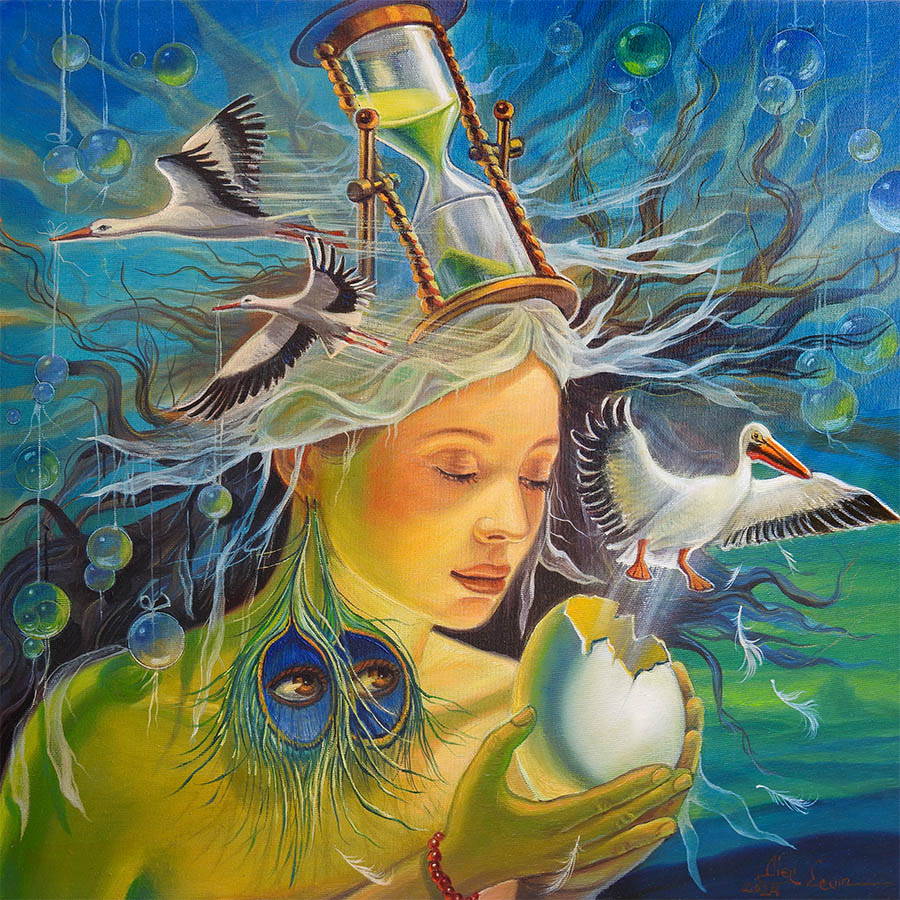
This painting moves the collection toward renewal and continuation rather than limitation. At first glance, the hourglass and cracked egg create a vivid surreal tension, but the longer you look, the more the image feels hopeful. The storks and suspended forms suggest that endings and beginnings are part of the same visual sentence.
It is especially effective for viewers who want a work that balances fragility with optimism. The details are delicate, yet the whole composition feels alive. Seen from afar, it reads as a bold symbolic image. Seen closely, it becomes a study in transformation, which is one reason it stands out in this group of paintings.
Man Proposes, God Disposes
This work carries one of the collection’s most thought-provoking titles, and the composition matches that seriousness. From a distance, the viewer notices the strong central arrangement and the surreal clustering of objects. As the eye moves in, the broken egg, chess pieces, bird, and vessels become part of a larger reflection on human plans and the uncertainty that surrounds them.
What makes the piece especially compelling is its restraint. It does not overwhelm the viewer with excess. Instead, it uses carefully placed symbols to create a sense of humility before time and fate. That makes it a powerful example of how Levin can turn a surreal image into a moral and emotional question.

Shofar of Revelation
This painting broadens the time theme into something more spiritual and expansive. The shofar, ladder, and shafts of light create a composition that feels both ceremonial and visionary. From afar, the image is striking and open. Up close, the fine symbolic relationships begin to matter: the pathway, the ascent, and the scattering of forms all suggest movement toward understanding.
It is one of the most uplifting works in the selection because it connects revelation with direction. The painting does not only speak about time passing. It suggests time as a way of being called forward. For collectors, that makes it a meaningful bridge between surrealism and spiritual symbolism.

What makes Alex Levin’s surreal Jewish paintings so rewarding is that they do not give up their meaning all at once. They meet the eye with dramatic color and shape, then continue speaking through detail, symbolism, and visual rhythm. That is why the experience of these works changes over time: the first look is only the beginning.
If you are drawn to art that pairs Jewish symbolism with imagination, this collection offers a distinctive way to explore time, renewal, and reflection. Browse the full Signs of Time – Surrealism Jewish Paintings Hebrew collection and discover which image keeps revealing more each time you return to it.