Jewish sculpture has a much richer history than many people realize. From ancient carved decoration and Jewish ceremonial objects to modern abstract sculpture and contemporary Judaica, three-dimensional art has long been part of Jewish visual culture.
The subject is sometimes misunderstood because of the biblical prohibition against graven images. Yet Jewish art was never simply a story of avoiding visual representation. Jewish communities created architecture, metalwork, carved objects, ritual art, manuscripts and decorative forms across many centuries and cultures.
Today, Jewish sculpture can include traditional Judaica, monumental public art, abstract works, contemporary installations and modern materials such as acrylic.
What Is Jewish Sculpture?
Jewish sculpture is a broad term describing three-dimensional artwork connected with Jewish religion, history, culture, identity or experience.
It can include:
- Stone carving
- Bronze sculpture
- Wood carving
- Metalwork
- Jewish ceremonial objects
- Abstract sculpture
- Public monuments
- Contemporary installations
- Glass and acrylic art
- Three-dimensional Judaica
Some Jewish sculptures are explicitly religious. Others are connected with Jewish identity, Israel, history or memory without functioning as ritual objects.
Does Judaism Forbid Sculpture?
This is one of the most common questions about Jewish visual art.
The Torah contains a prohibition against making graven images in the context of idolatry. Over the centuries, Jewish communities and religious authorities interpreted questions surrounding figurative art in different ways.
It is therefore misleading to say that Judaism simply prohibits all sculpture or all visual representation.
Jewish history contains extensive examples of decorative art, architectural ornament, ceremonial objects and later figurative and abstract art.
The central religious concern is much more closely connected with idolatry and prohibited forms of representation than with a universal ban on artistic creation.
Jewish Art Beyond Painting
People often associate Jewish art with paintings of Jerusalem, rabbis, shtetl life or biblical scenes.
But Jewish visual culture extends far beyond canvas.
Jewish artists and craftspeople have created Torah ornaments, menorahs, spice containers, Seder plates, mezuzah cases, synagogue decorations, silverwork, textiles, carved stone and many other objects.
These works demonstrate how beauty and craftsmanship became part of Jewish religious and domestic life.
Jewish Ceremonial Art and Judaica
Judaica is one of the most important areas where art and three-dimensional form meet Jewish tradition.
A menorah, Torah crown or mezuzah case has a practical or ceremonial purpose, but it can also be an important work of art.
Jewish craftsmen across Europe, North Africa, the Middle East and other regions adapted local materials and artistic styles while creating objects for Jewish use.
This resulted in an extraordinary variety of forms.
A silver Torah ornament made in Central Europe may look completely different from ceremonial art produced in Morocco, Italy or the Middle East while serving a related religious purpose.
The Menorah as Jewish Sculpture
The menorah is perhaps the most immediately recognizable three-dimensional Jewish symbol.
Menorahs and Hanukkah lamps have been produced in countless forms and materials.
Some follow traditional symmetrical designs. Others use highly modern shapes, unconventional materials and sculptural abstraction.
This makes the menorah an excellent example of how an ancient Jewish symbol can continually be reinterpreted through contemporary design.
Torah Ornaments as Sculptural Art
The Torah scroll itself is traditionally handwritten according to established rules, but the objects surrounding it can be highly artistic.
Torah crowns, finials, breastplates, pointers and ark decorations have provided Jewish artists and craftspeople with opportunities for elaborate metalwork and sculptural design.
These objects combine religious function with visual beauty.
They also demonstrate that Jewish ceremonial art is not confined to flat decoration.
Jewish Sculpture in Museums
Major Jewish museums preserve both ceremonial objects and modern sculpture.
The Jewish Museum in New York, for example, has a collection spanning thousands of years of Jewish culture and includes archaeological objects, Judaica, paintings, sculpture and contemporary art.
Its sculpture holdings include works by artists working in very different styles, demonstrating the breadth of the category.
Jewish sculpture therefore belongs both to the history of Judaica and to the larger history of modern and contemporary art.
Modern Jewish Sculpture
Modern Jewish sculptors expanded far beyond ceremonial art.
They worked with stone, bronze, steel, wood, found objects and industrial materials.
Some explored Jewish themes directly.
Others became major figures in international modern art without making explicitly religious subjects the focus of their careers.
This is similar to modern Jewish painting: the identity of the artist and the subject of the artwork do not always have to be the same thing.
Louise Nevelson and Modern Sculpture
Louise Nevelson became one of the most recognizable sculptors of the 20th century.
Born into a Jewish family in what is now Ukraine, she immigrated to the United States as a child.
She became famous for monumental assemblages constructed from pieces of wood, often unified through a single color.
Her work demonstrates the extraordinary distance modern sculpture traveled from the traditional carved figure.
Separate pieces could be assembled into complex architectural environments of shadow, repetition and form.
Jewish Artists and Abstract Sculpture
Abstraction gave sculptors new possibilities.
A work no longer needed to represent a recognizable person or biblical scene.
Form, balance, texture, negative space and material could become the entire subject.
For Jewish artists, abstraction also offered a way to address spirituality, memory and identity without literal religious imagery.
Israeli Sculpture
The development of art in Israel created another important chapter in Jewish sculpture.
Israeli sculptors have worked in stone, metal, wood, earth, installation art and many other materials.
The landscape itself frequently becomes part of the work.
Jerusalem stone, desert environments, archaeological forms, Hebrew language, war, memory and the relationship between ancient history and modern Israel have all influenced Israeli sculpture.
Jewish Sculpture and Jerusalem
Jerusalem provides sculptors and three-dimensional artists with an enormous vocabulary of forms.
Ancient stones, city walls, gates, the Kotel, the Temple, Hebrew letters and archaeological fragments can all become sources of inspiration.
A sculptural work does not need to reproduce Jerusalem realistically.
An artist can reduce the city to blocks, layers and textures that recall its stone architecture.
Explore Alex Levin’s Jerusalem art.
The Kotel in Three-Dimensional Jewish Art
The Kotel is particularly well suited to three-dimensional interpretation because the Wall itself is defined by physical structure and texture.
Individual stones project and recede. Narrow spaces separate the blocks. Written prayers are placed between stones.
An artwork with depth can emphasize these architectural qualities differently from a conventional flat print.
This is one reason Jerusalem and Kotel imagery works particularly well in acrylic blocks and other dimensional formats.
The Jerusalem Temple in Jewish Sculpture
The ancient Jerusalem Temple provides another powerful subject.
Because the Temple no longer stands, every modern visualization requires some degree of reconstruction and artistic interpretation.
Three-dimensional presentation can give viewers a stronger sense of architecture, monumentality and physical space.
Alex Levin’s Second Holy Jewish Temple Acrylic Block transforms one of his Temple paintings into a free-standing art object.
Jewish Sculpture and the Lubavitcher Rebbe
Portraiture can also move into three-dimensional presentation.
A familiar portrait placed behind thick transparent acrylic acquires depth and changes as surrounding light moves through the material.
Alex Levin’s Lubavitcher Rebbe Acrylic Block Sculpture presents his portrait of Rabbi Menachem Mendel Schneerson as a free-standing Judaica object rather than conventional wall art.
The format is particularly suitable for desks, bookshelves and display cabinets where a framed picture might not be practical.
What Is Acrylic Sculpture?
Acrylic is a transparent synthetic material frequently used in contemporary design, display and art.
Its clarity allows light to enter and move through the object.
This can create a strong sense of depth when an image is mounted behind or incorporated with thick acrylic.
Acrylic can also be cut, polished, layered, engraved or formed into dimensional objects.
Acrylic Art vs. Traditional Sculpture
Not every acrylic artwork is a sculpture in the traditional sense.
A carved marble figure, for example, is physically shaped throughout its material.
An acrylic art block may instead contain or present a two-dimensional image within a thick, free-standing transparent object.
The result sits somewhere between fine-art reproduction, decorative object and sculpture.
This distinction is useful when describing Alex Levin’s Acrylic 3D Blocks. They begin with his original paintings but transform those images into substantial free-standing objects with visible depth.
Why Acrylic Creates a Three-Dimensional Effect
Thick acrylic changes the way an image interacts with light.
The viewer sees the artwork through a transparent surface rather than directly on exposed paper or canvas.
Light can enter through the front and polished edges, while the thickness of the block creates physical separation between the viewer and the image.
The result can make colors and details appear unusually luminous.
Jewish Acrylic Sculpture by Alex Levin
Israeli artist Alex Levin has adapted selected Jerusalem and Judaica paintings into free-standing acrylic art blocks.
The collection includes subjects such as:
- The Kotel in Jerusalem
- The Jerusalem Temple
- The Lubavitcher Rebbe
- Shabbat
- Moses crossing the sea
- Jewish dance
- Klezmer musicians
- Shema Israel
- Jerusalem streets
Each begins with an existing Alex Levin artwork but presents it in a format designed to stand independently rather than hang on a wall.
Explore Jewish Acrylic 3D Blocks by Alex Levin
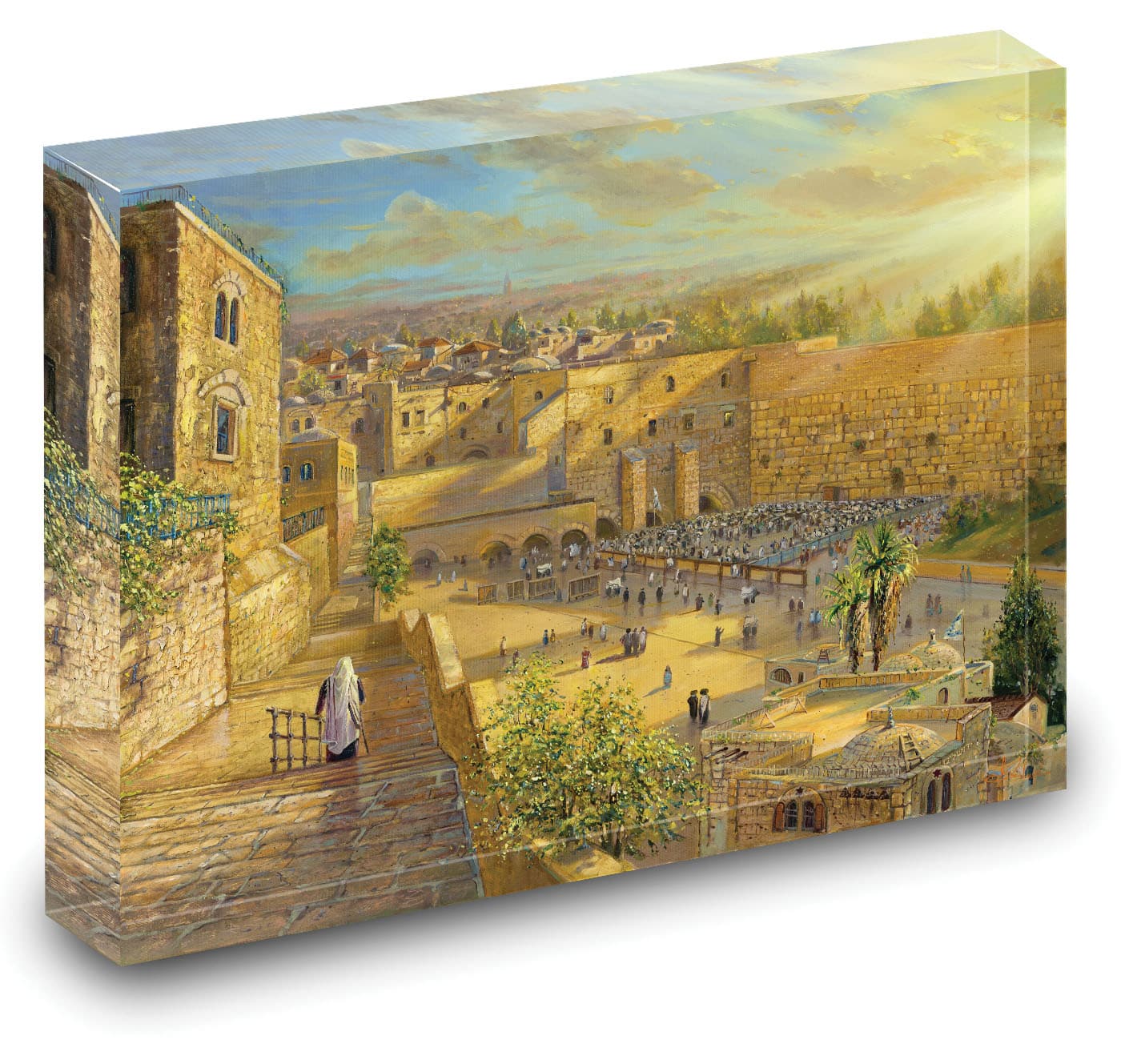
Acrylic Block Sculpture – Sunrise Behind the Kotel
Alex Levin’s Sunrise Behind the Kotel Acrylic Block uses Jerusalem architecture particularly effectively.
The thick transparent format adds physical depth to an image already built around layers of stone, light and perspective.
The block stands independently, allowing the Jerusalem scene to be displayed on a desk, shelf or table rather than requiring wall space.
Acrylic Block Sculpture – Woman Honoring the Shabbat
The Woman Honoring the Shabbat Acrylic Block demonstrates how a traditional Jewish ritual can be translated into a contemporary format.
The subject remains immediately connected with Shabbat, candle lighting and the Jewish home, while transparent acrylic gives the artwork a modern presentation.
Acrylic Block Sculpture – The Lubavitcher Rebbe
Alex Levin’s Lubavitcher Rebbe Acrylic Block takes a recognizable Jewish portrait and turns it into a compact free-standing art object.
This format can work especially well in an office, study or home library where the artwork can be placed among books and other Judaica.
Acrylic Block Sculpture – The Jerusalem Temple
The Second Holy Jewish Temple Acrylic Block combines architectural imagery with the dimensional qualities of acrylic.
Temple artwork naturally depends on depth, monumental scale and layers of architecture.
The block format provides a different viewing experience from the same imagery presented as a conventional wall print.
Jewish Sculpture for a Modern Home
Traditional wall art is not ideal for every space.
A small free-standing sculpture or acrylic block can be placed on:
- A bookshelf
- Office desk
- Side table
- Console table
- Display cabinet
- Home library
This makes three-dimensional Judaica particularly useful for collectors who want meaningful Jewish art without adding another framed piece to the wall.
Jewish Sculpture as a Housewarming Gift
Three-dimensional Jewish art can make a meaningful housewarming gift.
Jerusalem, Shabbat, Torah and the Kotel are subjects closely associated with Jewish identity and the Jewish home.
A compact free-standing object is also easier to place than a large painting because the recipient does not need to choose a permanent wall location.
Jewish Sculpture as a Wedding Gift
Jewish weddings celebrate the creation of a new household.
Artwork connected with Jerusalem, Shabbat or Jewish tradition can therefore have particular meaning as a wedding or engagement gift.
Contemporary acrylic Judaica offers an alternative for couples whose home style is modern and who may prefer clean transparent materials to traditional silver or carved wood.
Jewish Sculpture for an Office
Acrylic blocks are particularly suitable for offices because they stand independently and require relatively little space.
A Jerusalem scene, Kotel image or Rebbe portrait can create a personal connection with Jewish identity without dominating a professional environment.
The transparent material also fits easily with contemporary office furniture and modern interiors.
Traditional Judaica vs. Contemporary Jewish Sculpture
Traditional Judaica may use silver, brass, wood, ceramic or stone.
Contemporary Jewish artists and designers increasingly work with materials such as acrylic, glass, stainless steel and mixed media.
The material changes, but the underlying subjects can remain familiar.
A Kotel, menorah, Torah or Jerusalem Temple can be represented through a modern material without losing its cultural meaning.
Can Jewish Art Be Both Traditional and Modern?
Absolutely.
The subject and the artistic format do not need to come from the same historical period.
An artist can portray an ancient Jerusalem Temple using modern digital production. A centuries-old Shabbat tradition can become contemporary acrylic art. Hebrew letters can appear in abstract sculpture.
This combination of old meaning and new form is one of the defining characteristics of contemporary Jewish art.
Explore Alex Levin’s Contemporary Jewish Art collection.
Jewish Sculpture and the Future of Judaica
Jewish ceremonial and decorative art has always reflected the materials and artistic technologies available to each generation.
Contemporary artists now have access to materials and production methods that earlier Jewish craftspeople could not have imagined.
Acrylic, digital printing, laser cutting and other techniques create opportunities for new forms of Judaica.
The challenge is not simply to use a modern material.
The strongest work still needs to connect visual design with meaningful Jewish content.
Frequently Asked Questions About Jewish Sculpture
What is Jewish sculpture?
Jewish sculpture is three-dimensional artwork connected with Jewish religion, history, culture, Israel or Jewish identity. It can include ceremonial Judaica, carved and cast sculpture, abstract art, monuments, installations and contemporary acrylic art.
Does Judaism prohibit sculpture?
Judaism contains important restrictions concerning graven images and idolatry, but it is inaccurate to describe Jewish tradition as universally prohibiting all sculpture or visual art. Jewish communities have produced extensive ceremonial and decorative art throughout history.
What are examples of Jewish sculptural art?
Examples include menorahs, Torah crowns and finials, carved synagogue decoration, memorial sculpture, abstract Jewish sculpture, Jerusalem-inspired works and contemporary Judaica produced in materials such as metal, glass and acrylic.
What is Judaica?
Judaica generally refers to objects associated with Jewish religion, tradition and culture. Artistic Judaica can include menorahs, mezuzah cases, Kiddush cups, Torah ornaments, Seder plates, Shabbat candlesticks and contemporary Jewish decorative objects.
What is an acrylic block sculpture?
An acrylic block sculpture is a free-standing art object made from thick transparent acrylic. In Alex Levin’s collection, an image based on an original painting is presented behind crystal-clear acrylic to create greater depth and luminosity.
Does an acrylic block need a frame?
No. Alex Levin’s acrylic blocks are designed to stand independently on a flat surface, so they do not require framing or wall mounting.
How large are Alex Levin’s acrylic block sculptures?
The current collection uses compact 8 × 10-inch formats with approximately 1-inch-thick acrylic, with orientation depending on the artwork.
What subjects are available as Jewish acrylic sculptures?
Subjects include Jerusalem, the Kotel, the Jerusalem Temple, the Lubavitcher Rebbe, Shabbat, Moses, Jewish dancing, klezmer musicians and Shema Israel.
Are Jewish acrylic sculptures good gifts?
They can be especially suitable for Jewish weddings, housewarmings, anniversaries, engagements and offices because they combine meaningful Jewish imagery with a compact, free-standing contemporary format.
Where can I find Jewish acrylic sculptures?
ArtLevin.com offers a collection of Jerusalem and Judaica Acrylic 3D Blocks based on original paintings by Israeli artist Alex Levin.
Explore Acrylic 3D Blocks by Alex Levin