
Some paintings make an immediate impression. Others keep offering new details the longer they hang in your home. That slower kind of looking is especially rewarding in Alex Levin’s Jewish Paintings – Judaica Art collection, where scenes of prayer, family, study, and tradition often hold both a broad emotional read and a close-up richness of gesture, color, and atmosphere.
That is one reason these works resonate so strongly in living spaces, study rooms, and synagogues. From across a room, you may first notice the mood: a grandfather bent over a book, a child at his side, the glow of Jerusalem stone, or the quiet energy of a Shabbat table. Up close, the experience changes. A hand resting on a page, the weight of a tallit stripe, or the way light gathers around a face can deepen the scene into something personal and lasting.
Alex Levin’s Jewish paintings are not only about subject matter. They are also about how a subject unfolds in time. A viewer may respond first to memory, then to composition, and finally to the small details that make a scene feel lived-in rather than posed. That layered experience is what gives these works their staying power.
Why distance matters in Judaica art
Jewish-themed paintings often work on two levels at once. From a distance, they establish a strong visual rhythm through shape, light, and contrast. A tallit can become a band of movement. A cluster of figures can read as a single unit of family or community. Jerusalem architecture can anchor the whole scene with structure and gravity.
Then, as you move closer, the painting opens differently. Facial expression, linework, and smaller objects begin to matter. A book is not just a prop. It becomes evidence of study. A meal is not just a table setting. It becomes a sign of Shabbat, hospitality, and continuity. In Jewish art, these layers are not decorative extras. They are part of the meaning.
This is why choosing a painting for your home is often less about matching a style and more about deciding what kind of daily looking you want to live with. Do you want a scene that announces itself boldly from across the room? Or one that rewards quiet attention and repeated viewing? In many cases, the best Jewish paintings do both.
A collection that rewards slow looking
The works in this collection are especially compelling because they combine recognizable Jewish life with carefully staged visual structure. Some emphasize generations and education. Others focus on prayer, place, or the energy of tradition passed down in family settings. Even when the theme is familiar, Levin approaches it in a way that keeps the viewer engaged beyond the first glance.
That lasting appeal matters in real rooms. A painting above a dining table may be seen every day, but not always in the same light. Morning and evening change the colors. Conversation changes the pace of looking. Guests may notice one detail while the owner notices another. A strong painting grows with that rhythm rather than fighting it.
If you are exploring the broader collection, it helps to think about how the work will function over time. Some pieces hold attention through warmth and narrative. Others through sacred atmosphere. Some are intimate enough for a reading nook, while others are expansive enough for a larger wall. This variety is one of the strengths of Jewish paintings by Alex Levin.
From first impression to lasting presence
The best way to understand this kind of art is to imagine living with it. At first, you may respond to a composition simply because it feels familiar or uplifting. Later, you begin noticing the relation between figures, the angle of a gaze, or the balance between foreground and background. Eventually, the painting becomes part of the room’s emotional architecture.
That process is especially meaningful in Jewish art because the subject itself often carries memory. A father teaching a child, an elder reading, or a scene rooted in Jerusalem or the shtetl can evoke not just a story, but a family history. The painting becomes less like a fixed image and more like a companion to reflection.
Alex Levin’s approach is effective because he does not flatten the subject into symbolism alone. Instead, he gives the viewer enough atmosphere to feel the work immediately and enough detail to return to it later. That balance is what makes these paintings suitable for both collectors and anyone looking for art that feels meaningful in daily life.
For readers who want a broader context for the themes in these works, it can also be helpful to compare them with the artist’s Jerusalem paintings, where the city often functions as both setting and spiritual backdrop. In both cases, the eye begins with the whole scene and then discovers the small visual decisions that make it memorable.
That same experience can be found in the paintings below, where generational closeness, prayerful stillness, and traditional Jewish life reveal more each time you look.
Featured Paintings by Alex Levin
Jewish Generation
This abstract family scene works beautifully because it reads clearly from a distance, then becomes more intimate as you look longer. The embrace, the pastel geometry, and the hint of Jerusalem in the background create an immediate sense of continuity and belonging.
Up close, the soft transitions and layered forms give the work a gentler emotional texture. It feels like a memory translated into color, which makes it especially fitting for a room where family presence matters.

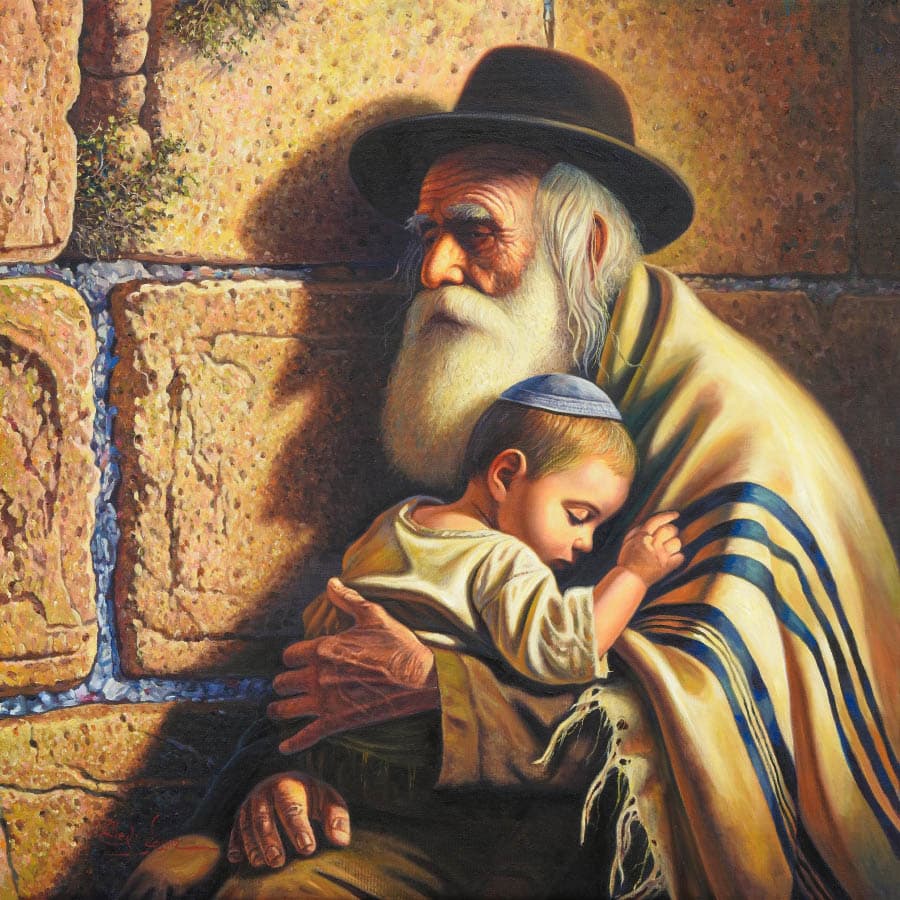
Generations at the Western Wall
From across the room, the strong silhouette of the grandfather and child draws attention at once. The Kotel behind them gives the painting an unmistakable sense of place, while the composition suggests protection, blessing, and continuity.
When you move closer, the tenderness of the pose becomes even more affecting. The sleeping child, the prayer shawl, and the sunlit stone all contribute to a scene that feels both monumental and deeply human.
One on One with God
This is a painting of quiet focus. At a distance, the seated figure and the warm Jerusalem stones establish a mood of solitude and devotion. The composition is simple, but that simplicity gives the scene strength.
Up close, the prayer book, the posture, and the texture of the stones invite slower looking. The work captures the private side of Jewish spirituality, where stillness itself becomes part of the subject.

Lessons of Faith
The first impression here is communal: one elder teaching several children in a warm, glowing setting. The grouping immediately communicates transmission, memory, and shared attention.
The longer you look, the more the details matter. The expressions, the open book, and the surrounding light all reinforce the feeling that faith is being passed not through slogans but through patient presence and study.

Light of Generations
This painting is especially strong for viewers who enjoy discovering emotional nuance over time. At a glance, the scene feels warm and familiar, with the elder and child locked in a gentle moment of attention.
Closer viewing reveals how carefully the figures are balanced. The interaction between age and youth gives the work its emotional center, turning a simple domestic scene into a meditation on continuity.

Jewish paintings often become more meaningful the longer they live with you. Their first impression may be beauty, but their lasting value comes from recognition, memory, and the small visual moments that continue to speak over time.
If you are looking for art that brings tradition into the room without losing warmth or sophistication, explore the Jewish Paintings – Judaica Art collection and notice which scenes draw you back for a second look. The most enduring works are often the ones that keep revealing new details after the first glance.