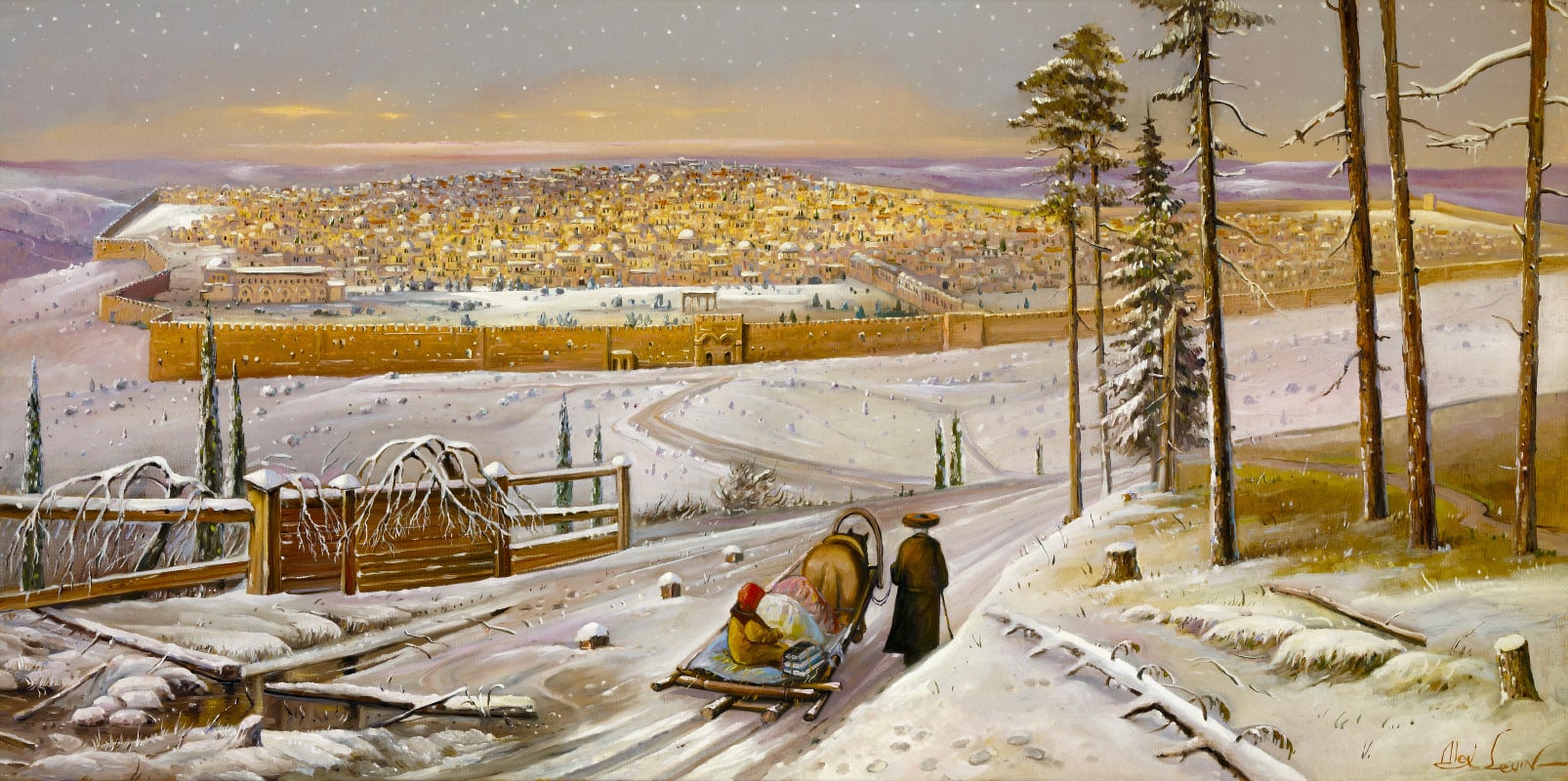
Hanukkah art transforms the light, history and traditions of the Jewish Festival of Lights into visual form. Glowing menorahs, Jerusalem streets, families gathered around candles, the ancient Temple, the Maccabees and contemporary Jewish symbols all provide artists with powerful subjects.
For Israeli artist Alex Levin, Hanukkah offers something especially suited to painting: the contrast between darkness and light.
A small flame can illuminate a face, a room or an ancient Jerusalem wall. That visual contrast reflects one of the central ideas associated with Hanukkah – bringing light into darkness and preserving Jewish identity across generations.
What Is Hanukkah?
Hanukkah, also spelled Chanukah, is an eight-day Jewish holiday commemorating the rededication of the Temple in Jerusalem following the Maccabean revolt in the second century BCE.
The Hebrew word Hanukkah means “dedication.”
The historical story centers on the struggle of the Maccabees and the restoration and rededication of the Temple after it had been desecrated under the Seleucid ruler Antiochus IV.
Over time, another tradition became central to the holiday: the miracle of a small quantity of ritually pure oil that, according to the Talmud, burned for eight days.
That tradition helps explain why light became the defining visual symbol of Hanukkah.
Why Is Hanukkah Called the Festival of Lights?
Hanukkah is commonly known as the Festival of Lights because Jewish families light a special Hanukkah lamp during each of the holiday’s eight nights.
One light is added each night until all eight Hanukkah lights are burning.
An additional light known as the shamash is used to kindle the others.
The growing number of flames creates one of the most recognizable scenes in Jewish life and one of the most visually compelling subjects in Jewish art.
The Hanukkah Menorah in Art
The Hanukkah lamp is often called a menorah, although the more specific Hebrew term is hanukkiah.
A hanukkiah has places for eight Hanukkah lights plus the shamash.
This is different from the ancient Temple menorah, which had seven branches.
Artists have interpreted the Hanukkah menorah in many ways. Some paint realistic family scenes showing candles being lit. Others isolate the menorah against darkness so that the flames become the central focus of the entire artwork.
Contemporary artists may transform the menorah into an abstract composition of light, color and symbolic shapes.
Explore Hanukkah Paintings by Alex Levin
Why Light Is So Powerful in Hanukkah Paintings
Light has always been one of the most expressive tools available to a painter.
In Hanukkah artwork, the candle flame has both a physical and symbolic role.
Artistically, candlelight creates warm highlights, deep shadows and reflections. It can illuminate a person’s face while allowing the surrounding room or Jerusalem street to disappear gradually into darkness.
Symbolically, light can suggest faith, continuity, memory, hope and the survival of Jewish tradition.
This combination makes Hanukkah particularly suitable for dramatic paintings centered on illumination.
The Story of the Maccabees
The historical background of Hanukkah begins during the second century BCE, when Judea was under Seleucid rule.
Under Antiochus IV Epiphanes, Jewish religious practices were restricted and the Jerusalem Temple was desecrated.
A Jewish revolt began under Mattathias and his sons, the best known of whom was Judah Maccabee.
The Maccabean forces eventually regained control of Jerusalem and purified and rededicated the Temple.
The festival commemorating that dedication became Hanukkah.
Are the Maccabees in the Hebrew Bible?
No. This is an important distinction.
The Books of First and Second Maccabees preserve major ancient accounts of the events surrounding the revolt and the rededication of the Temple, but they are not part of the Jewish canon of the Hebrew Bible.
The familiar story of the oil lasting eight days also does not appear in the Books of Maccabees. It appears later in rabbinic tradition, most famously in the Babylonian Talmud.
This means that the historical military story and the later rabbinic miracle-of-the-oil tradition are related strands in the way Hanukkah has been remembered.
The Miracle of the Oil
According to the Talmudic tradition, when the Temple was rededicated, only one container of ritually pure oil could be found for the menorah.
There was enough oil for one day, but it miraculously lasted for eight days.
This story became one of the best-known explanations for the eight-night celebration and the lighting of Hanukkah candles.
For artists, the story creates an especially powerful image: a limited amount of physical light representing something spiritually much larger.
Hanukkah and the Jerusalem Temple
The story of Hanukkah cannot be separated from Jerusalem and the Temple.
The word Hanukkah refers to the dedication or rededication of the sacred space after the Maccabees regained control.
That historical connection is sometimes overlooked because modern celebrations focus so strongly on candle lighting, dreidels, food and family.
Yet the Temple gives the holiday its historical setting.
You can learn more about the Temple in our guide to the First and Second Jerusalem Temples.
Explore Alex Levin’s collection of Jerusalem Temple paintings.
Jerusalem in Hanukkah Art
Jerusalem provides a natural setting for Hanukkah paintings because the historical events commemorated by the holiday are connected with the city.
An artist can portray glowing candles against ancient Jerusalem stone, families celebrating in narrow streets or an illuminated menorah overlooking the Old City.
The warm gold of candlelight works especially well against Jerusalem’s stone architecture.
This creates a visual connection between a celebration taking place today and events that occurred more than two thousand years ago.
Hanukkah in Jerusalem by Alex Levin
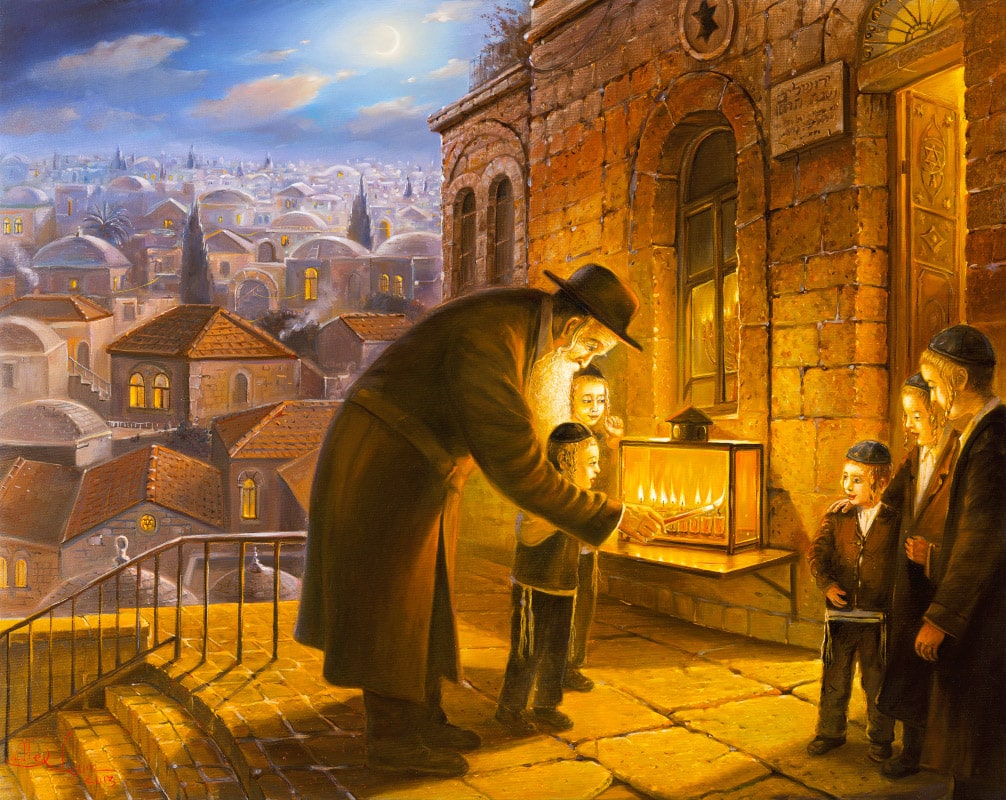
Alex Levin’s Hanukkah in Jerusalem brings the holiday into the streets of the Holy City.
An older man lights the Hanukkah menorah as children gather around him.
Two sources of light shape the composition: the moon above Jerusalem and the warm candlelight surrounding the figures.
The contrast between moonlight and menorah light creates a scene that feels both intimate and connected with the larger city around it.
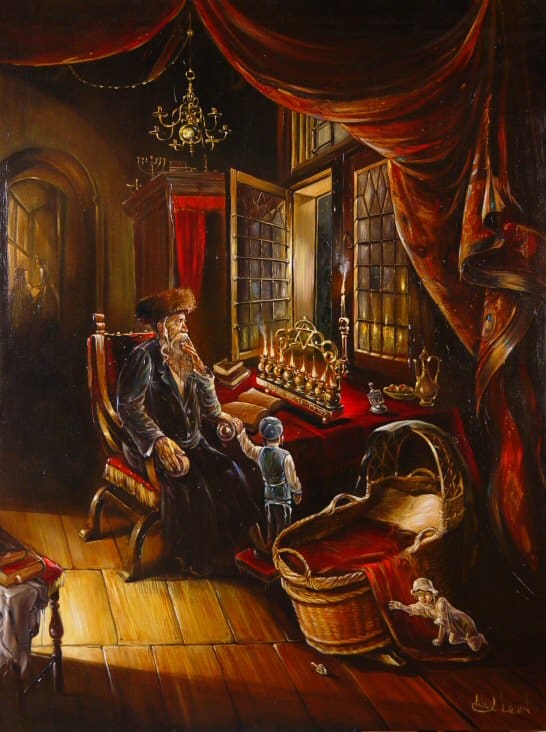
The painting also communicates an important theme in Levin’s Jewish Life series – traditions passed from an older generation to younger children.
Passing Hanukkah Traditions From Generation to Generation
Many Jewish holiday paintings focus not only on ritual objects but on the people using them.
A menorah becomes more meaningful when a child watches a parent or grandparent light it.
That interaction turns the subject from a still life into a story about continuity.
Jewish families have celebrated Hanukkah under very different historical circumstances and in communities throughout the world.
Artwork depicting several generations together can represent the survival of those customs across time and geography.
Magnificent Light of Menorah
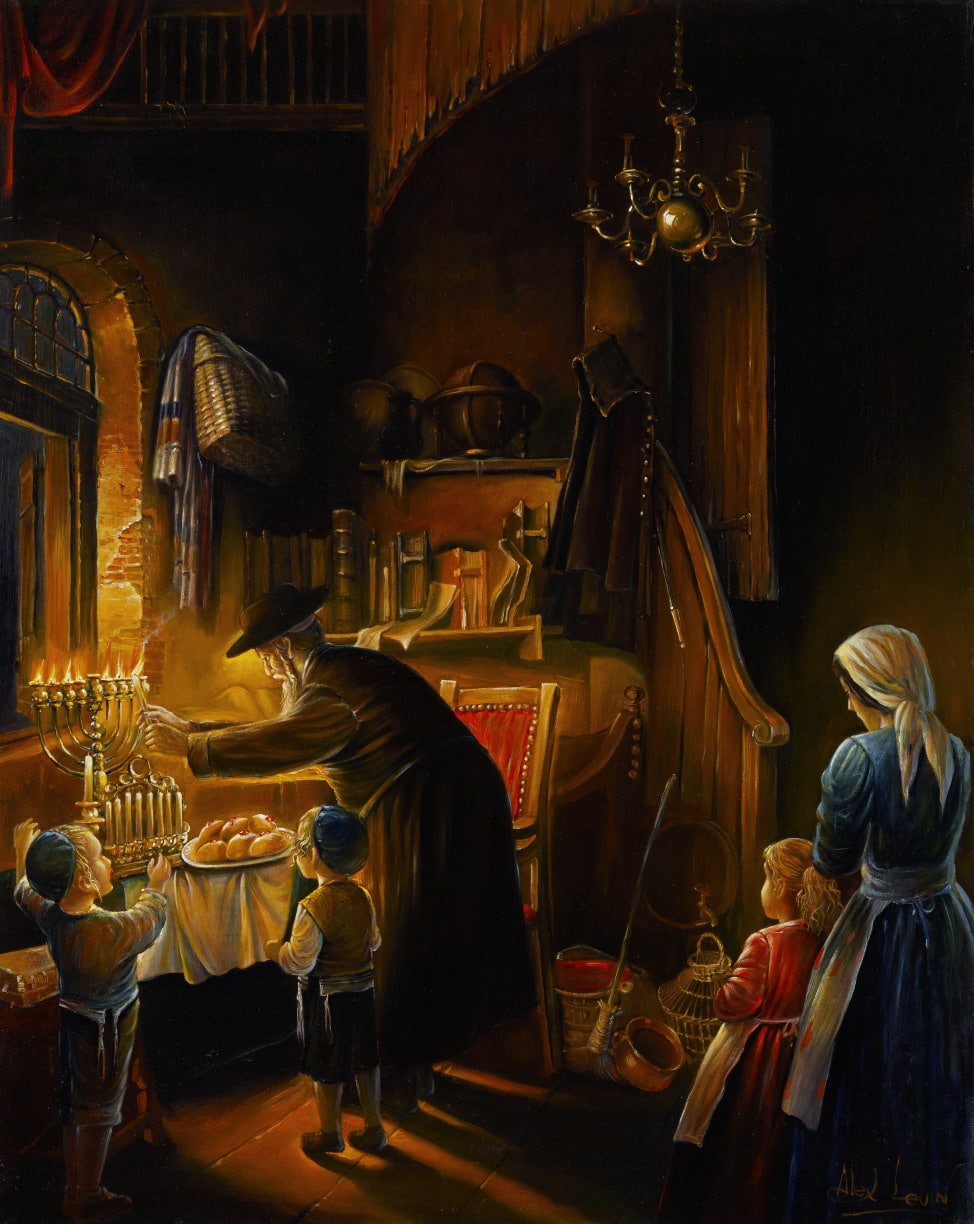
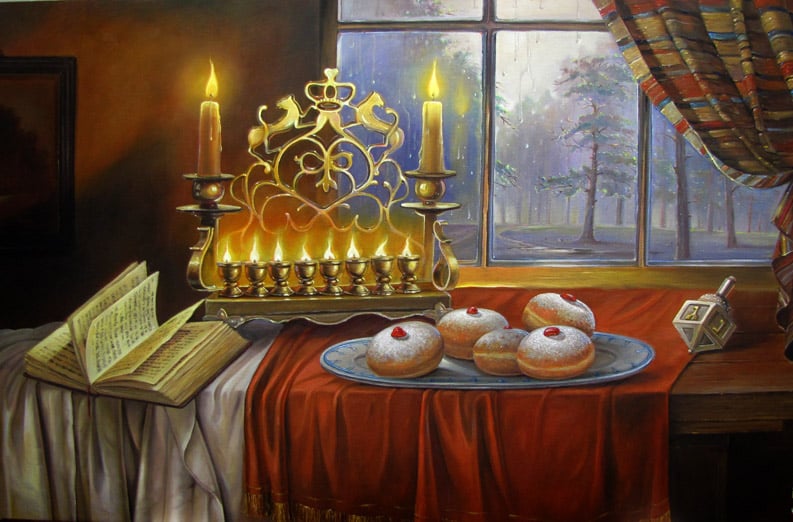
In Magnificent Light of Menorah, Alex Levin focuses on the warm glow created by multiple Hanukkah lights.
The menorah becomes the emotional center of the scene.
The painting also includes traditional Hanukkah foods, connecting the religious ritual with the family celebration surrounding it.
This combination of ritual, food and light reflects the way Hanukkah is experienced in the home rather than simply explaining its history.
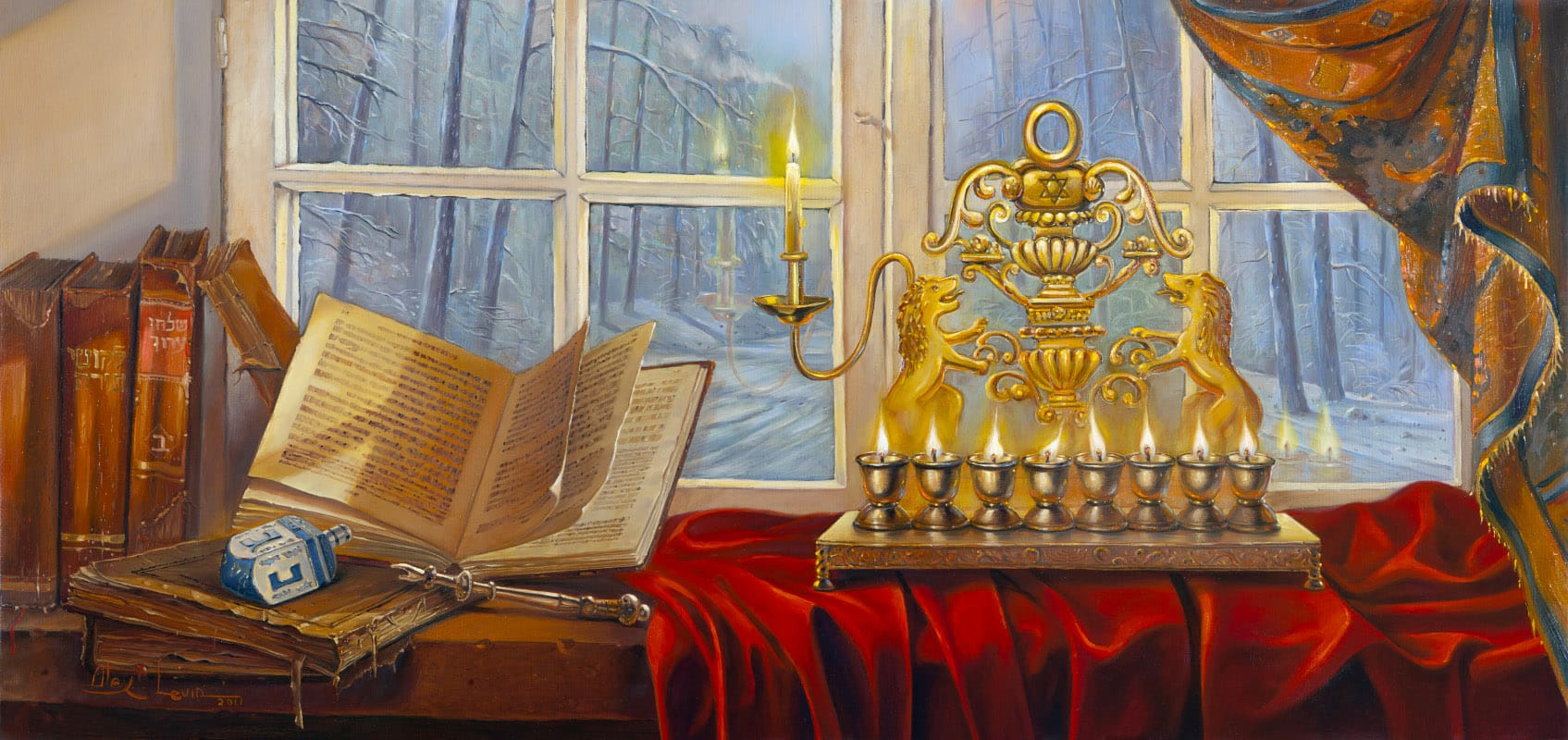
Hanukkah Lights as Jewish Still Life
Hanukkah also works beautifully as a still-life subject.
A menorah, Torah books, dreidel, candles and traditional foods can tell a story even when no people appear in the painting.
In Hanukkah Lights, the ritual objects themselves become the central characters.
A still life allows the viewer to concentrate on texture, reflected light, Hebrew lettering, candle flames and the arrangement of symbolic objects.
It can also make Hanukkah imagery suitable for a home throughout the year rather than only during the holiday.
The Dreidel in Hanukkah Art
The dreidel is another immediately recognizable Hanukkah symbol.
The four-sided spinning top traditionally carries Hebrew letters associated with the phrase “A great miracle happened there.” In Israel, a variant traditionally uses a letter indicating “here” rather than “there.”
Although dreidel games are playful, the object itself has become a strong piece of visual shorthand for Hanukkah.
Artists may include dreidels in family scenes, still lifes, children’s imagery and contemporary Judaica.
Hanukkah Gelt
Hanukkah gelt refers to money traditionally given during Hanukkah.
Today many people immediately think of chocolate coins wrapped in gold foil, especially in children’s celebrations.
Coins, dreidels and candlelight together create a recognizable visual vocabulary for modern Hanukkah artwork.
These objects can appear playful while still connecting the painting with family tradition.
Latkes and Sufganiyot in Hanukkah Art
Foods fried in oil have become strongly associated with Hanukkah because oil plays such an important role in the holiday tradition.
Ashkenazi communities are particularly associated with latkes, while sufganiyot, jelly-filled doughnuts, are especially popular in Israel.
Food gives artists another way to portray the holiday beyond explicitly religious imagery.
A table filled with candles, latkes or sufganiyot can communicate family warmth, celebration and memory.
Traditional Hanukkah Art
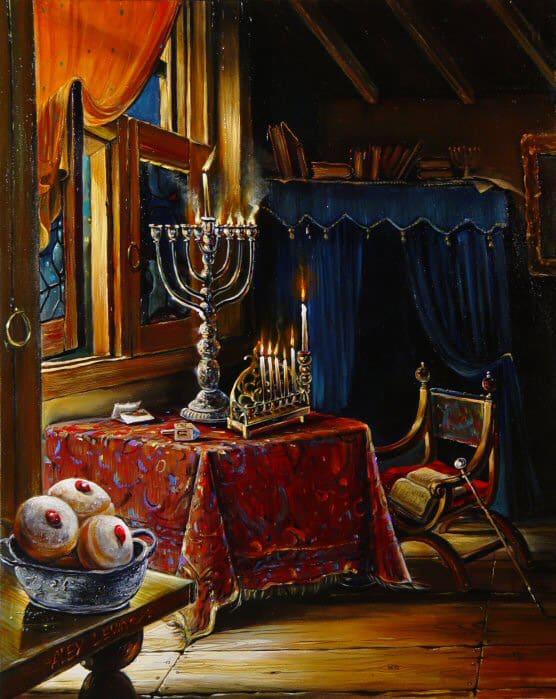
Traditional Hanukkah paintings frequently emphasize recognizable ritual and family scenes.
A typical work may show parents and children gathered around a menorah, a rabbi lighting candles, a table prepared with holiday foods or a Jewish community celebrating together.
Traditional artwork often focuses on emotional warmth and detailed storytelling.
The viewer can identify not only the holiday but also the relationships between the people in the scene.
Modern Hanukkah Art
Modern and contemporary Hanukkah art can take a very different approach.
The menorah may be reduced to lines of light. Hebrew letters may become abstract shapes. Jerusalem architecture may be fragmented into geometric forms.
Rather than documenting a family celebration literally, an artist may use Hanukkah to explore concepts such as light, memory, freedom and Jewish identity.
This allows an ancient holiday to be expressed through a modern visual language.
Abstract Hanukkah Art
Alex Levin also uses contemporary and abstract approaches to the Festival of Lights.
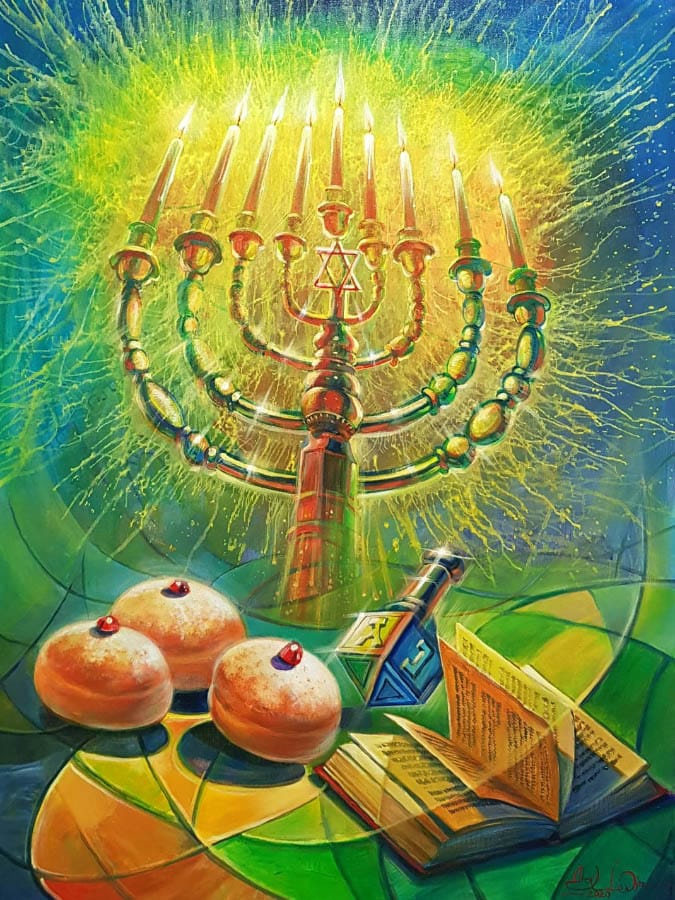
His Hanukkah – The Jewish Festival of Lights moves away from a purely traditional holiday scene.
Color, light and symbolic forms become as important as literal representation.
This type of artwork works particularly well in modern interiors where collectors want Jewish symbolism without necessarily choosing a traditional narrative painting.
Abstract Hanukkah in Jerusalem
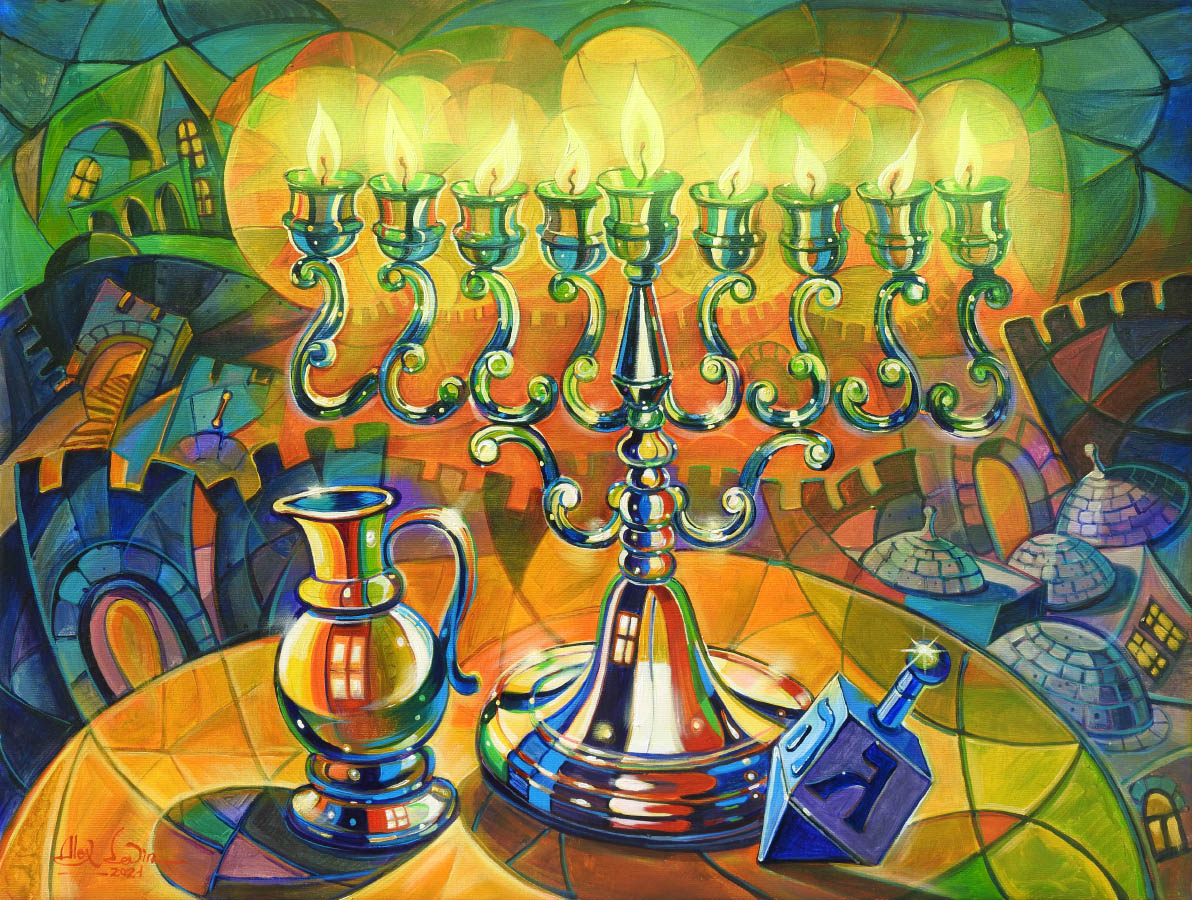
In Hanukkah in Jerusalem – Jewish Festival of Lights, Levin combines the holiday with contemporary Jerusalem imagery.
The composition connects the Festival of Lights with the city at the center of the original Hanukkah story.
This combination of ancient subject and contemporary treatment is characteristic of a broader direction in modern Jewish art.
Historical memory does not need to be painted as though it belongs only to the past.
Hanukkah and Jewish Identity
Hanukkah is often interpreted as a holiday concerned with Jewish continuity and identity.
The Maccabean story emerged from a period of intense political, religious and cultural conflict.
In later generations, lighting the menorah became a visible ritual repeated year after year in Jewish homes.
That makes Hanukkah particularly meaningful to artists interested in the relationship between ancient Jewish history and contemporary Jewish life.
Hanukkah in the Jewish Home
Unlike pilgrimage festivals centered historically on the Temple, much of modern Hanukkah observance takes place in the home.
The family menorah becomes a focal point for the holiday.
Family members gather, blessings are recited, candles are lit and songs may be sung.
Because the home plays such an important role, Hanukkah painting naturally overlaps with themes found throughout Jewish Life art – family, ritual, children, light and shared tradition.
Explore Alex Levin’s Jewish Life paintings.
Hanukkah Art as a Jewish Gift
Hanukkah artwork can make a meaningful gift for a Jewish home, family, synagogue or collector.
Some people prefer a traditional family scene, while others choose a menorah still life or contemporary interpretation.
Jerusalem Hanukkah paintings can be especially meaningful for collectors who want to connect the Festival of Lights with the city where the historical rededication of the Temple took place.
Because menorah imagery represents light and Jewish continuity, these artworks can also remain meaningful when displayed throughout the year.
Hanukkah Paintings by Alex Levin
Israeli artist Alex Levin has created a dedicated collection of Hanukkah paintings ranging from traditional scenes to contemporary Judaica.
The collection includes families lighting candles, menorah still lifes, Jerusalem scenes and abstract interpretations of the Festival of Lights.
Across these different styles, light remains the connecting visual element.
View the Complete Hanukkah Paintings Collection
Choosing Hanukkah Artwork for Your Home
The best Hanukkah artwork depends on the atmosphere you want to create.
- Traditional Jewish art – choose a family menorah-lighting scene.
- Jerusalem art – choose Hanukkah imagery set in the Old City or against Jerusalem architecture.
- Modern Judaica – choose an abstract or contemporary menorah composition.
- Jewish still life – choose candles, ritual objects and traditional foods without a large figurative scene.
The subject can therefore work in traditional, contemporary and modern interiors while maintaining a strong Jewish identity.
Frequently Asked Questions About Hanukkah Art
What is Hanukkah art?
Hanukkah art is artwork inspired by the Jewish Festival of Lights and its history and traditions. Common subjects include menorahs, candle lighting, Jerusalem, the Maccabees, dreidels, Hanukkah foods and Jewish family celebrations.
What is the main symbol of Hanukkah?
The Hanukkah menorah, or hanukkiah, is the holiday’s most recognizable symbol. One additional light is kindled on each of the eight nights, using a helper light known as the shamash.
Is a Hanukkah menorah the same as the Temple menorah?
No. The ancient Temple menorah had seven branches. A Hanukkah lamp has eight lights corresponding to the eight nights of Hanukkah plus a shamash used to light the others.
Why is Hanukkah celebrated for eight nights?
Rabbinic tradition in the Talmud tells of one container of pure oil that was expected to last for one day but burned for eight. Ancient sources also connect the holiday with the eight-day celebration following the rededication of the Temple.
Are the Books of Maccabees in the Hebrew Bible?
No. First and Second Maccabees are important ancient sources for the Maccabean revolt and the rededication of the Temple, but they are not included in the Jewish canon of the Hebrew Bible.
What does Hanukkah mean?
Hanukkah means “dedication” in Hebrew and refers to the rededication of the Jerusalem Temple following the Maccabean victory.
Why is Hanukkah called the Festival of Lights?
The name reflects the central practice of lighting the Hanukkah menorah over eight nights and the later Jewish tradition concerning the miracle of the Temple oil.
What are common subjects in Hanukkah paintings?
Common subjects include menorahs, families lighting candles, Jerusalem, dreidels, Jewish children, latkes, sufganiyot, Torah books and scenes inspired by the Maccabees and the Temple.
How do you spell Hanukkah?
Hanukkah, Chanukah and several other English spellings are transliterations of the same Hebrew word. Hanukkah and Chanukah are among the most common forms.
Where can I buy Hanukkah paintings?
ArtLevin.com features traditional, Jerusalem and contemporary Hanukkah paintings by Israeli artist Alex Levin. View the Hanukkah Paintings collection.