Israeli paintings reflect one of the most visually and culturally diverse countries in the world. Jerusalem stone, the Mediterranean coast, Tel Aviv streets, the Galilee, Judean Desert, Dead Sea, Jewish traditions, biblical history, immigration, war, memory, and modern Israeli life have all inspired generations of artists.
There is no single style that defines Israeli art. Some painters work in detailed realism, while others use abstraction, surrealism, symbolism, expressionism, or contemporary techniques.
What connects much of the art created in Israel is the relationship between people and place – a land where ancient history and modern life constantly exist side by side.
What Are Israeli Paintings?
The term Israeli paintings can refer broadly to paintings created by artists working in Israel or artwork inspired by Israeli landscapes, cities, history, culture, and people.
Common subjects include:
- Jerusalem and the Old City
- The Kotel and Temple Mount
- Tel Aviv and Jaffa
- The Galilee and Sea of Galilee
- The Dead Sea and Judean Desert
- Mediterranean landscapes
- Jewish traditions and religious life
- Biblical stories
- Israeli history and national events
- Immigration and Jewish identity
- Contemporary Israeli society
Israeli art can therefore range from quiet landscape painting to complex contemporary artwork dealing with identity, memory, religion, politics, and history.
How Did Modern Israeli Art Begin?
The development of modern Israeli art began before the establishment of the State of Israel in 1948.
An important milestone came in 1906, when artist Boris Schatz established the Bezalel School of Arts and Crafts in Jerusalem.
Bezalel sought to develop new forms of Jewish visual culture by combining Jewish history and biblical imagery with local materials, Middle Eastern decorative traditions, European art, and the landscapes of the Land of Israel.
The school later developed into today’s Bezalel Academy of Arts and Design and played an important role in the development of Israeli visual culture.
Early Paintings of the Land of Israel
Early painters working in the Land of Israel frequently focused on the landscape and the rapidly changing communities around them.
Artists painted Jerusalem, Jaffa, Tel Aviv, Galilee villages, olive groves, agricultural settlements, local residents, Mediterranean light, and scenes of everyday life.
These paintings were not simply landscapes. They often expressed the artists’ attempt to understand their relationship with the land and the development of a new Jewish society.
Reuven Rubin became particularly associated with this period. After settling in the Land of Israel in the 1920s, he painted landscapes, Jerusalem, Tel Aviv, Jaffa, olive groves, biblical subjects, and the people around him.
You can learn more about Rubin and other major painters in our guide to famous Israeli artists and painters.
Jerusalem Paintings
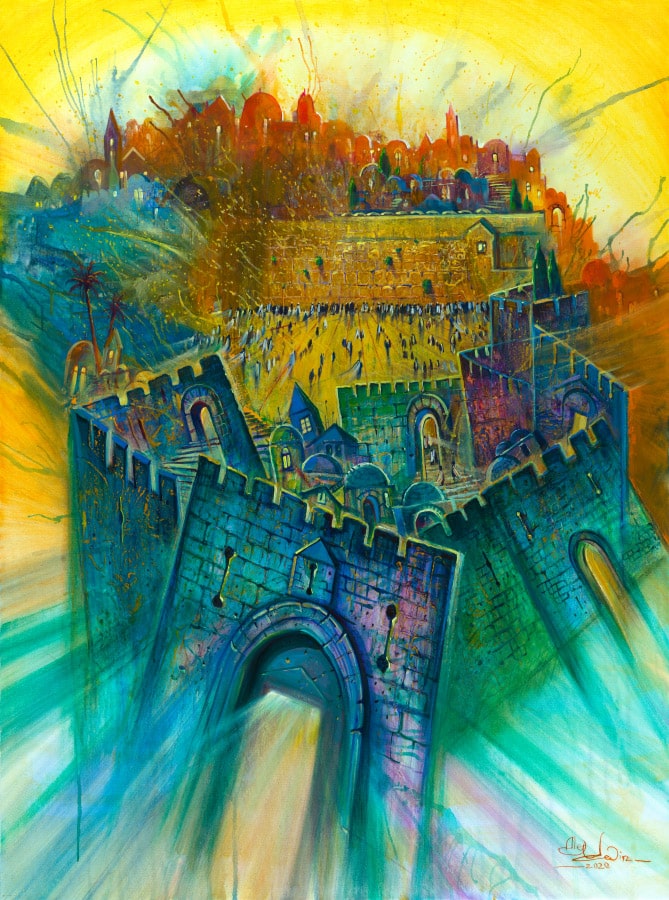
Jerusalem is probably the most enduring subject in Israeli painting.
The city offers artists an extraordinary combination of architecture, religion, archaeology, history, landscape, and changing light.
Artists have portrayed Jerusalem realistically, symbolically, romantically, abstractly, and even through imagined visions of the ancient or future city.
Popular subjects include:
- The Old City walls
- Western Wall
- Temple Mount
- Jerusalem gates
- Mount of Olives
- Jewish Quarter
- Jerusalem streets
- City of David
- Panoramic views
- The ancient Jerusalem Temple
Israeli artist Alex Levin has made Jerusalem one of the central themes of his career.
Explore his collection of Jerusalem paintings.
The Kotel in Israeli Art
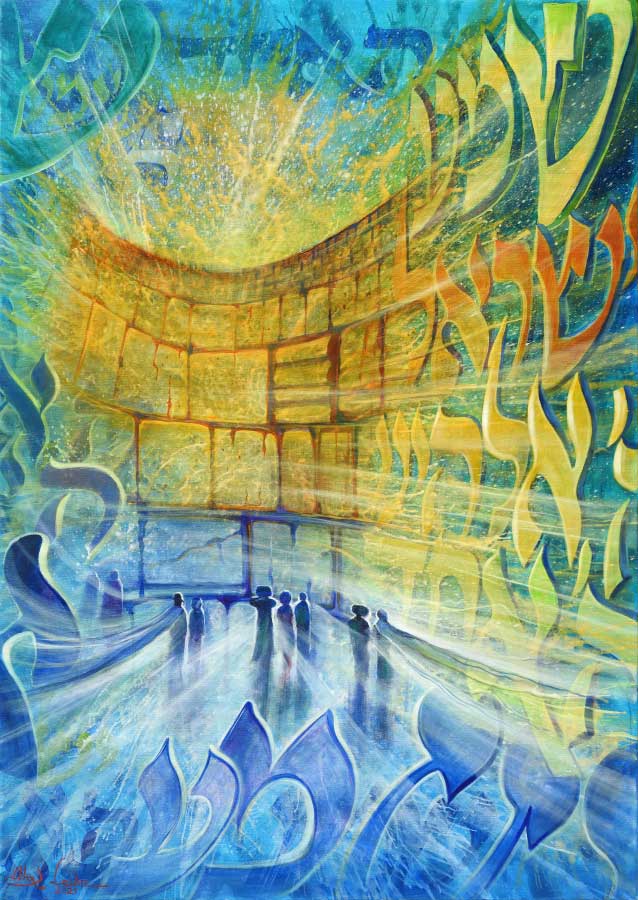
The Kotel, or Western Wall, is one of the most recognizable landmarks in Israeli and Jewish art.
Paintings often portray worshippers standing beside the ancient stones, soldiers visiting the Wall, families celebrating important occasions, people placing written prayers between the stones, or the plaza illuminated by Jerusalem’s changing light.
The Kotel provides artists with both an architectural subject and a powerful symbol.
It can represent prayer, Jewish history, Jerusalem, memory, survival, and the continuity of Jewish life.
Explore Alex Levin’s collection of Kotel paintings.
Tel Aviv Paintings
If Jerusalem represents ancient history and spiritual tradition, Tel Aviv offers artists a very different visual language.
Founded in the early 20th century beside ancient Jaffa, Tel Aviv developed into a modern Mediterranean city filled with beaches, cafes, boulevards, nightlife, markets, architecture, bicycles, and constantly changing street life.
Artists can portray the city through its waterfront, Bauhaus architecture, Rothschild Boulevard, Carmel Market, old neighborhoods, skyscrapers, or the contrast between Tel Aviv and nearby Jaffa.
Reuven Rubin painted the rapidly developing city in the 1920s, documenting streets, residents, sand dunes, the Mediterranean, and the emergence of a new urban environment. :chatgpt-content-reference{index=”1″}
Explore Alex Levin’s collection of Tel Aviv paintings.
Jaffa in Israeli Painting
Jaffa provides another striking subject for Israeli artists.
The ancient port, stone alleys, Mediterranean waterfront, churches, mosques, markets, and historic architecture create a visual contrast with modern Tel Aviv immediately to the north.
Painters often emphasize the warm stone, blue Mediterranean water, fishing boats, narrow passages, and changing evening light.
The combination of ancient Jaffa and contemporary Tel Aviv demonstrates one of the recurring themes in Israeli art – the meeting of old and new within a very small geographic space.
Israeli Landscape Painting
Israel contains remarkably varied landscapes despite its relatively small size.
Artists can travel from Mediterranean beaches and fertile northern hills to desert landscapes and the Dead Sea within a few hours.
Important landscape subjects include:
- The Galilee
- Sea of Galilee
- Golan Heights
- Judean Hills
- Negev Desert
- Dead Sea
- Mediterranean coast
- Jerusalem hills
- Olive groves
- Vineyards and agricultural landscapes
Landscape painting became an important part of early Israeli art. Reuven Rubin, for example, repeatedly painted local landscapes after settling in the country, including Galilee, Jaffa, Tiberias, olive groves, and the road to Safed. :chatgpt-content-reference{index=”2″}
The Galilee and Sea of Galilee in Art
The Galilee offers artists softer, greener landscapes than Jerusalem or the desert regions of southern Israel.
Olive trees, hills, fields, villages, the Sea of Galilee, and changing seasonal vegetation provide a broad range of subjects.
The Sea of Galilee also carries deep biblical and historical associations, giving paintings of the region meaning beyond ordinary landscape art.
For some artists, the Galilee represents peace and natural beauty; for others, it provides a visual connection with biblical history and generations of life in the Land of Israel.
The Dead Sea in Israeli Art
The Dead Sea creates one of Israel’s most unusual landscapes.
The combination of water, desert mountains, mineral formations, salt, intense sunlight, and dramatic changes in color has attracted painters and photographers for generations.
Depending on the hour and weather, the water can appear deep blue, turquoise, silver, or almost white.
The stark landscape allows artists to work with simple forms and strong contrasts that can be interpreted realistically or abstractly.
The Judean Desert and Negev
Desert landscapes occupy another important place in art from Israel.
The Judean Desert and Negev can appear visually empty at first, yet subtle variations in rock, sand, mountains, shadows, and changing light provide artists with enormous possibilities.
Desert paintings may emphasize silence and isolation, biblical history, ancient travel routes, monasteries, archaeological sites, or simply the extraordinary color of the landscape.
Sunrise and sunset can transform neutral desert tones into deep reds, golds, purples, and oranges.
Nature of the Holy Land
Israeli landscape art is not limited to dramatic panoramas.
Artists also portray olive trees, pomegranates, vineyards, wildflowers, cypress trees, Mediterranean vegetation, and agricultural landscapes.
Many of these plants carry biblical or cultural associations in addition to their visual beauty.
The olive tree, for example, can represent the landscape itself as well as longevity, peace, and the continuity of life in the region.
Explore Alex Levin’s collection of Nature of the Holy Land paintings.
Jewish Life in Israeli Paintings
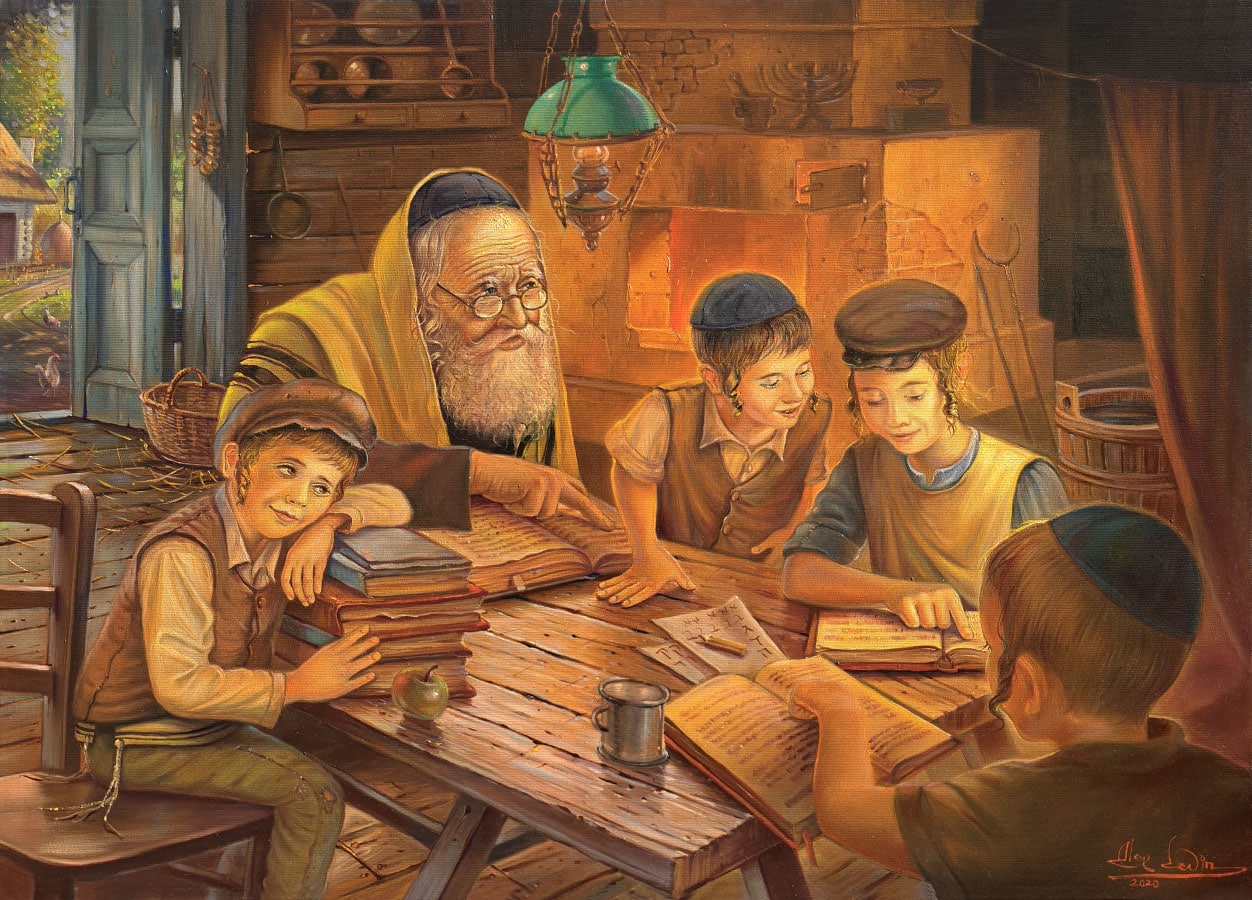
Jewish traditions provide another major source of inspiration for Israeli artists.
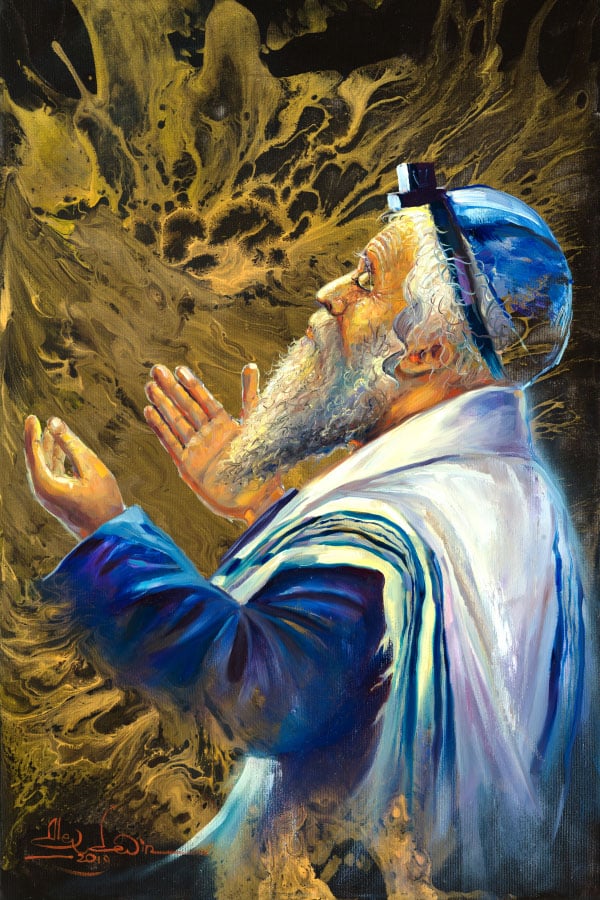
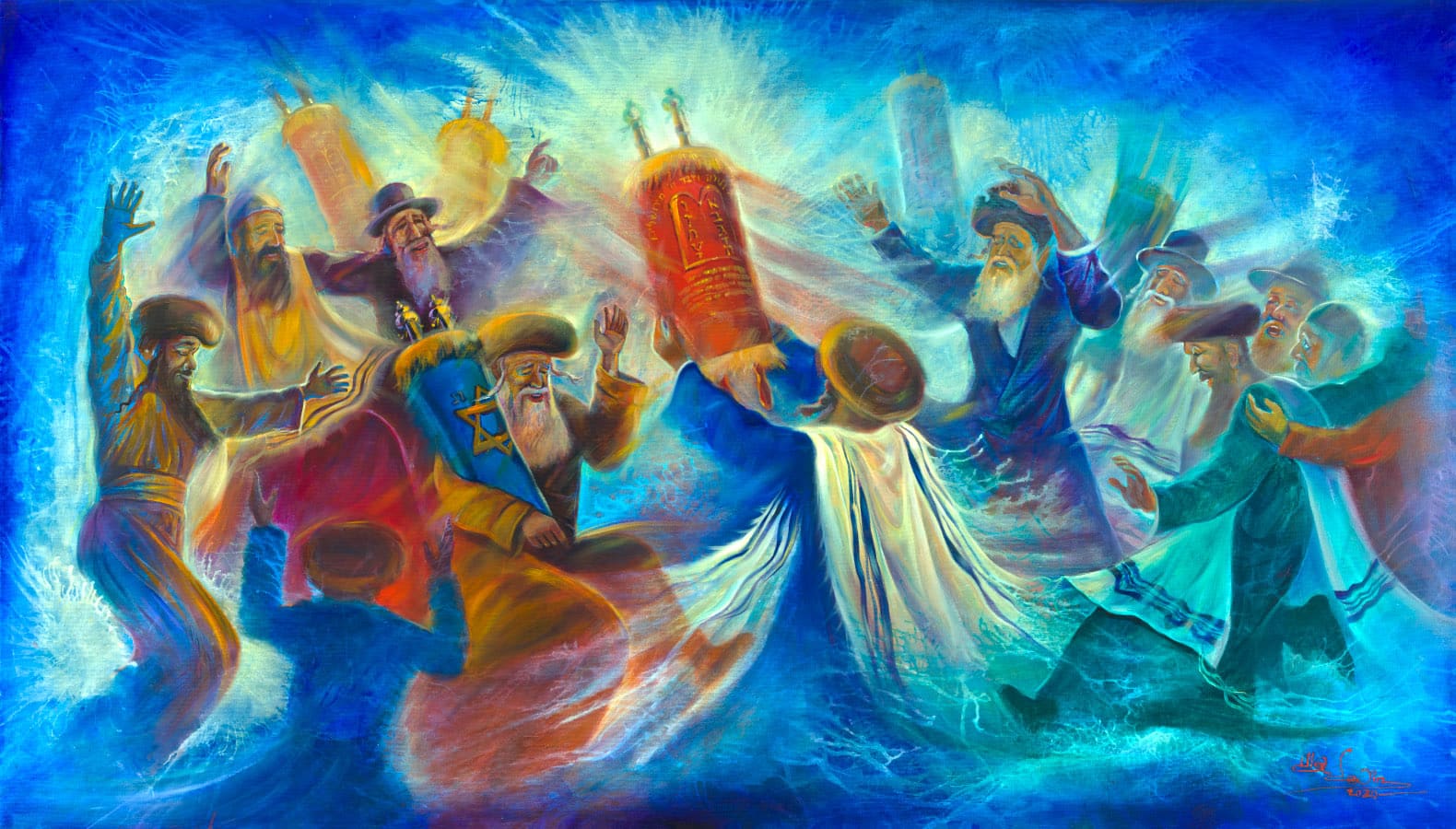
Paintings may portray Shabbat, Torah study, Jewish holidays, prayer, rabbis, synagogues, weddings, family gatherings, or traditional Jewish neighborhoods.
These subjects connect contemporary Israeli life with customs practiced by Jewish communities throughout the world for generations.
Some artists depict these traditions realistically, while others combine them with abstraction or contemporary design.
Explore Alex Levin’s collection of Jewish Life paintings.
Biblical Themes in Israeli Art
The landscapes of Israel make biblical subjects particularly compelling for artists working there.
Stories associated with Abraham, Isaac, Jacob, Moses, King David, King Solomon, the prophets, Jerusalem, and the ancient Temple can be connected visually with the same geographic landscape in which many biblical narratives are set.
Artists may approach biblical subjects historically, spiritually, symbolically, or through contemporary interpretation.
A painting of Moses, for example, may attempt to reconstruct the biblical world or may use modern visual language to explore themes of freedom, leadership, Torah, and responsibility.
The Jerusalem Temple in Israeli Painting
The ancient Jerusalem Temple occupies a unique place in Jewish and Israeli art.
Because the First and Second Temples no longer stand and no complete visual record survives, artists combine biblical texts, historical sources, archaeological research, architectural interpretation, and imagination.
This gives artists unusual freedom to visualize ancient Jerusalem and the Beit Hamikdash.
Alex Levin has created an extensive series of Jerusalem Temple paintings ranging from detailed historical interpretations to contemporary visions.
Israeli History in Art
Modern Israeli history has also become an important subject for painters.
Artists have portrayed immigration, the creation of the State of Israel, wars, military service, national leaders, Holocaust survivors arriving in Israel, Jewish communities returning from different countries, and moments of national celebration or loss.
Such paintings can function simultaneously as art, memory, personal testimony, and interpretation of historical events.
They often reveal how individual artists understand events that continue to shape Israeli society.
Israeli Portrait Painting
Portraiture provides another way to explore Israeli identity.
Artists have portrayed political leaders, rabbis, soldiers, immigrants, cultural figures, ordinary families, and people encountered in everyday life.
A portrait can preserve clothing, expressions, social history, and personality while also reflecting the artistic style of a particular period.
Some Israeli portraits are highly realistic. Others use abstraction, symbolic backgrounds, text, or fragmented forms to explore identity beyond physical likeness.
Contemporary Israeli Art
Contemporary Israeli art extends far beyond traditional landscape and religious painting.
Artists work with abstraction, installation, photography, video, conceptual art, digital media, sculpture, mixed media, and experimental forms.
Subjects can include identity, memory, immigration, conflict, religion, language, environment, technology, family history, and relationships between Israel and the wider world.
Contemporary Israeli painters may also reinterpret traditional themes such as Jerusalem, Torah, Jewish symbols, and biblical narratives through modern visual language.
Abstract Israeli Painting
Abstraction allows artists to express Israel without directly painting recognizable buildings or landscapes.
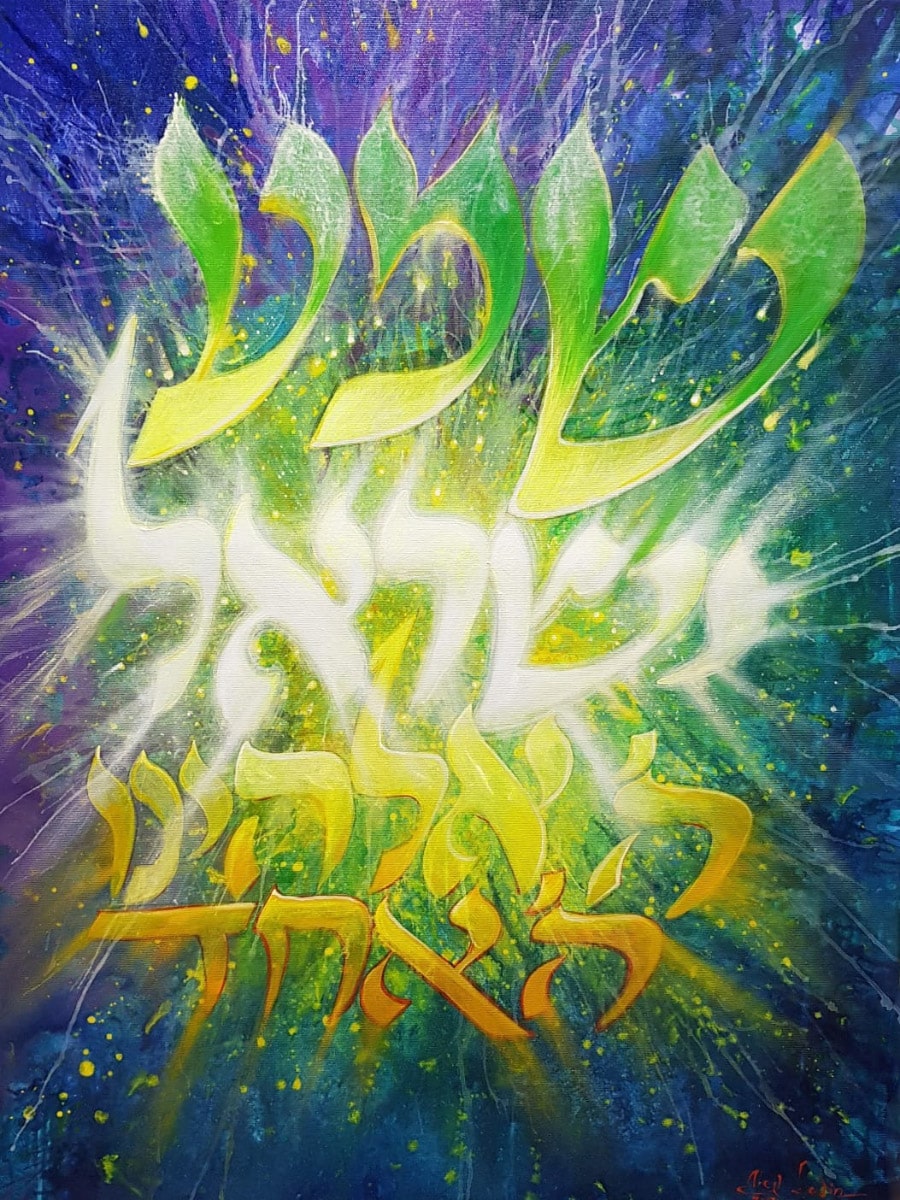
Colors, shapes, textures, Hebrew letters, architectural fragments, and symbolic forms can suggest Jerusalem, desert landscapes, Jewish history, or contemporary Israel.
Some abstract Israeli paintings retain recognizable elements such as the Kotel, Star of David, menorah, Jerusalem walls, or Hebrew text.
Others move almost entirely away from recognizable imagery.
Explore Alex Levin’s contemporary Jewish art.
Why Light Is Important in Israeli Painting
One of the most noticeable characteristics of Israel is the intensity and variety of its natural light.
Jerusalem stone can change from pale cream to gold, pink, or orange depending on the time of day.
The Mediterranean produces entirely different blues from the Dead Sea, while the desert creates strong shadows and sharp contrasts.
For painters, this means that the same location can become a completely different subject depending on the hour, weather, and season.
Light is therefore not simply illumination in Israeli painting. It can become one of the primary elements of the composition.
Traditional vs. Contemporary Israeli Paintings
Traditional Israeli paintings often emphasize recognizable landscapes, Jerusalem architecture, biblical scenes, Jewish life, or historical subjects.
Contemporary paintings may address the same subjects through abstraction, surrealism, unusual perspectives, fragmented imagery, bold colors, or mixed media.
Neither approach defines Israeli art by itself.
The diversity between traditional and contemporary work reflects the diversity of Israeli society and the enormous range of subjects available to artists.
Israeli Paintings by Alex Levin
Israeli artist Alex Levin works across many of the themes that have shaped Israeli painting.
His art includes Jerusalem, the Kotel, Tel Aviv, landscapes of the Holy Land, Jewish traditions, biblical subjects, the Jerusalem Temple, Israeli history, and contemporary Jewish themes.
His work ranges from detailed realistic painting to contemporary and surreal compositions.
Jerusalem is especially central to his work, where architecture and dramatic light often become as important as the people and stories portrayed within the scene.
Explore Art of Israel by Alex Levin
Collectors interested in Israeli art can explore several different collections:
Jerusalem Paintings – Old City, Kotel, streets, gates, sacred landmarks, and panoramic Jerusalem views.
Tel Aviv Paintings – artwork inspired by Tel Aviv, Jaffa, Mediterranean life, and the modern city.
Nature of the Holy Land – landscapes, olive trees, Galilee, desert, Sea of Galilee, and the natural beauty of Israel.
Jewish Life Paintings – Torah, Shabbat, holidays, prayer, family life, and Jewish traditions.
Contemporary Jewish Art – modern and abstract interpretations of Jerusalem, Judaism, Israel, and Jewish identity.
Frequently Asked Questions About Israeli Paintings
What is Israeli art?
Israeli art includes painting, sculpture, photography, installation, design, and other visual art created in Israel or connected with Israeli culture, landscapes, history, and society. It includes both Jewish and secular subjects and ranges from traditional realism to contemporary conceptual art.
What are common subjects in Israeli paintings?
Common subjects include Jerusalem, Tel Aviv, Jaffa, the Galilee, Dead Sea, Negev Desert, Mediterranean coast, Jewish traditions, biblical stories, Israeli history, landscapes, immigration, and contemporary life.
When did modern Israeli art begin?
Modern art in the Land of Israel developed before the establishment of the State of Israel. An important milestone was the establishment of the Bezalel School of Arts and Crafts in Jerusalem by Boris Schatz in 1906. :chatgpt-content-reference{index=”3″}
Who are some famous Israeli painters?
Important Israeli painters include Reuven Rubin, Mordecai Ardon, Nahum Gutman, Moshe Castel, Menashe Kadishman, Yigal Ozeri, and Alex Levin, among many others. See our guide to 10 famous Israeli artists and painters.
Why is Jerusalem common in Israeli art?
Jerusalem combines religious significance, ancient history, distinctive architecture, archaeology, dramatic landscapes, and a unique quality of light. It has therefore inspired artists working in Israel for generations.
What is the difference between Israeli art and Jewish art?
Israeli art refers primarily to art associated with Israel and Israeli artists, while Jewish art refers more broadly to Jewish religion, history, culture, and identity throughout the world. The two categories often overlap but are not identical.
Where can I buy Israeli paintings?
Israeli paintings can be purchased directly from artists, galleries, museums, and specialist art websites. ArtLevin.com offers original paintings and fine-art reproductions by Israeli artist Alex Levin covering Jerusalem, Tel Aviv, Jewish life, Israeli landscapes, biblical subjects, and contemporary art.
What type of Israeli painting is best for a home?
The best choice depends on personal connection and interior style. Jerusalem and Kotel paintings are often chosen for their spiritual meaning, Israeli landscapes for their natural beauty, Tel Aviv works for modern interiors, and Jewish Life paintings for homes where tradition and heritage are especially important.