Contemporary Jewish art brings ancient traditions, familiar symbols, and Jewish history into a modern visual language.
The subjects may be centuries or even thousands of years old – Torah, Jerusalem, Shabbat, prayer, Jewish identity, rabbis, and biblical themes – but contemporary artists are free to reinterpret them through abstraction, vivid color, unusual composition, symbolism, and modern materials.
For Israeli artist Alex Levin, contemporary Jewish art is not a departure from tradition. It is another way of exploring it.
His contemporary works often combine recognizable Jewish imagery with expressive color, light, geometric forms, and symbolic elements, creating artwork that feels connected to Jewish history while fitting naturally into a modern home.
Explore Alex Levin’s Contemporary Jewish Art

What Is Contemporary Jewish Art?
Contemporary Jewish art is modern artwork inspired by Jewish history, religion, culture, identity, and tradition.
There is no single contemporary Jewish style.
One artist may work with abstraction. Another may use realistic figures in an unconventional composition. Others may incorporate Hebrew letters, Torah imagery, Jerusalem architecture, Jewish symbols, or biblical themes.
What connects these works is not a particular technique, but the relationship between modern artistic expression and Jewish subject matter.
Contemporary Jewish art can therefore include paintings of Jerusalem, abstract Judaica, portraits, Torah-inspired works, Shabbat scenes, Jewish symbolism, and modern interpretations of biblical stories.
Tradition Reinterpreted Through Modern Art
Jewish art has always developed alongside the communities that created it.
Contemporary Judaica continues that process.
Instead of simply repeating traditional images, modern artists can ask how familiar Jewish subjects should be represented for today’s viewer.
A Torah scroll may be painted realistically, or it may become the center of an abstract composition filled with light.
Jerusalem may appear as an accurately rendered cityscape, or its walls and skyline may be reduced to shapes, color, and movement.
A portrait of a rabbi may emphasize physical likeness, while another version may surround the figure with symbolic imagery.
The subject remains connected to Jewish tradition, but the visual language changes.
Jerusalem in Contemporary Jewish Art
Jerusalem is one of the most important subjects in Jewish art, and it offers enormous freedom to contemporary artists.
The city’s walls, Kotel, gates, rooftops, Temple imagery, and distinctive Jerusalem stone are recognizable even when they are simplified or transformed.
In contemporary Jerusalem paintings, an artist may exaggerate color, rearrange the skyline, combine landmarks, or use abstraction to communicate a feeling rather than an exact geographical view.
This can make Jerusalem appear less like a physical city and more like a place of memory, faith, history, and spiritual connection.
Alex Levin works in both realistic and contemporary interpretations of Jerusalem. This allows the same city to be viewed in very different ways – one through architectural detail and another through color, light, and symbolism.
Explore Contemporary Jerusalem Paintings
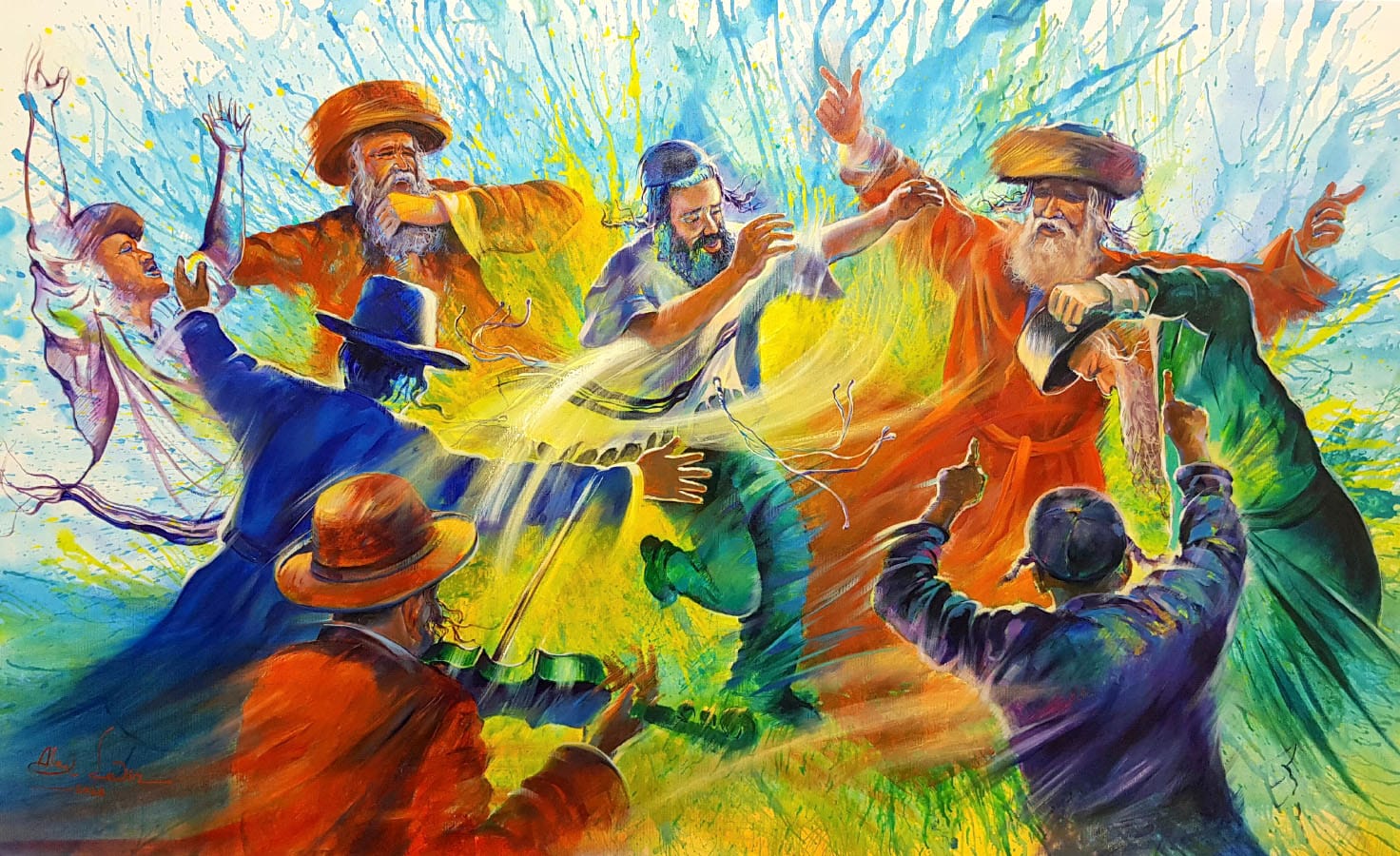
Torah in Contemporary Jewish Art
The Torah is one of the most powerful subjects available to a Jewish artist.
Traditional paintings may show a Torah scroll during prayer, study, or synagogue services.
Contemporary Jewish art can take the same subject much further.
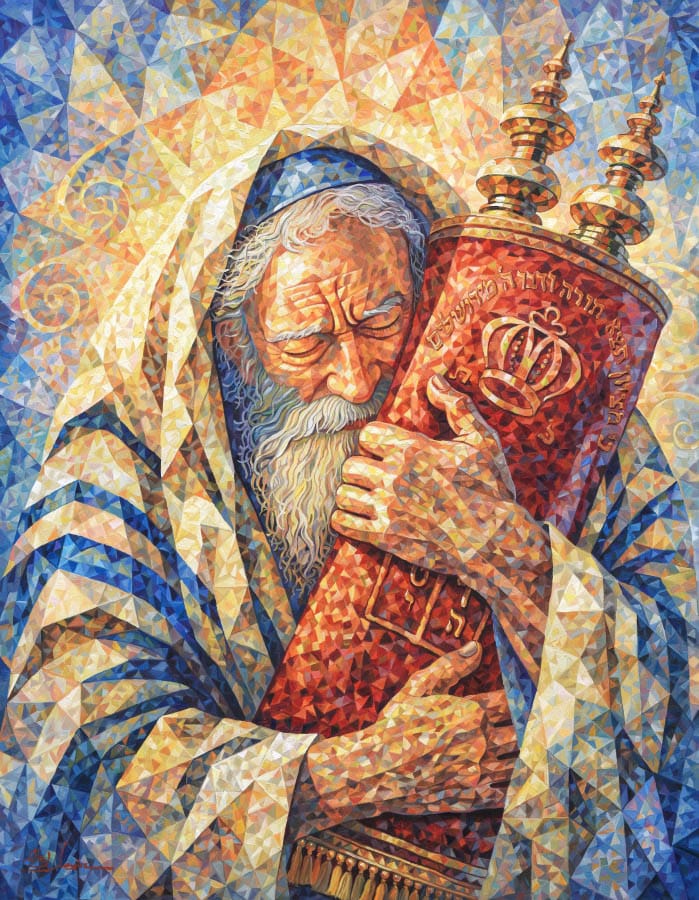
The Torah may become a source of light within the painting. Hebrew letters may merge with the composition. A person embracing a Torah scroll may represent not only a physical gesture, but the relationship between Jewish people, tradition, memory, and future generations.
This is especially effective in modern Judaica because the artist can use abstraction and color to communicate emotions that cannot always be expressed through realistic detail alone.
In Alex Levin’s Torah paintings, the scroll often becomes more than an object within the scene. It becomes the emotional center of the composition.
Shabbat Through a Contemporary Lens
Shabbat has long been represented through familiar images – candles, family gatherings, prayer, challah, and the Shabbat table.
Contemporary artists can preserve these recognizable elements while changing the visual approach.
Rather than documenting every detail of a room, a modern Shabbat painting may focus almost entirely on candlelight.
The glow can become symbolic – representing peace, holiness, family, tradition, and the transition from the ordinary week into Shabbat.
Color also gives contemporary artists greater freedom.
Deep blues, gold, red, violet, or abstract areas of light can create the emotional atmosphere of Shabbat without requiring a completely realistic scene.
Jewish Portraits in Contemporary Art
Portraiture is another area where traditional and contemporary Jewish art meet.
A portrait can document the appearance of an individual, but contemporary portraiture often tries to communicate something beyond physical likeness.
Expression, posture, color, background imagery, and symbolic elements can suggest wisdom, faith, personality, history, or spiritual presence.
Some contemporary Jewish portraits depict rabbis or recognizable Jewish figures.
Others portray ordinary men, women, or children whose appearance represents a broader Jewish experience.
This makes portraiture especially powerful because one face can suggest an entire story.
The Lubavitcher Rebbe in Contemporary Jewish Art
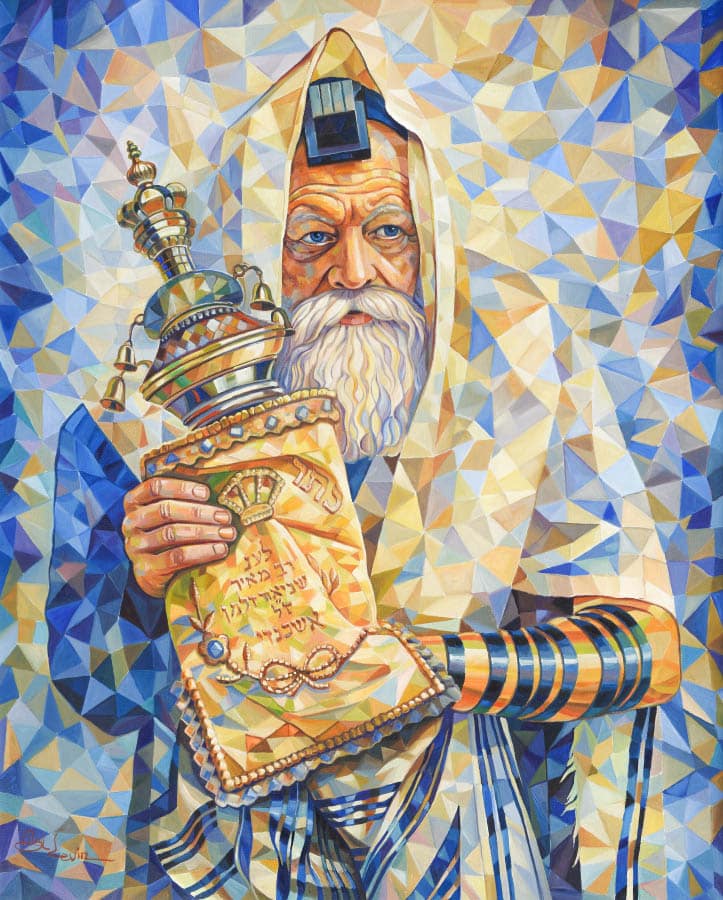
Rabbi Menachem Mendel Schneerson, known as the Lubavitcher Rebbe, has become an important subject in modern Jewish portraiture.
Many traditional portraits concentrate on creating a recognizable likeness.
Contemporary artists may approach the same subject differently.
Color, light, Torah imagery, Jerusalem, abstract forms, or symbolic backgrounds can become part of the portrait, allowing the artwork to communicate ideas associated with leadership, teaching, faith, and spiritual influence.
Alex Levin has created both traditional and contemporary interpretations of the Rebbe.
The contrast between those approaches demonstrates how the same subject can remain immediately recognizable while being expressed through very different artistic languages.
Explore Lubavitcher Rebbe Paintings

Color and Light in Modern Judaica
Color plays an especially important role in contemporary Jewish art.
A traditional painting may attempt to reproduce the colors found in a real scene.
A contemporary painting does not have that limitation.
Blue can suggest spirituality or distance.
Gold can suggest Jerusalem stone, light, sacred objects, or warmth.
Red can introduce energy and intensity.
White light can become a symbol of hope, faith, or revelation.
The artist is therefore able to use color not simply to describe what something looks like, but to communicate what the subject means.
Alex Levin frequently uses light in this way.
In his paintings, illumination can emerge from candles, Jerusalem, a Torah scroll, or even from within an abstract composition itself.
Jewish Symbols in Contemporary Art
Contemporary Judaica frequently incorporates symbols that immediately connect a modern composition to Jewish tradition.
These can include:
- Torah scrolls
- Hebrew letters
- Menorahs
- Jerusalem
- The Kotel
- Shabbat candles
- Jewish books and prayer
- Pomegranates
- Stars of David
- Biblical imagery
These elements do not always need to dominate the painting.
Sometimes a single recognizable symbol is enough to establish the Jewish character of an otherwise abstract work.
The relationship between recognizable symbolism and artistic freedom is one of the reasons contemporary Jewish art can take so many different forms.
Contemporary Jewish Art and Jewish Identity
Jewish identity is not expressed in only one way.
It can involve religion, family, history, Israel, memory, culture, community, language, and traditions passed between generations.
Contemporary Jewish art gives artists a way to explore all of these ideas without being restricted to historical styles.
A modern work may look very different from the Jewish paintings of previous generations, yet still examine the same questions:
What do we remember?
What do we preserve?
What do we pass on?
What connects one generation to another?
And how does an ancient tradition continue to exist in a modern world?
These questions make contemporary Jewish art about more than decoration or artistic style.
They make it part of an ongoing conversation about Jewish identity.
Alex Levin’s Approach to Contemporary Jewish Art
Alex Levin works across both traditional realism and contemporary art.
That range is important because it allows the same Jewish subjects to be interpreted in multiple ways.
One painting may carefully depict Jerusalem stone, a face, or a Torah scroll.
Another may use the same subject as the foundation for an expressive composition dominated by light, color, and symbolism.
Levin’s technique often begins with tempera underpainting followed by multiple layers of oil paint.
The layers allow him to develop depth and luminosity, qualities that appear throughout both his realistic and contemporary paintings.
Regardless of style, recurring themes remain visible throughout the work – Jerusalem, Jewish history, Torah, prayer, memory, tradition, and the connection between generations.
Explore Alex Levin’s Jewish Life Paintings
Contemporary Jewish Art in a Modern Home
One reason contemporary Judaica has become appealing to collectors is that Jewish subject matter does not have to require a traditional interior.
Abstract and contemporary Jewish paintings can work naturally with modern furniture, clean architecture, and minimalist spaces.
A colorful Jerusalem composition can become the focal point of a living room.
A contemporary Torah painting can bring Jewish meaning into a study or office without feeling overly formal.
A modern Rebbe portrait may combine recognizable Jewish imagery with a much more contemporary visual presence.
Presentation also matters.
Canvas provides the texture and appearance traditionally associated with fine art.
Metal can give contemporary artwork a clean, modern appearance.
Acrylic glass can emphasize color, contrast, and luminosity.
The artwork can therefore remain deeply connected to Jewish tradition while fitting comfortably within a twenty-first-century interior.
Traditional Jewish Art vs. Contemporary Jewish Art
Traditional and contemporary Jewish art should not necessarily be viewed as opposites.
Both can explore exactly the same subjects.
The difference is primarily in how the artist chooses to communicate them.
Traditional Jewish art often emphasizes recognizable scenes, figures, architecture, and historical detail.
Contemporary Jewish art may simplify those elements, rearrange them, exaggerate color, or use symbolism and abstraction.
Neither approach replaces the other.
In fact, viewing them together can make the subject more interesting.
A realistic Jerusalem painting shows how the city appears.
A contemporary Jerusalem painting may attempt to show how the city feels.
Explore Contemporary Jewish Art by Subject
- Contemporary Jewish Art
- Contemporary Jerusalem Paintings
- Torah Paintings
- Shabbat Paintings
- Jewish Portraits
- Lubavitcher Rebbe Paintings
- Jewish Life Paintings
Frequently Asked Questions About Contemporary Jewish Art
What is contemporary Jewish art?
Contemporary Jewish art is modern artwork inspired by Jewish religion, culture, history, identity, traditions, or symbols. It can include realistic, abstract, symbolic, and experimental styles.
What is contemporary Judaica?
Contemporary Judaica applies modern artistic styles to Jewish subjects and symbols. It may include Jerusalem, Torah, Shabbat, Hebrew letters, Jewish figures, biblical themes, and other elements of Jewish life.
Is contemporary Jewish art always abstract?
No.
Contemporary Jewish art can be completely abstract, partially abstract, or highly realistic. The term describes art created within a modern context rather than one particular visual style.
What is abstract Jewish art?
Abstract Jewish art uses color, shape, line, texture, and symbolic elements instead of relying entirely on realistic representation.
A viewer may still recognize Jewish subjects such as Jerusalem, Torah, Hebrew letters, or religious symbols within the composition.
Can traditional Jewish subjects be contemporary art?
Yes.
Torah, Shabbat, Jerusalem, biblical stories, rabbis, and Jewish traditions can all be interpreted through contemporary artistic techniques.
The subject can remain traditional while the style is modern.
Why is Jerusalem common in contemporary Jewish art?
Jerusalem carries historical, religious, and emotional meaning while also offering recognizable visual elements such as walls, gates, domes, towers, and Jerusalem stone.
Artists can transform these elements considerably while still preserving a clear connection to the city.
What contemporary Jewish art works well in a modern home?
Abstract Jerusalem art, contemporary Torah paintings, modern Jewish portraits, and colorful Judaica compositions can work especially well in contemporary interiors.
The best choice depends on the colors, scale, presentation, and personal meaning of the artwork.
What is the difference between Jewish art and Judaica?
Jewish art is a broad term for artwork connected to Jewish subjects, culture, history, or identity.
Judaica can refer both to Jewish artwork and to ceremonial or decorative objects connected to Jewish tradition. In contemporary art, the terms often overlap.