Jewish wedding traditions combine religious law, family customs, celebration, symbolism, and centuries of Jewish history.
From the chuppah and ketubah to the seven blessings, wedding procession, dancing, and breaking of the glass, each part of a Jewish wedding carries meaning that reaches far beyond the wedding day itself.
These traditions have also inspired generations of artists. Paintings of Jewish weddings can capture the excitement of the ceremony, the beauty of the chuppah, Jerusalem streets, musicians, family members, rabbis, and the joyful movement of a traditional celebration.
Israeli artist Alex Levin has returned to the Jewish wedding as a subject in several paintings, combining Jewish tradition with the architecture and atmosphere of Jerusalem.
What Is a Jewish Wedding?
A Jewish wedding is both a religious ceremony and the beginning of a legally and spiritually recognized marriage within Jewish tradition.
The Hebrew word often used for a wedding is chatunah or chasunah.
Although specific customs vary among Ashkenazi, Sephardic, Hasidic, Mizrahi, and other Jewish communities, several elements have become widely recognizable.
These may include:
- Kabbalat panim – receptions before the ceremony
- Badeken – veiling of the bride in some traditions
- The wedding procession
- Chuppah – the marriage canopy
- Kiddushin or erusin – betrothal
- The wedding ring
- Ketubah – Jewish marriage contract
- Sheva Brachot – Seven Blessings
- Breaking of the glass
- Yichud – a period of privacy for the couple
- The wedding feast and dancing
Not every Jewish community practices every custom in exactly the same way, but together these traditions create the distinctive structure of the Jewish wedding.
Ancient Jewish Wedding Traditions
It is important to be careful when discussing ancient Jewish wedding traditions because Jewish marriage practices changed over many centuries.
Biblical narratives describe marriages and family arrangements, but they do not provide one standardized wedding ceremony identical to modern Jewish weddings.
By the rabbinic and Talmudic periods, Jewish marriage had developed a more clearly defined legal structure involving kiddushin, or betrothal, followed later by nissuin, the completion of the marriage.
Historically, these could take place many months apart.
Today, the two stages are normally performed as part of the same wedding ceremony beneath the chuppah.
Betrothal in Ancient and Rabbinic Jewish Marriage
In rabbinic Jewish law, betrothal is known as kiddushin or erusin.
Kiddushin created a legally binding relationship between the couple even before the later marriage ceremony was completed.
In later Jewish practice, the traditional ring ceremony became the best-known form of kiddushin.
Today, the groom traditionally places a ring on the bride’s finger and recites the declaration:
Harei at mekudeshet li b’taba’at zo k’dat Moshe v’Yisrael – “Behold, you are consecrated to me with this ring according to the law of Moses and Israel.”
Practices vary among different Jewish movements and communities, but the ring remains one of the most recognizable symbols of the Jewish wedding.
What Is a Chuppah?
The chuppah is the canopy beneath which the Jewish wedding ceremony takes place.
Today it is one of the most immediately recognizable symbols of Jewish marriage.
The chuppah is commonly understood as representing the new home the couple will create together.
Its open sides can also suggest hospitality and openness to family, friends, and community.
Chuppahs can be extremely simple or elaborately decorated with fabric, flowers, embroidery, family heirlooms, or a tallit.
For artists, the chuppah creates a natural visual center for a wedding painting, with the bride and groom surrounded by family, guests, musicians, and architecture.
The Chuppah in Jewish Wedding Art
The chuppah is particularly powerful as an artistic subject because it immediately identifies the scene as a Jewish wedding.
In paintings, it can become a source of color and movement, especially when fabric shifts in the wind or when the ceremony takes place outdoors.
When the wedding is set in Jerusalem, the chuppah can be framed by Jerusalem stone, narrow streets, arches, balconies, or views of the Old City.
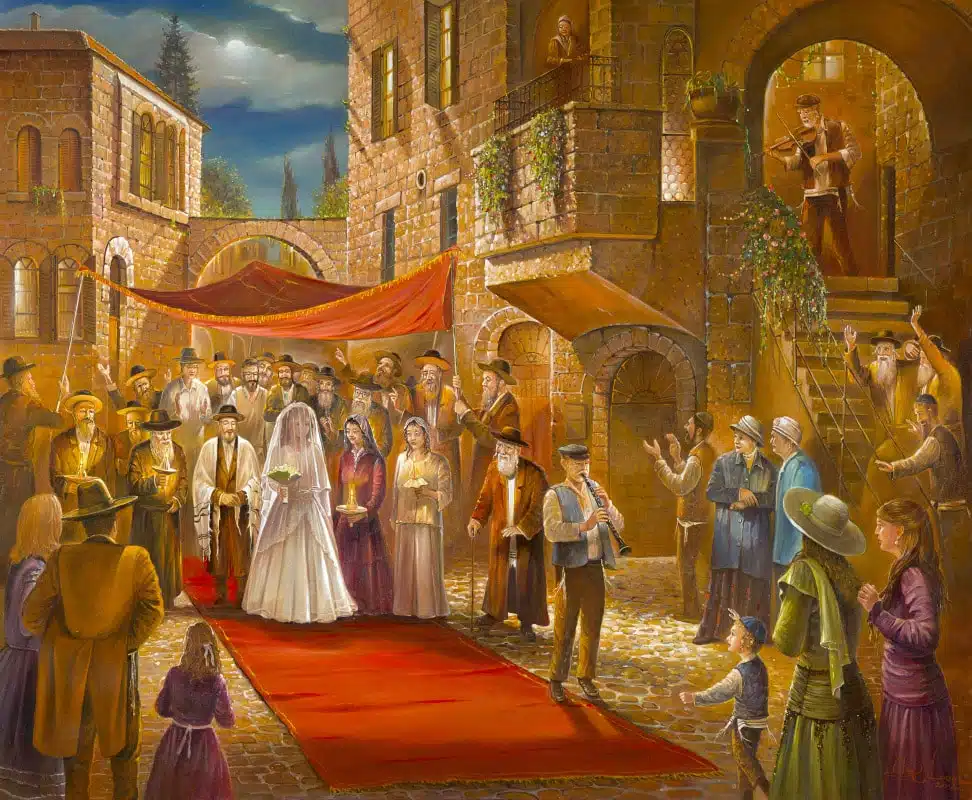
Alex Levin explores this combination of wedding tradition and Jerusalem architecture in works such as Chuppah in Jerusalem.
What Is the Ketubah?
The ketubah is the traditional Jewish marriage contract.
Its roots lie in Jewish law and the financial and marital obligations associated with marriage.
The ketubah became one of the most recognizable documents associated with Jewish weddings and is traditionally signed before the wedding ceremony.
Over the centuries, ketubot also became works of art.
Jewish communities in different parts of the world decorated marriage contracts with calligraphy, floral patterns, architectural imagery, biblical symbols, Jerusalem scenes, and other decorative elements.
As a result, the ketubah occupies a unique place where Jewish law, family history, calligraphy, and visual art meet.
Ketubah Art
Decorated ketubot are among the most personal forms of Judaica art.
Unlike a painting created for an anonymous audience, a ketubah is connected directly with a particular couple and wedding.
Historic ketubot from Italy, North Africa, the Middle East, Europe, and other Jewish communities demonstrate dramatically different artistic styles.
Modern ketubah artists continue this tradition using watercolor, papercutting, calligraphy, digital design, Hebrew lettering, Jerusalem imagery, and contemporary abstraction.
After the wedding, many couples frame and display the ketubah in their home.
The Seven Blessings – Sheva Brachot
The Sheva Brachot, or Seven Blessings, form an important part of a traditional Jewish wedding ceremony.
They are recited beneath the chuppah over a cup of wine.
The blessings connect the marriage of the individual couple with broader themes including creation, humanity, joy, Jerusalem, and the future happiness of the bride and groom.
The final blessings celebrate joy and companionship and refer to the sounds of happiness returning to the cities of Judah and the streets of Jerusalem.
This connection with Jerusalem makes the Seven Blessings especially meaningful when artists portray a Jewish wedding taking place within the Holy City.
Jerusalem and the Jewish Wedding
Jerusalem occupies a symbolic place even in Jewish weddings celebrated far from Israel.
The city appears in traditional wedding blessings, in the breaking of the glass, in music, and in the ancient Jewish hope for Jerusalem’s restoration.
Couples may also incorporate Jerusalem imagery into ketubot, wedding invitations, chuppah decorations, or gifts.
For couples who marry in Jerusalem itself, the city’s architecture and light become part of the visual memory of the event.
Explore Alex Levin’s collection of Jerusalem paintings.
Why Do Jews Break a Glass at a Wedding?
Breaking a glass is one of the best-known Jewish wedding customs.
The glass is traditionally broken near the conclusion of the ceremony, immediately before guests shout Mazal Tov!
Several explanations have been given for the custom.
One of the most familiar interpretations is that even during a moment of great personal joy, Jews remember the destruction of the Temple in Jerusalem.
The custom also reflects the broader Jewish idea that celebration should remain connected with historical memory and awareness of the world beyond ourselves.
The origins and explanations of the practice developed over time, so it is better understood as a tradition with several layers of meaning rather than one single explanation.
Mazal Tov and the Celebration
Immediately after the glass is broken, wedding guests traditionally call out Mazal Tov!
The phrase is commonly translated as congratulations or good fortune.
The mood then shifts rapidly from the solemn ceremony into celebration.
Music, dancing, food, family, and friends become central to the wedding feast.
For artists, this transition offers some of the most energetic Jewish wedding imagery – musicians playing, people dancing in circles, guests lifting the bride and groom, and crowds filling the scene with movement.
Jewish Wedding Dancing
Dancing is a central part of many Jewish wedding celebrations.
Traditional Jewish weddings frequently include circles of dancers moving around the bride and groom.
At Ashkenazi weddings, the couple may be lifted on chairs while guests dance around them.
Hasidic and Orthodox communities often separate men’s and women’s dancing according to their customs.
In art, Jewish wedding dancing creates opportunities for strong rhythm and movement. Raised arms, musicians, flowing clothing, crowded streets, and joyful expressions can transform a static canvas into something that seems almost musical.
Jewish Wedding Music
Music has accompanied Jewish weddings across many different Jewish cultures.
Eastern European Ashkenazi weddings became closely associated with klezmer musicians, while Sephardic and Mizrahi Jewish communities developed their own musical traditions.
The sounds, instruments, melodies, and dances differ from community to community.
In Jewish paintings, musicians often serve as symbols of celebration and communal life.
Violins, clarinets, drums, and other instruments can also evoke memories of Jewish towns and communities that existed before the Holocaust.
Jewish Weddings in the Shtetl
The Jewish wedding became a particularly important subject in artistic depictions of Eastern European shtetl life.
A wedding could involve not only two families but an entire community.
Artists may show the wedding procession moving through a village street, musicians accompanying the couple, children watching, rabbis standing beneath the chuppah, and neighbors joining the celebration.
After the destruction of so many Eastern European Jewish communities during the Holocaust, paintings of shtetl weddings acquired another meaning: they preserve visual memories of a vanished world.
Explore Alex Levin’s collection of shtetl paintings.
Jewish Wedding Processions
Processions have been associated with Jewish weddings in different communities and historical periods.
Family members and friends might accompany the bride or groom with music, song, candles, or other ceremonial elements.
In historical paintings, wedding processions allow the artist to move the celebration beyond the chuppah and into the surrounding street or town.
This makes the entire community part of the story.
Jerusalem’s narrow stone streets provide an especially dramatic background for this kind of scene.
Yichud After the Wedding Ceremony
In many traditional Jewish communities, the bride and groom spend a short period alone immediately after the wedding ceremony.
This is known as yichud, meaning seclusion.
After standing before family and community beneath the chuppah, the couple enters a private room together before joining the wedding celebration.
The contrast between the public ceremony and this private moment emphasizes that marriage is both a communal event and a deeply personal relationship.
Jewish Wedding Art Through History
Jewish weddings have appeared in manuscripts, ketubah decoration, prints, paintings, photography, and contemporary art.
Artists have been attracted to weddings because they bring together many visually powerful Jewish traditions in one event.
A single wedding scene can contain a chuppah, rabbi, Torah symbolism, musicians, traditional clothing, Jerusalem architecture, dancing, candles, family members, and Hebrew text.
At the same time, wedding artwork can preserve details of Jewish customs that differ between communities and historical periods.
Why Jewish Wedding Paintings Are Meaningful
A Jewish wedding painting can represent much more than a festive scene.
Marriage marks the creation of a new Jewish home and the continuation of family and community across generations.
This makes wedding art especially appropriate for a wedding gift, anniversary gift, or artwork displayed in a family home.
A painting can also connect a contemporary couple with Jewish weddings celebrated generations earlier.
Chuppah in Jerusalem by Alex Levin
Israeli artist Alex Levin has created several interpretations of Jewish weddings and chuppah ceremonies.
In Chuppah in Jerusalem, the wedding becomes part of the historic Jerusalem environment.
The chuppah stands among Jerusalem stone buildings while relatives, community members, musicians, and guests surround the bride and groom.
The scene combines several themes that recur throughout Levin’s work – Jewish tradition, family, Jerusalem architecture, history, and the continuity of Jewish life.
Another Jerusalem wedding painting presents the ceremony from a different perspective, again placing the Jewish wedding within the visual atmosphere of the Holy City.
Jewish Wedding Paintings by Alex Levin
Alex Levin’s wedding artwork ranges from traditional Jerusalem scenes to contemporary interpretations of the chuppah ceremony.
These works are part of his broader exploration of Jewish family life, holidays, prayer, Torah study, celebrations, and traditions passed from one generation to another.
Explore Jewish Life Paintings by Alex Levin
You can also explore his collection of Jerusalem paintings and contemporary Jewish art.
Frequently Asked Questions About Jewish Wedding Traditions
What are the main Jewish wedding traditions?
Common traditions include the chuppah, kiddushin or betrothal, exchange of a ring, reading of the ketubah, Seven Blessings, breaking of the glass, yichud, wedding feast, music, and dancing. Customs vary among Jewish communities.
What is a chuppah?
A chuppah is the canopy beneath which a Jewish wedding ceremony takes place. It is commonly understood as symbolizing the new home the couple will create together.
What is a ketubah?
A ketubah is the traditional Jewish marriage contract. Historically it records important marital obligations, while decorated ketubot have also become an important form of Jewish ceremonial art.
What are the Seven Blessings at a Jewish wedding?
The Sheva Brachot are seven traditional wedding blessings recited beneath the chuppah. They connect the couple’s marriage with creation, joy, community, Jerusalem, and the future happiness of the bride and groom.
Why do Jews break a glass at weddings?
One widely recognized explanation is that the custom recalls the destruction of the Jerusalem Temple even during moments of great personal joy. The custom has accumulated several interpretations over the centuries.
Were ancient Jewish weddings the same as Jewish weddings today?
No. Jewish marriage customs developed over centuries. In rabbinic times, betrothal and the completion of marriage were often separated by a significant period, while today the stages are generally combined into one wedding ceremony beneath the chuppah.
What did ancient Jewish wedding celebrations include?
Practices varied by period and community. Rabbinic sources describe betrothal, marriage celebrations, wedding processions, blessings, festive meals, and communal participation. Modern customs developed from these older traditions over many centuries.
What is yichud?
Yichud is the period of seclusion traditionally observed by the bride and groom after the wedding ceremony in many Orthodox and traditional Jewish communities.
What does Mazal Tov mean at a Jewish wedding?
Mazal Tov is the traditional expression of congratulations and good wishes. Guests commonly shout it immediately after the glass is broken at the conclusion of the wedding ceremony.
Where can I find Jewish wedding paintings?
ArtLevin.com features Jewish wedding and chuppah paintings by Israeli artist Alex Levin as part of his larger collection of Jewish Life and Jerusalem artwork.