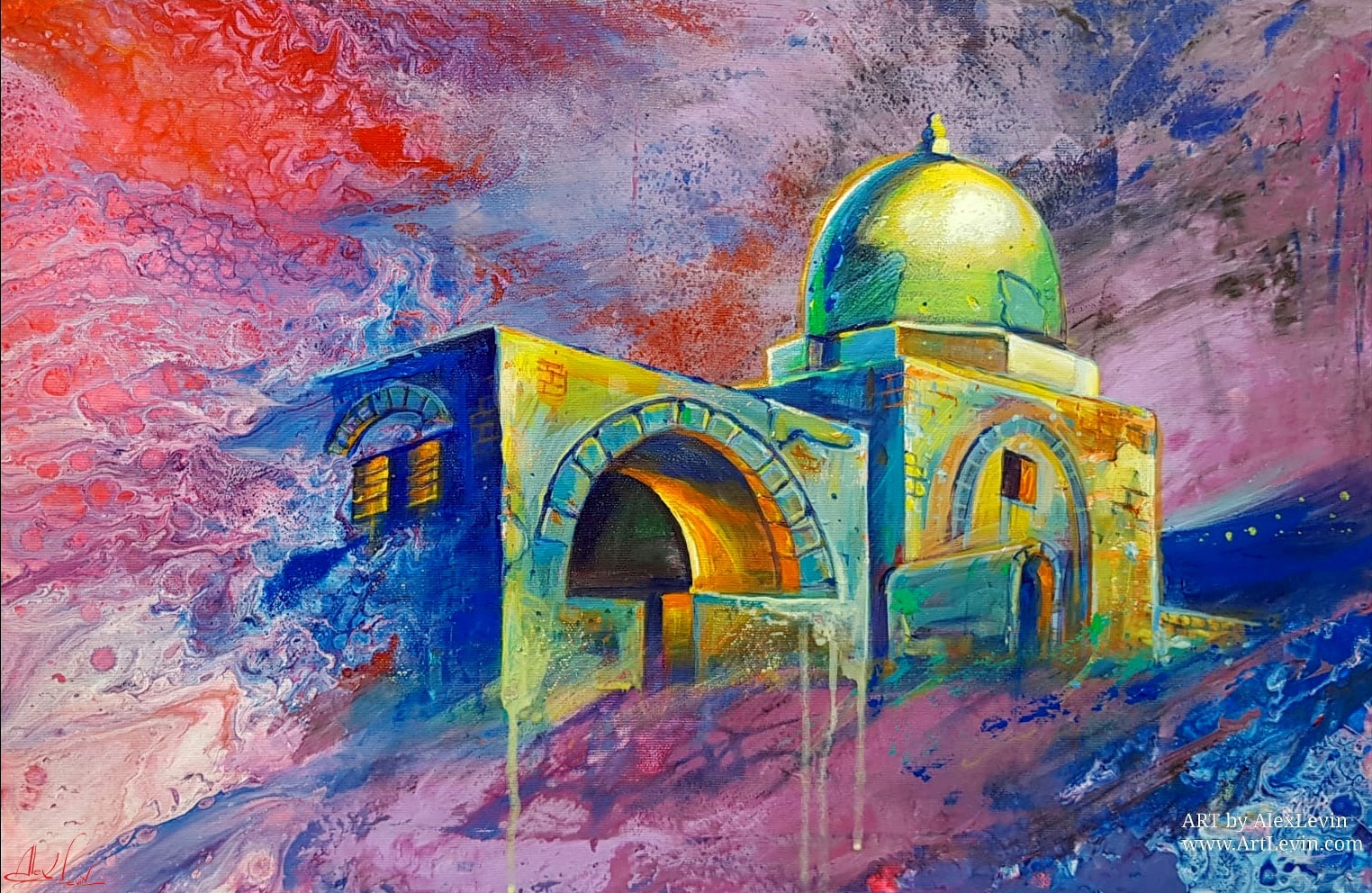
Kever Rachel, or Rachel’s Tomb, is one of the most recognized and emotionally significant Jewish holy sites in the Land of Israel.
According to biblical tradition, Rachel – one of the four Jewish matriarchs, wife of Jacob, and mother of Joseph and Benjamin – died while traveling and was buried on the road to Ephrath, identified in the biblical text with Bethlehem.
For generations, Jews have come to the traditional site of Rachel’s Tomb to pray for family, children, health, protection, and hope during difficult times.
The small domed building that became an iconic image of Kever Rachel has also inspired paintings, photographs, Judaica, and Jewish art for generations.
Who Was Rachel the Matriarch?
Rachel – Rachel Imeinu, “our mother Rachel” – is one of the four matriarchs of the Jewish people together with Sarah, Rebecca, and Leah.
According to the Book of Genesis, Rachel was the daughter of Laban and the beloved wife of Jacob.
Jacob first met Rachel beside a well after traveling to the home of his relatives. He agreed to work for her father, Laban, for seven years in order to marry her.
Rachel eventually became the mother of two of Jacob’s sons: Joseph and Benjamin.
Her life and death became deeply connected with Jewish ideas of motherhood, sacrifice, compassion, exile, prayer, and the hope that Jewish children will ultimately return home.
Where Is Kever Rachel?
The traditional site known as Kever Rachel is located near the northern entrance of Bethlehem, south of Jerusalem, along the historic Jerusalem-Hebron road.
The biblical account in Genesis says that Rachel died and was buried “on the road to Ephrath – that is Bethlehem.”
Jacob then erected a monument over her grave.
The site traditionally identified as Rachel’s Tomb has been associated with her burial place for many centuries and became an important destination for Jewish prayer and pilgrimage.
Scholars have debated the precise archaeological location of Rachel’s biblical burial place, so it is most accurate to describe the current Kever Rachel as the traditional site of Rachel’s Tomb.
What Does Kever Rachel Mean?
The Hebrew phrase Kever Rachel – קבר רחל literally means “Rachel’s grave” or “Rachel’s tomb.”
The word kever means grave or tomb, while Rachel refers to the biblical matriarch.
A common Ashkenazi/Yiddish-influenced pronunciation is Kever Rochel, which is why both spellings frequently appear in English.
Other spellings include Kever Rahel and Rachel’s Tomb.
The Biblical Story of Rachel’s Death
Rachel’s death is described in Genesis 35.
Jacob and his family were traveling when Rachel went into difficult labor while giving birth to her second son.
Before dying, Rachel named the child Ben-Oni. Jacob later called him Benjamin.
Genesis then states that Rachel was buried on the road to Ephrath, identified with Bethlehem, and that Jacob erected a pillar over her grave.
Unlike Sarah, Rebecca, Leah, Jacob, Abraham, and Isaac, Rachel was not traditionally buried in the Cave of the Patriarchs in Hebron.
Her separate roadside burial later acquired profound symbolic meaning in Jewish tradition.
Why Was Rachel Buried on the Road?
Jewish tradition offers a spiritual explanation for Rachel’s unusual burial place.
According to Midrashic tradition, Jacob foresaw that generations later Jewish exiles would pass near Rachel’s grave after the destruction of Jerusalem.
Rachel would then serve symbolically as a mother waiting beside the road for her children, praying for them and pleading for their eventual return.
This tradition transformed Rachel from a biblical matriarch into one of Judaism’s most powerful symbols of maternal compassion.
The idea of Rachel waiting for her children also connects directly with the famous words of the prophet Jeremiah.
Rachel Weeping for Her Children
One of the most moving biblical passages associated with Rachel appears in Jeremiah 31.
The prophet describes Rachel weeping for her children and refusing to be comforted because they are gone.
The passage then continues with a message of hope: her tears will ultimately be rewarded and her children will return.
For generations, these verses have shaped Jewish understanding of Rachel as the symbolic mother of Jewish children in exile.
Because of this association, Kever Rachel became a place where people pray not only for themselves but also for their families and the Jewish people as a whole.
Why Do Jews Pray at Kever Rachel?
Jews visit Kever Rachel to pray for many different reasons.
Visitors may pray for:
- Children and fertility
- Health and healing
- Marriage
- Family difficulties
- Protection
- Peace
- Personal challenges
- The welfare of the Jewish people
The prayers are directed to God, while Rachel is remembered as a matriarch whose compassion and prayers for her descendants occupy a special place in Jewish tradition.
Many visitors recite Psalms, personal prayers, or passages associated with Rachel.
Kever Rachel and Prayer for Children
Rachel’s own struggle to have children gives Kever Rachel particular meaning for people praying for fertility and family.
Genesis describes Rachel’s deep desire to become a mother before the birth of Joseph.
Her later death during the birth of Benjamin adds another emotional dimension to her story.
Over generations, women and families seeking children have therefore felt a special connection with Rachel Imeinu.
Kever Rachel remains closely associated with prayers concerning motherhood, children, and family well-being.
Rachel’s Yahrzeit – 11 Cheshvan
Jewish tradition observes the 11th day of the Hebrew month of Cheshvan as the anniversary of Rachel Imeinu’s passing.
On this date, especially large numbers of worshippers traditionally visit Kever Rachel to pray.
Those unable to visit may commemorate Rachel by studying Torah, reciting Psalms, giving charity, or reflecting on the qualities traditionally associated with her life.
The date has become an important annual expression of the continuing connection between Rachel and generations of Jewish families.
The History of Rachel’s Tomb
The site traditionally identified as Rachel’s Tomb has been known to pilgrims for many centuries.
Early Jewish, Christian, and Muslim travelers all recorded traditions connected with Rachel’s burial place.
The appearance of the structure changed repeatedly over time.
Historical descriptions mention a small domed structure supported by arches or columns. Later generations enclosed and altered the building.
The familiar white-domed image that became widely reproduced in Jewish art is largely associated with the site’s appearance during the 19th and early 20th centuries.
Sir Moses Montefiore and Kever Rachel
British Jewish philanthropist Sir Moses Montefiore played an important role in the 19th-century history of Rachel’s Tomb.
In 1841, Montefiore arranged renovations and added an enclosed antechamber to the existing structure.
This expanded building became the image of Kever Rachel familiar from countless photographs, postcards, prints, paintings, and pieces of Judaica.
Montefiore was deeply involved in Jewish charitable and communal projects throughout the Land of Israel, and his work at Kever Rachel became another part of that legacy.
Why Does Kever Rachel Look Different Today?
Older photographs and paintings of Rachel’s Tomb usually show a small white-domed building standing relatively openly beside the road.
Today, the historic structure is enclosed within a much larger protective complex.
The surrounding area changed considerably during the late 20th and early 21st centuries because of population growth, political conflict, and security concerns.
As a result, a visitor today does not encounter the same open landscape familiar from historic photographs and paintings.
This is one reason older artistic depictions of Kever Rachel have become especially meaningful: they preserve the appearance of the site before the modern protective structures surrounded it.
Kever Rachel in Historic Jewish Art
Rachel’s Tomb became a familiar subject in Jewish visual culture long before modern photography.
Its distinctive domed structure appeared on prints, postcards, decorative objects, charity boxes, wall art, and illustrations of the Holy Land.
For Jewish families living far from Israel, images of Kever Rachel could symbolize both the biblical past and a continuing spiritual connection with the Land of Israel.
The building’s simple architecture also made it immediately recognizable.
Unlike a large cityscape, one small white dome could instantly evoke Rachel Imeinu, prayer, Bethlehem, and Jewish history.
Kever Rachel in Contemporary Jewish Art
Contemporary Jewish artists continue to interpret Rachel’s Tomb in both traditional and modern ways.
Some paintings recreate its historic appearance with the domed structure standing beside an open road.
Others use abstraction, dramatic light, symbolic figures, Hebrew letters, or modern colors to explore Rachel’s emotional meaning rather than simply documenting the building.
Recurring themes include motherhood, prayer, hope, exile, return, protection, and the relationship between past and present.
Kever Rachel Paintings by Alex Levin
Israeli artist Alex Levin has created an extensive series of paintings inspired by Rachel Imeinu and Kever Rachel.
Some portray the historic domed structure realistically, preserving the familiar appearance of Rachel’s Tomb from earlier generations.
Other works interpret the subject symbolically through contemporary color, light, figures, and imagery connected with prayer and Jewish history.
Explore Kever Rachel Paintings by Alex Levin
The collection currently includes traditional and contemporary interpretations of Rachel’s Tomb and Rachel Imeinu.
Rachel’s Tomb – Kever Rachel Painting
One of Alex Levin’s traditional interpretations is Rachel’s Tomb – Kever Rachel.
The painting recalls the historic appearance of the site before the modern protective complex was constructed around it.
This type of image has particular nostalgic power because generations of Jewish families recognize the small white-domed building as the traditional image of Kever Rachel.
Journey to Pray With Rachel
Another work, Journey to Pray With Rachel – Rachel’s Tomb, focuses on the pilgrimage to Kever Rachel rather than only the building itself.
The idea of traveling to Rachel’s Tomb has been part of Jewish devotional life for centuries.
By including people approaching the site, the artwork emphasizes that Kever Rachel is not merely an archaeological or architectural landmark. It is a living place of prayer.
The Sound of the Shofar at Kever Rachel
Alex Levin’s Sounds of Shofar at Kever Rachel connects Rachel’s Tomb with another powerful Jewish symbol – the shofar.
The historic setting, prayer, and sound of the shofar combine to create an image centered on spiritual memory and hope.
The painting also reflects Levin’s interest in portraying Jewish sacred sites not simply as architecture but as places where Jewish life takes place.
Modern and Abstract Kever Rachel Art
Rachel’s Tomb can also be interpreted through contemporary Jewish art.
In works such as Kever Rachel – In Need for Divine Intervention, the traditional subject is transformed through modern composition and symbolic color.
Rather than attempting to reproduce the historical site exactly, contemporary artwork can emphasize prayer, emotion, national memory, and spiritual connection.
This allows an ancient biblical story and centuries-old pilgrimage tradition to speak through a modern artistic language.
Why Kever Rachel Art Is Meaningful in a Jewish Home
A painting of Kever Rachel may carry very different meanings for different families.
For some, it represents Rachel Imeinu and motherhood.
For others, it symbolizes prayer for children, connection with Israel, family heritage, hope during difficult times, or memories of visiting the site.
Kever Rachel artwork can therefore be especially meaningful as a Jewish wedding gift, housewarming gift, family gift, or piece of Judaica displayed in a home.
It may also appeal to collectors interested in historical images of the Land of Israel and traditional Jewish holy sites.
Frequently Asked Questions About Kever Rachel
What is Kever Rachel?
Kever Rachel is the Hebrew name for Rachel’s Tomb, the traditional burial place of the biblical matriarch Rachel, wife of Jacob and mother of Joseph and Benjamin.
Where is Kever Rachel located?
The traditional site of Rachel’s Tomb is located near the northern entrance to Bethlehem, south of Jerusalem, along the historic Jerusalem-Hebron road.
Is Kever Rachel in Hebron?
No. Kever Rachel is traditionally identified near Bethlehem. Hebron is farther south and is home to the Cave of the Patriarchs, where Abraham, Sarah, Isaac, Rebecca, Jacob, and Leah are traditionally buried.
Why was Rachel not buried in Hebron?
Genesis states that Rachel died during the journey and was buried on the road to Ephrath, identified with Bethlehem. Jewish tradition later gave additional spiritual meaning to her roadside burial, describing Rachel as waiting there to pray for her descendants during exile.
What does Kever Rachel mean?
Kever Rachel means “Rachel’s Tomb” or “Rachel’s Grave” in Hebrew. The spelling Kever Rochel reflects a common Ashkenazi pronunciation.
Why do people pray at Kever Rachel?
Jewish visitors pray at Kever Rachel for many reasons, including children, marriage, health, family, protection, peace, and personal needs. Rachel Imeinu is traditionally associated with maternal compassion and prayer for the Jewish people.
When is Rachel Imeinu’s yahrzeit?
Jewish tradition marks Rachel Imeinu’s yahrzeit on the 11th of Cheshvan. Large numbers of worshippers traditionally visit Kever Rachel around this date.
Is the present building the original biblical tomb?
The existing structure is much later than the biblical period. The site is traditionally identified as Rachel’s burial place, while scholars have debated the precise historical location of the biblical grave.
Why do old paintings of Kever Rachel look different from the site today?
Older paintings usually portray the small domed building before it was surrounded by the modern protective complex. The historic structure still exists within today’s larger secured site.
Where can I find paintings of Kever Rachel?
Alex Levin has created traditional, historical, and contemporary interpretations of Rachel’s Tomb. They can be viewed in the Kever Rachel Paintings collection.